Bovin Michelle J, Wolf Erika J, Resick Patricia A
VA National Center for PTSD, Boston, MA, USA; Boston University School of Medicine, Boston, MA, USA.
Duke University Medical Center , Durham, NC , USA.
Front Psychiatry. 2017 Feb 2;8:6. doi: 10.3389/fpsyt.2017.00006. eCollection 2017.
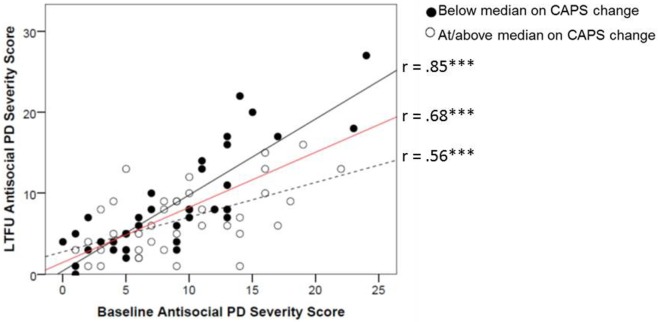
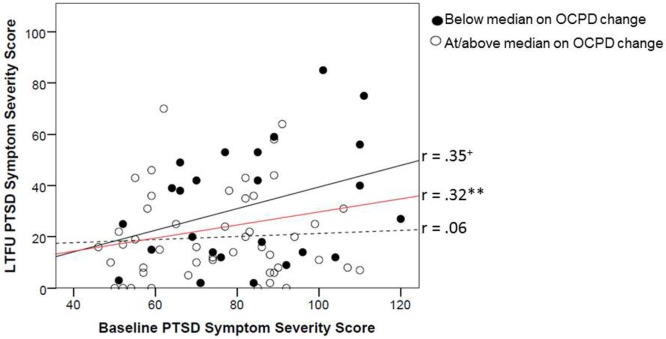
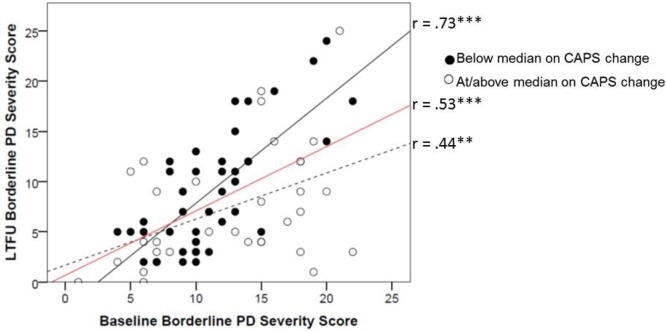
This study evaluated how change in posttraumatic stress disorder (PTSD) symptoms was associated with residualized change in comorbid personality disorder (PD) features and over the course of 5-10 years. The sample was comprised of 79 female rape survivors who met criteria for PTSD and who were a part of a larger study examining the effects of trauma-focused therapy. PTSD was assessed with the fourth edition of the (DSM-IV) version of the Clinician-Administered PTSD Scale [CAPS-IV (1)] and PD features were assessed with the DSM-IV dimensional PD scales on the Schedule for Non-adaptive and Adaptive Personality [SNAP (2)]. PTSD symptom severity and PD features were assessed at baseline and between 5 and 10 years after completing treatment. Multiple regression analyses revealed that PTSD symptom change was related to residualized change in PD severity for paranoid, schizotypal, antisocial, borderline, avoidant, and dependent PD (βs ranged from -0.23 to -0.33; all s < 0.05). In addition, for borderline and antisocial PDs, longitudinal stability of the PD was attenuated among those with greater PTSD symptom improvement (i.e., the relationship between these PDs over time was altered as a function of PTSD symptom change; βs ranged from -0.27 to -0.29; all s < 0.05). Similarly, change in severity of paranoid, schizotypal, antisocial, avoidant, and obsessive-compulsive (OC) PD was associated with residualized change in PTSD symptoms (βs ranged from -0.32 to -0.41; all s < 0.05), and the longitudinal stability of PTSD was attenuated as a product of change in OC PD (β = -0.27; < 0.02). These findings suggest that these two sets of disorders may impact one another substantially, altering the course of even chronic, characterological conditions. This carries important clinical implications for the treatment of both PTSD and PDs.
本研究评估了创伤后应激障碍(PTSD)症状的变化如何与共病的人格障碍(PD)特征的残余变化相关,以及在5至10年的时间里二者的关系。样本包括79名符合PTSD标准的女性强奸幸存者,她们是一项关于创伤聚焦疗法效果的更大规模研究的一部分。使用临床医生管理的PTSD量表第四版(DSM-IV)版本[CAPS-IV(1)]评估PTSD,使用非适应性和适应性人格量表[SNAP(2)]上的DSM-IV维度PD量表评估PD特征。在基线时以及完成治疗后5至10年之间评估PTSD症状严重程度和PD特征。多元回归分析显示,PTSD症状变化与偏执型、分裂样、反社会型、边缘型、回避型和依赖型PD的PD严重程度的残余变化相关(β值范围为-0.23至-0.33;所有p值<0.05)。此外,对于边缘型和反社会型PD,在PTSD症状改善较大的患者中,PD的纵向稳定性减弱(即,随着PTSD症状变化,这些PD随时间的关系发生改变;β值范围为-0.27至-0.29;所有p值<0.05)。同样,偏执型、分裂样、反社会型、回避型和强迫型(OC)PD严重程度的变化与PTSD症状的残余变化相关(β值范围为-0.32至-0.41;所有p值<0.05),并且作为OC PD变化的结果,PTSD的纵向稳定性减弱(β=-0.27;p<0.02)。这些发现表明,这两组障碍可能会对彼此产生重大影响,甚至改变慢性性格状况的病程。这对PTSD和PD的治疗具有重要的临床意义。