Morales Susana, Barros Jorge, Echávarri Orietta, García Fabián, Osses Alex, Moya Claudia, Maino María Paz, Fischman Ronit, Núñez Catalina, Szmulewicz Tita, Tomicic Alemka
Facultad de Medicina, Departamento de Psiquiatría, Depression and Suicidality Research Group, Pontificia Universidad Católica de Chile, Santiago, Chile; Millennium Institute for Research in Depression and Personality (MIDAP), Depression and Suicidality Research Group, Santiago, Chile.
Facultad de Medicina, Departamento de Psiquiatría, Depression and Suicidality Research Group, Pontificia Universidad Católica de Chile , Santiago , Chile.
Front Psychiatry. 2017 Feb 2;8:7. doi: 10.3389/fpsyt.2017.00007. eCollection 2017.
In efforts to develop reliable methods to detect the likelihood of impending suicidal behaviors, we have proposed the following.
To gain a deeper understanding of the state of suicide risk by determining the combination of variables that distinguishes between groups with and without suicide risk.
A study involving 707 patients consulting for mental health issues in three health centers in Greater Santiago, Chile. Using 345 variables, an analysis was carried out with artificial intelligence tools, Cross Industry Standard Process for Data Mining processes, and decision tree techniques. The basic algorithm was top-down, and the most suitable division produced by the tree was selected by using the lowest Gini index as a criterion and by looping it until the condition of belonging to the group with suicidal behavior was fulfilled.
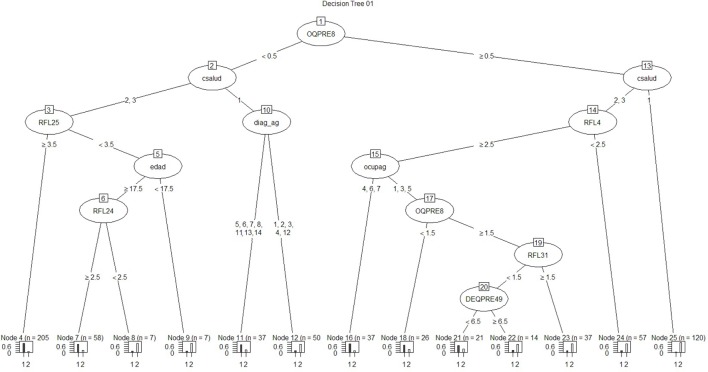
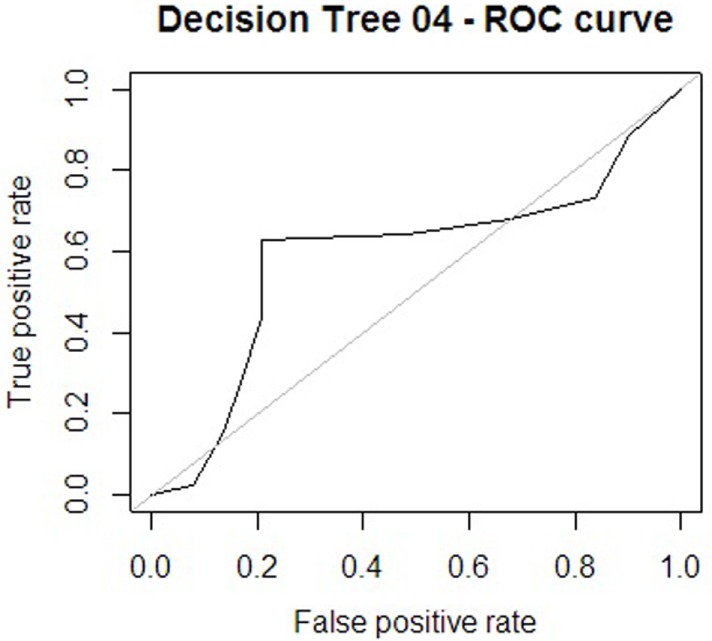
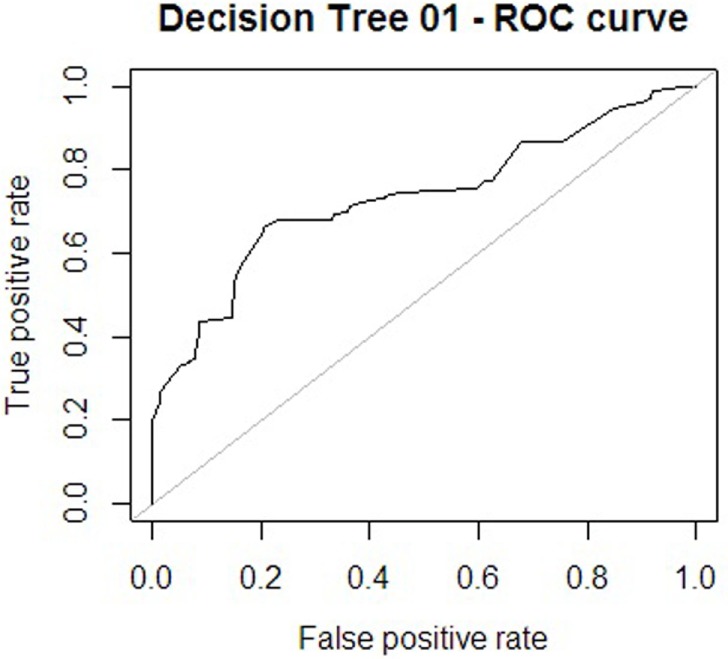
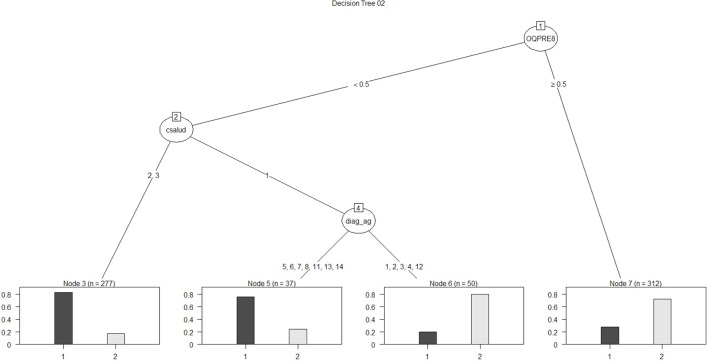
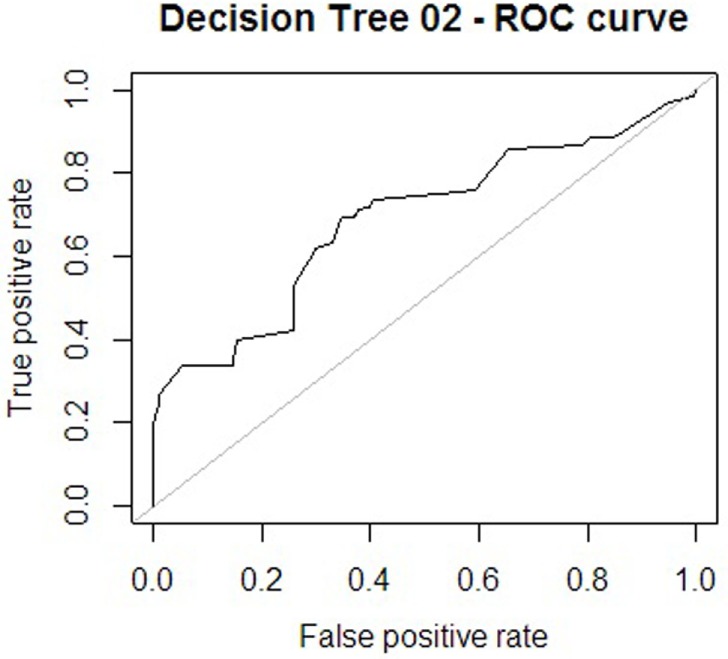
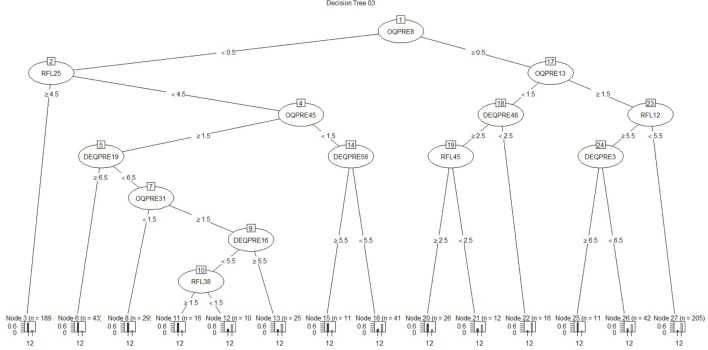
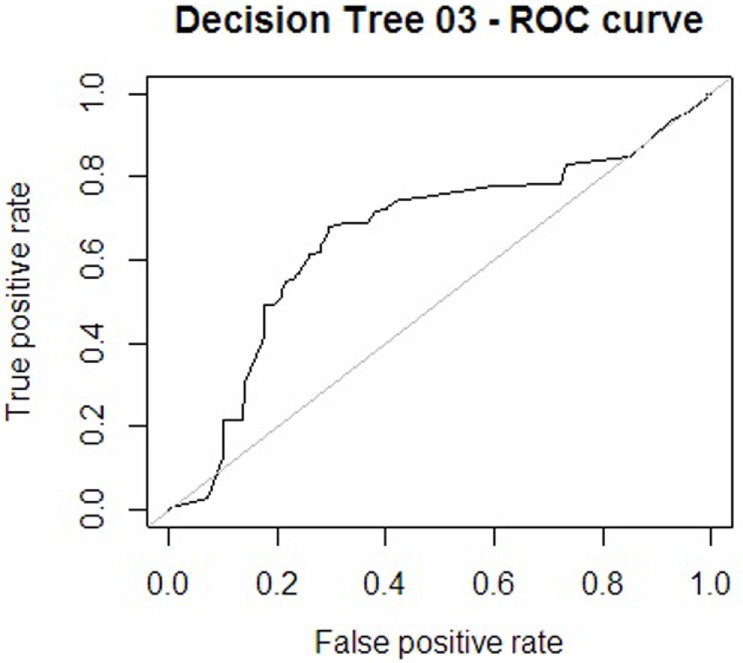
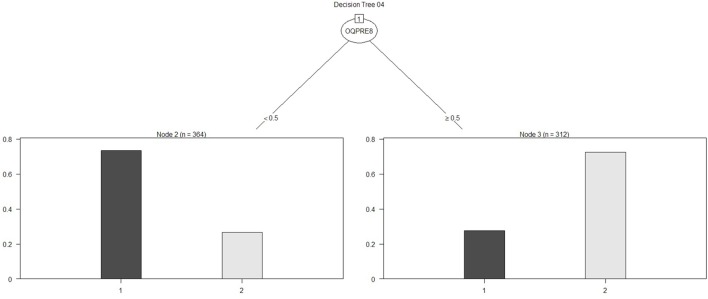
Four trees distinguishing the groups were obtained, of which the elements of one were analyzed in greater detail, since this tree included both clinical and personality variables. This specific tree consists of six nodes without suicide risk and eight nodes with suicide risk (tree decision 01, accuracy 0.674, precision 0.652, recall 0.678, specificity 0.670, measure 0.665, receiver operating characteristic (ROC) area under the curve (AUC) 73.35%; tree decision 02, accuracy 0.669, precision 0.642, recall 0.694, specificity 0.647, measure 0.667, ROC AUC 68.91%; tree decision 03, accuracy 0.681, precision 0.675, recall 0.638, specificity 0.721, measure, 0.656, ROC AUC 65.86%; tree decision 04, accuracy 0.714, precision 0.734, recall 0.628, specificity 0.792, measure 0.677, ROC AUC 58.85%).
This study defines the interactions among a group of variables associated with suicidal ideation and behavior. By using these variables, it may be possible to create a quick and easy-to-use tool. As such, psychotherapeutic interventions could be designed to mitigate the impact of these variables on the emotional state of individuals, thereby reducing eventual risk of suicide. Such interventions may reinforce psychological well-being, feelings of self-worth, and reasons for living, for each individual in certain groups of patients.
为努力开发可靠方法以检测即将发生自杀行为的可能性,我们提出以下内容。
通过确定区分有自杀风险和无自杀风险群体的变量组合,更深入地了解自杀风险状况。
一项涉及智利大圣地亚哥三个健康中心707名因心理健康问题前来咨询的患者的研究。使用345个变量,借助人工智能工具、跨行业数据挖掘标准流程和决策树技术进行分析。基本算法是自上而下的,通过使用最低基尼指数作为标准并循环该过程,直到满足属于有自杀行为群体的条件,从而选择树产生的最合适划分。
获得了区分不同群体的四棵树,其中对其中一棵的元素进行了更详细分析,因为这棵树包含临床和个性变量。这棵特定的树由六个无自杀风险节点和八个有自杀风险节点组成(决策树01,准确率0.674,精确率0.652,召回率0.678,特异性0.670,度量0.665,曲线下面积(AUC)为73.35%;决策树02,准确率0.669,精确率0.642,召回率0.694,特异性0.647,度量0.667,ROC AUC为68.91%;决策树03,准确率0.681,精确率0.675,召回率0.638,特异性0.721,度量0.656,ROC AUC为65.86%;决策树04,准确率0.714,精确率0.734,召回率0.628,特异性0.792,度量0.677,ROC AUC为58.85%)。
本研究定义了一组与自杀意念和行为相关变量之间的相互作用。通过使用这些变量,有可能创建一个快速且易于使用的工具。因此,可以设计心理治疗干预措施来减轻这些变量对个体情绪状态的影响,从而降低最终的自杀风险。此类干预措施可能会增强特定患者群体中每个个体的心理健康、自我价值感和生存理由。