School of Mathematical and Statistical Sciences, University of Texas Rio Grande Valley, Edinburgh, TX, United States.
Virtual Hearing Lab, Beaumont, TX, United States.
J Med Internet Res. 2021 Nov 2;23(11):e28999. doi: 10.2196/28999.
There is huge variability in the way that individuals with tinnitus respond to interventions. These experiential variations, together with a range of associated etiologies, contribute to tinnitus being a highly heterogeneous condition. Despite this heterogeneity, a "one size fits all" approach is taken when making management recommendations. Although there are various management approaches, not all are equally effective. Psychological approaches such as cognitive behavioral therapy have the most evidence base. Managing tinnitus is challenging due to the significant variations in tinnitus experiences and treatment successes. Tailored interventions based on individual tinnitus profiles may improve outcomes. Predictive models of treatment success are, however, lacking.
This study aimed to use exploratory data mining techniques (ie, decision tree models) to identify the variables associated with the treatment success of internet-based cognitive behavioral therapy (ICBT) for tinnitus.
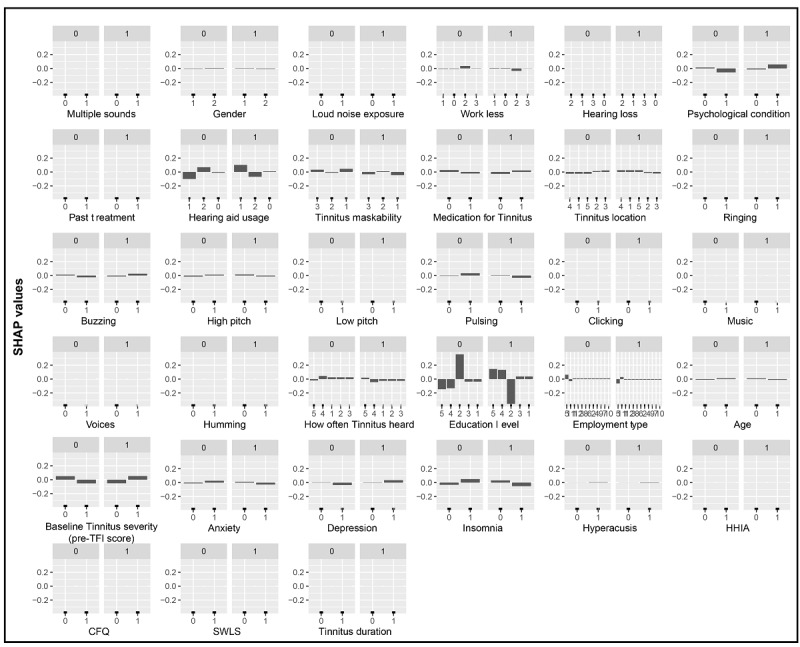
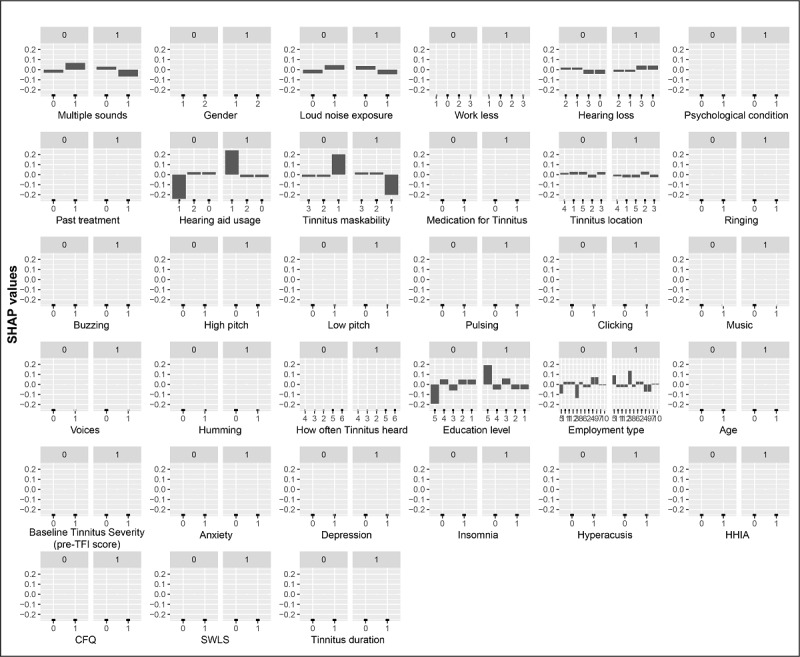
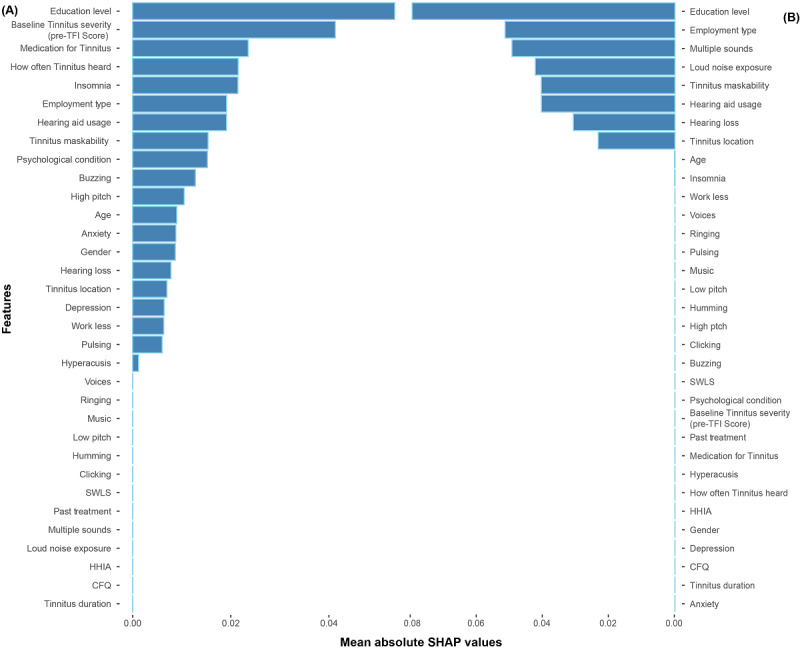
Individuals (N=228) who underwent ICBT in 3 separate clinical trials were included in this analysis. The primary outcome variable was a reduction of 13 points in tinnitus severity, which was measured by using the Tinnitus Functional Index following the intervention. The predictor variables included demographic characteristics, tinnitus and hearing-related variables, and clinical factors (ie, anxiety, depression, insomnia, hyperacusis, hearing disability, cognitive function, and life satisfaction). Analyses were undertaken by using various exploratory machine learning algorithms to identify the most influencing variables. In total, 6 decision tree models were implemented, namely the classification and regression tree (CART), C5.0, GB, XGBoost, AdaBoost algorithm and random forest models. The Shapley additive explanations framework was applied to the two optimal decision tree models to determine relative predictor importance.
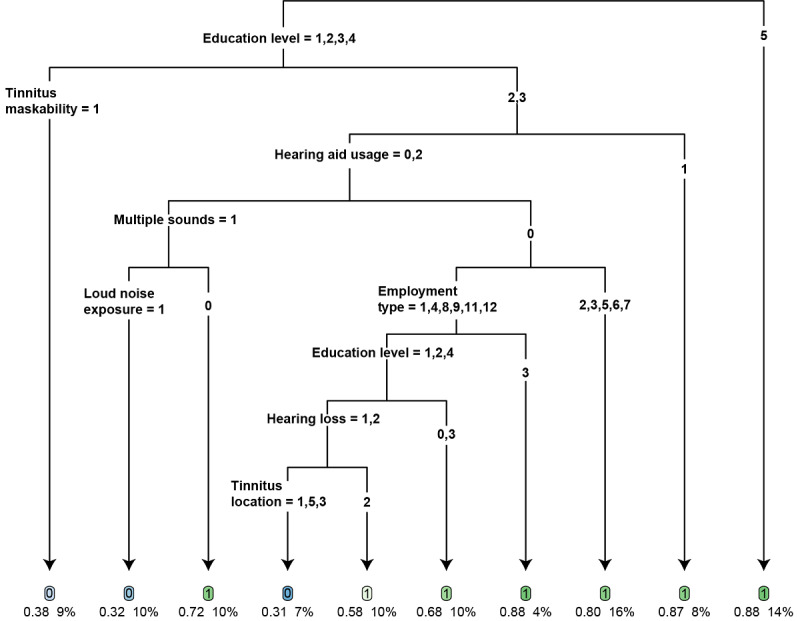
Among the six decision tree models, the CART (accuracy: mean 70.7%, SD 2.4%; sensitivity: mean 74%, SD 5.5%; specificity: mean 64%, SD 3.7%; area under the receiver operating characteristic curve [AUC]: mean 0.69, SD 0.001) and gradient boosting (accuracy: mean 71.8%, SD 1.5%; sensitivity: mean 78.3%, SD 2.8%; specificity: 58.7%, SD 4.2%; AUC: mean 0.68, SD 0.02) models were found to be the best predictive models. Although the other models had acceptable accuracy (range 56.3%-66.7%) and sensitivity (range 68.6%-77.9%), they all had relatively weak specificity (range 31.1%-50%) and AUCs (range 0.52-0.62). A higher education level was the most influencing factor for ICBT outcomes. The CART decision tree model identified 3 participant groups who had at least an 85% success probability following the undertaking of ICBT.
Decision tree models, especially the CART and gradient boosting models, appeared to be promising in predicting ICBT outcomes. Their predictive power may be improved by using larger sample sizes and including a wider range of predictive factors in future studies.
个体对耳鸣干预的反应方式存在巨大差异。这些体验上的差异,加上一系列相关的病因,导致耳鸣成为一种高度异质的疾病。尽管存在这种异质性,但在提出管理建议时,仍采用“一刀切”的方法。尽管有各种管理方法,但并非所有方法都同样有效。认知行为疗法等心理方法具有最广泛的证据基础。由于耳鸣体验和治疗效果存在显著差异,因此管理耳鸣具有挑战性。基于个体耳鸣特征的量身定制的干预措施可能会改善结果。然而,缺乏预测治疗成功的模型。
本研究旨在使用探索性数据挖掘技术(即决策树模型)来识别与基于互联网的认知行为疗法(ICBT)治疗耳鸣的治疗成功相关的变量。
本分析纳入了 3 项单独临床试验中接受 ICBT 的 228 名个体。主要结局变量是耳鸣严重程度降低 13 分,这是在干预后使用耳鸣功能指数来衡量的。预测变量包括人口统计学特征、耳鸣和听力相关变量以及临床因素(即焦虑、抑郁、失眠、听觉过敏、听力障碍、认知功能和生活满意度)。通过使用各种探索性机器学习算法进行分析,以确定最具影响力的变量。总共实施了 6 个决策树模型,即分类回归树(CART)、C5.0、GB、XGBoost、AdaBoost 算法和随机森林模型。应用 Shapley 加法解释框架来确定两个最优决策树模型中的相对预测因子重要性。
在这 6 个决策树模型中,CART(准确率:均值 70.7%,SD 2.4%;灵敏度:均值 74%,SD 5.5%;特异性:均值 64%,SD 3.7%;接收者操作特征曲线下面积[AUC]:均值 0.69,SD 0.001)和梯度提升(准确率:均值 71.8%,SD 1.5%;灵敏度:均值 78.3%,SD 2.8%;特异性:58.7%,SD 4.2%;AUC:均值 0.68,SD 0.02)模型被认为是最佳预测模型。虽然其他模型具有可接受的准确性(范围为 56.3%-66.7%)和灵敏度(范围为 68.6%-77.9%),但它们的特异性都相对较弱(范围为 31.1%-50%),AUC 范围为 0.52-0.62。较高的教育水平是 ICBT 结果的最主要影响因素。CART 决策树模型确定了 3 组参与者,他们在接受 ICBT 后至少有 85%的成功概率。
决策树模型,尤其是 CART 和梯度提升模型,在预测 ICBT 结果方面似乎很有前途。通过在未来的研究中使用更大的样本量并纳入更广泛的预测因素,它们的预测能力可能会得到提高。