Li Peirong, Zhang Shujiang, Li Fei, Zhang Shifan, Zhang Hui, Wang Xiaowu, Sun Rifei, Bonnema Guusje, Borm Theo J A
Chinese Cabbage Department, Institute of Vegetables and Flowers, Chinese Academy of Agricultural SciencesBeijing, China; Plant Breeding, Wageningen University and ResearchWageningen, Netherlands.
Chinese Cabbage Department, Institute of Vegetables and Flowers, Chinese Academy of Agricultural Sciences Beijing, China.
Front Plant Sci. 2017 Feb 2;8:111. doi: 10.3389/fpls.2017.00111. eCollection 2017.
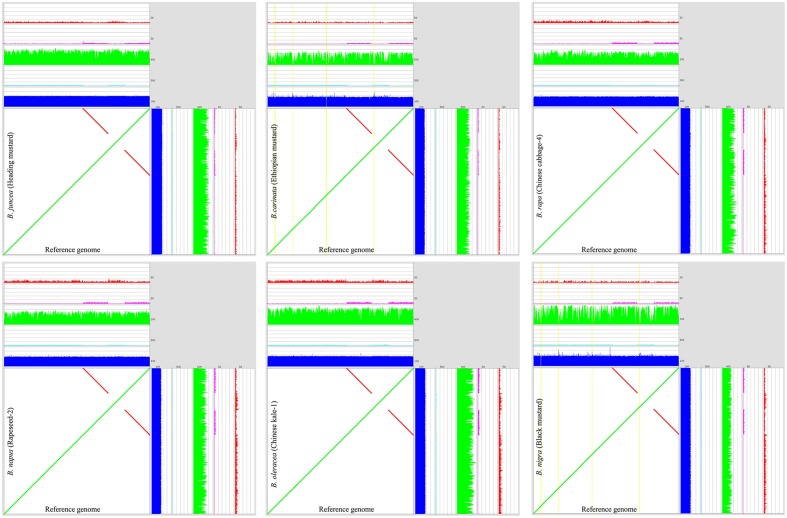
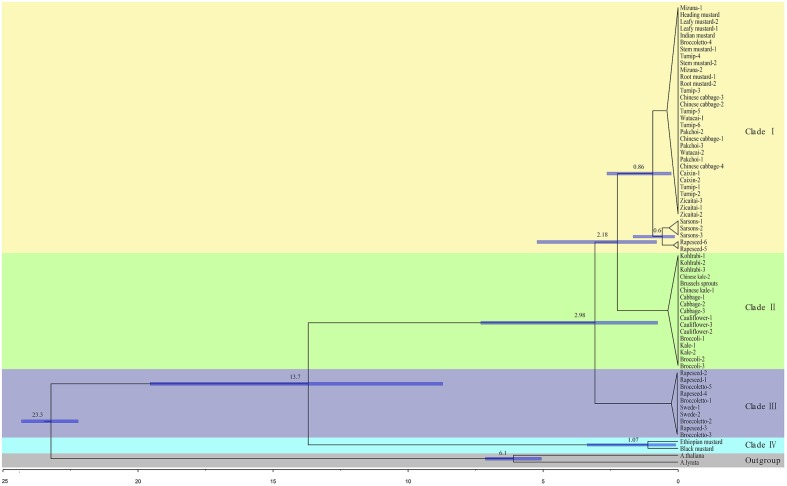
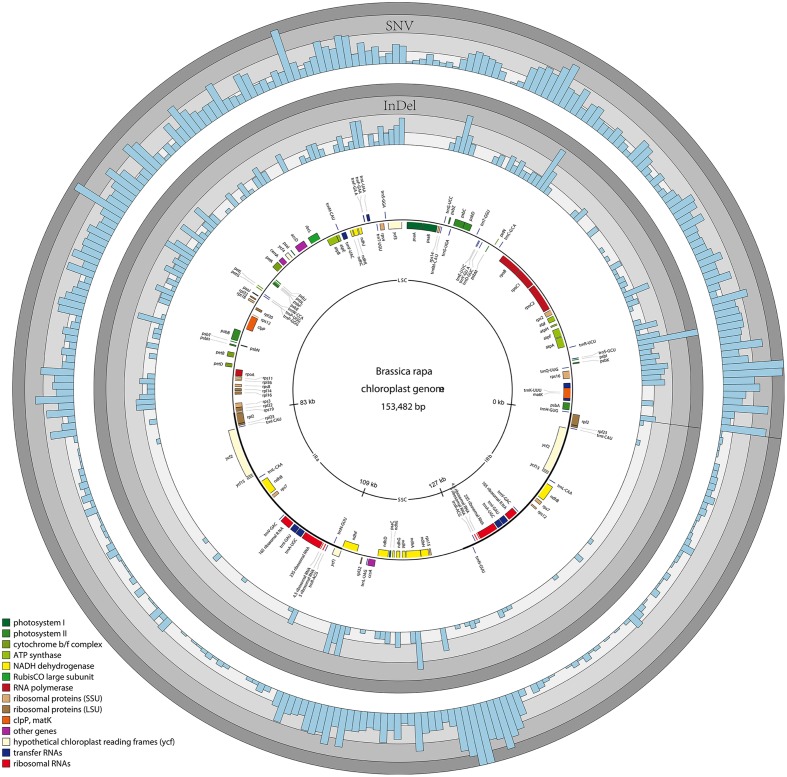
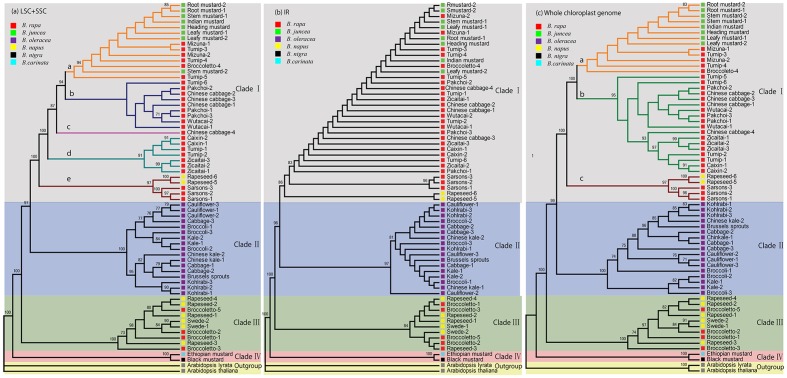
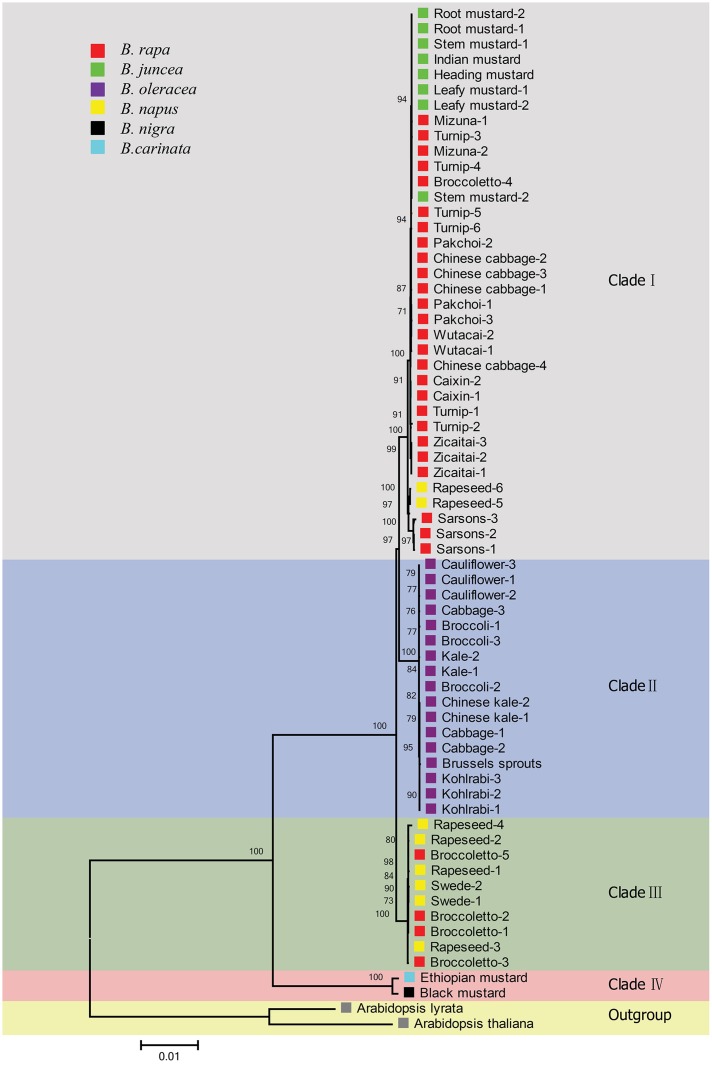
The genus comprises many economically important worldwide cultivated crops. The well-established model of the genus, U's triangle, consists of three basic diploid plant species (, , and ) and three amphidiploid species (, , and ) that arose through interspecific hybridizations. Despite being extensively studied because of its commercial relevance, several aspects of the origin of the species and the relationships within and among these six species still remain open questions. Here, we successfully assembled 60 complete chloroplast genomes of genotypes of all six species. A complete map of the single nucleotide variants and insertions and deletions in the chloroplast genomes of different species was produced. The chloroplast genome consists of a Large and a Small Single Copy (LSC and SSC) region between two inverted repeats, and while these regions of chloroplast genomes have very different molecular evolutionary rates, phylogenetic analyses of different regions yielded no contradicting topologies and separated the genus into four clades. and share their chloroplast genome with one of their hybridization donors and , respectively, which fits the U model. , surprisingly, shows evidence of two types of chloroplast genomes, with one type specific to some Italian broccoletto accessions. clearly has evidence for two independent hybridization events, as it contains either chloroplast genomes. The divergence estimation suggests that and diverged from the main clade 13.7 million years ago (Mya), while and diverged at 2.18 Mya. The use of the complete chloroplast DNA sequence not only provides insights into comparative genome analysis but also paves the way for a better understanding of the phylogenetic relationships within the genus.
该属包含许多在全球范围内具有重要经济价值的栽培作物。该属已确立的模型,即U三角,由三个基本的二倍体植物物种(、和)以及通过种间杂交产生的三个双二倍体物种(、和)组成。尽管因其商业相关性而受到广泛研究,但该属物种的起源以及这六个物种内部和之间的关系的几个方面仍然是悬而未决的问题。在这里,我们成功组装了所有六个物种的60个基因型的完整叶绿体基因组。绘制了不同物种叶绿体基因组中单个核苷酸变异以及插入和缺失的完整图谱。叶绿体基因组由两个反向重复序列之间的一个大单拷贝(LSC)区域和一个小单拷贝(SSC)区域组成,虽然叶绿体基因组的这些区域具有非常不同的分子进化速率,但对不同区域的系统发育分析产生了不矛盾的拓扑结构,并将该属分为四个进化枝。和分别与其杂交亲本之一和共享其叶绿体基因组,这与U模型相符。令人惊讶的是,显示出两种类型叶绿体基因组的证据,其中一种类型特定于一些意大利嫩茎花椰菜种质。显然有两个独立杂交事件的证据,因为它包含两种叶绿体基因组。分歧估计表明,和在1370万年前(Mya)从主要进化枝分化出来,而和在218万年前分化。完整叶绿体DNA序列的使用不仅为比较基因组分析提供了见解,也为更好地理解该属内的系统发育关系铺平了道路。