Riddell Jeff, Swaminathan Anand, Lee Monica, Mohamed Abdiwahab, Rogers Rob, Rezaie Salim R
University of Washington, Department of Medicine, Division of Emergency Medicine, Seattle, Washington.
New York University, Department of Emergency Medicine, New York, New York.
West J Emerg Med. 2017 Feb;18(2):229-234. doi: 10.5811/westjem.2016.12.32850. Epub 2017 Jan 30.
Emergency medicine (EM) educational podcasts have become increasingly popular. Residents spend a greater percentage of their time listening to podcasts than they do using other educational materials. Despite this popularity, research into podcasting in the EM context is sparse. We aimed to determine EM residents' consumption habits, optimal podcast preferences, and motivation for listening to EM podcasts.
We created a survey and emailed it to EM residents at all levels of training at 12 residencies across the United States from September 2015 to June 2016. In addition to demographics, the 20-question voluntary survey asked questions exploring three domains: habits, attention, and motivation. We used descriptive statistics to analyze results.
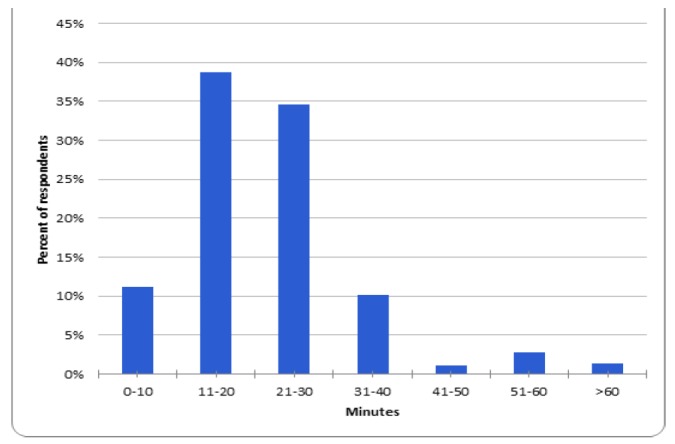
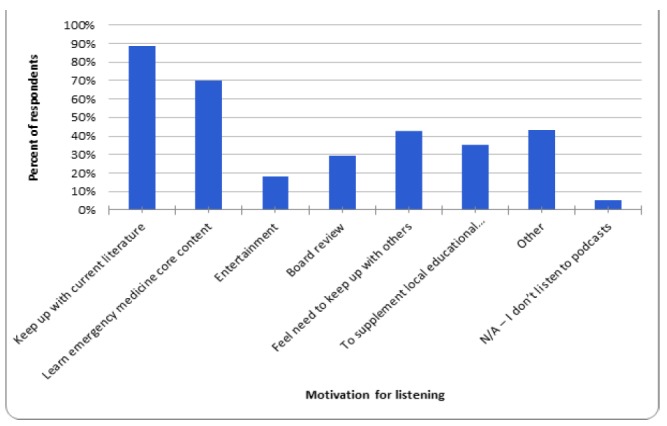
Of the 605 residents invited to participate, 356 (n= 60.3%) completed the survey. The vast majority listen to podcasts at least once a month (88.8%). Two podcasts were the most popular by a wide margin, with 77.8% and 62.1% regularly listening to () and the , respectively; 84.6% reported the ideal length of a podcast was less than 30 minutes. Residents reported their motivation to listen to EM podcasts was to "Keep up with current literature" (88.5%) and "Learn EM core content" (70.2%). Of those responding, 72.2% said podcasts change their clinical practice either "somewhat" or "very much."
The results of this survey study suggest most residents listen to podcasts at least once a month, prefer podcasts less than 30 minutes in length, have several motivations for choosing podcasts, and report that podcasts change their clinical practice.
急诊医学(EM)教育播客越来越受欢迎。住院医师花在听播客上的时间占比,比使用其他教育材料的时间占比更高。尽管如此受欢迎,但针对急诊医学领域播客的研究却很少。我们旨在确定急诊医学住院医师的消费习惯、最佳播客偏好以及收听急诊医学播客的动机。
我们设计了一项调查问卷,并于2015年9月至2016年6月通过电子邮件将其发送给美国12个住院医师培训项目中各级别的急诊医学住院医师。除了人口统计学信息外,这份包含20个问题的自愿调查问卷还涉及三个领域的问题:习惯、注意力和动机。我们使用描述性统计分析结果。
在邀请参与的605名住院医师中,356名(n = 60.3%)完成了调查。绝大多数人每月至少收听一次播客(88.8%)。有两个播客远超其他,分别有77.8%和62.1%的人经常收听()和();84.6%的人表示播客的理想时长应少于30分钟。住院医师表示,他们收听急诊医学播客的动机是“跟上当前文献”(88.5%)和“学习急诊医学核心内容”(70.2%)。在做出回应者中,72.2%的人表示播客对他们的临床实践有“一定”或“很大”的改变。
这项调查研究的结果表明,大多数住院医师每月至少收听一次播客,更喜欢时长少于30分钟的播客,选择播客有多种动机,并表示播客改变了他们的临床实践。