Nakano Masahiro, Arai Yoshiyuki, Kotera Ippei, Okabe Kohki, Kamei Yasuhiro, Nagai Takeharu
The Institute of Scientific and Industrial Research, Osaka University, Ibaraki, Osaka, Japan.
Research Institute for Electronic Science, Hokkaido University, Sapporo, Hokkaido, Japan.
PLoS One. 2017 Feb 17;12(2):e0172344. doi: 10.1371/journal.pone.0172344. eCollection 2017.
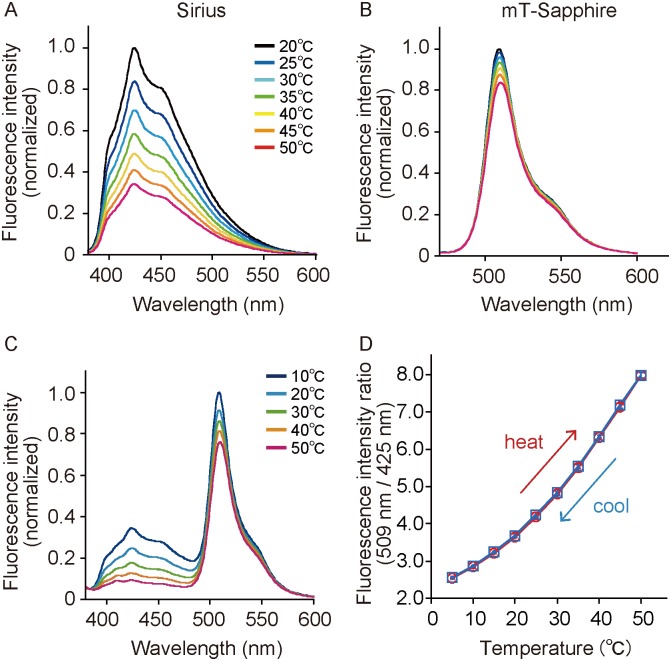
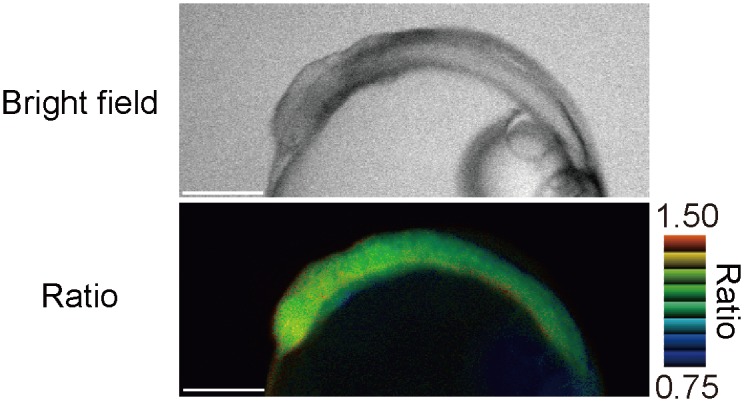
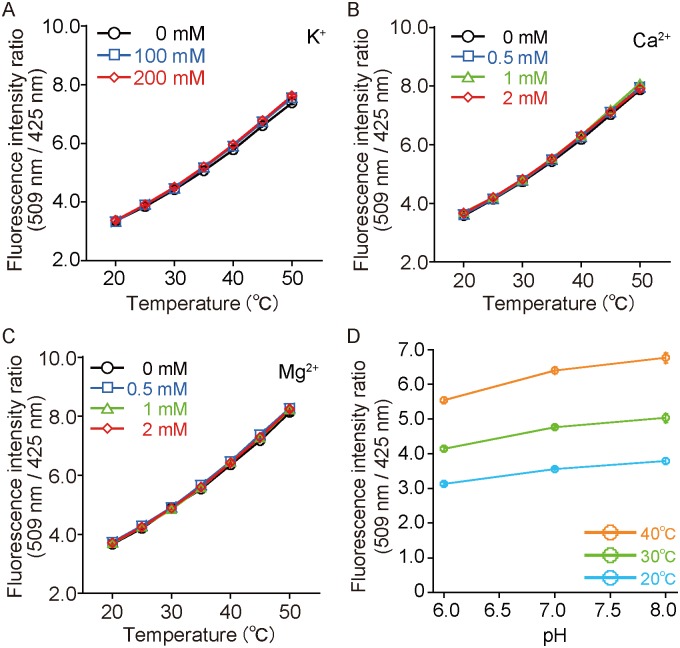
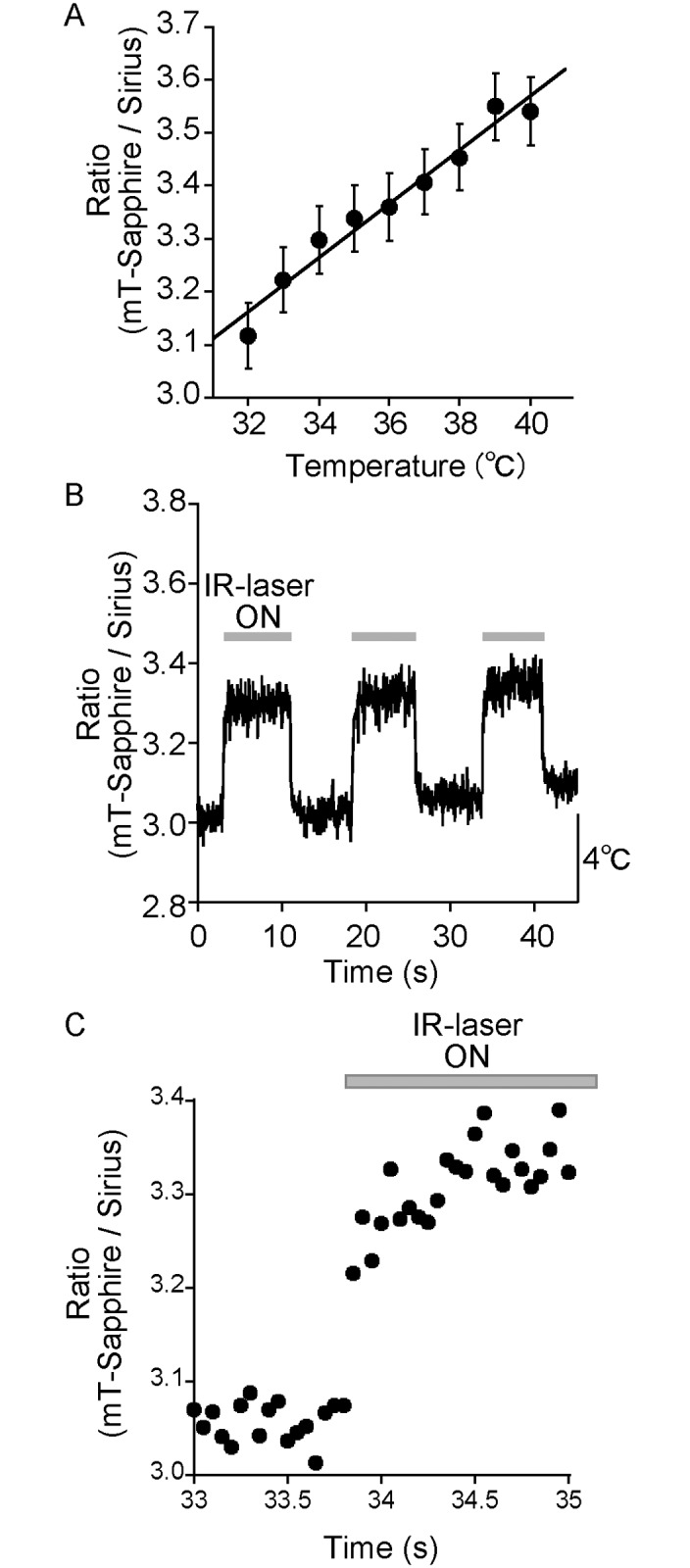
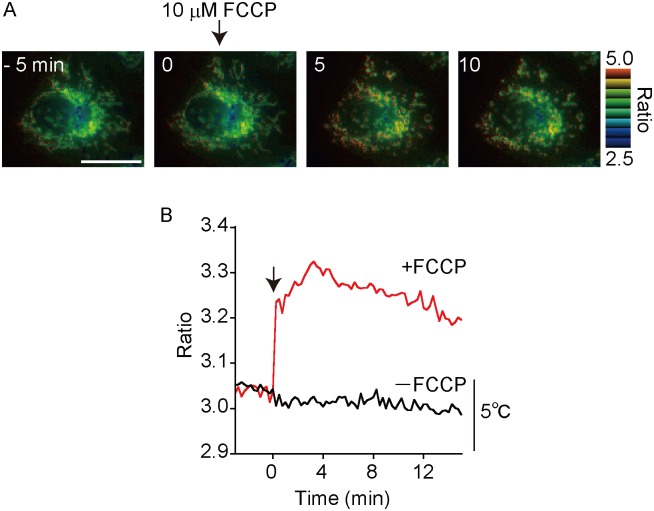
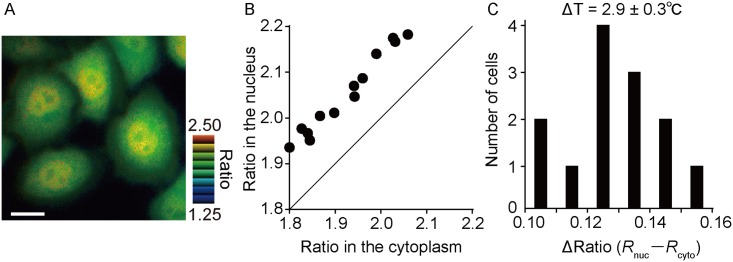
Temperature is a fundamental physical parameter that plays an important role in biological reactions and events. Although thermometers developed previously have been used to investigate several important phenomena, such as heterogeneous temperature distribution in a single living cell and heat generation in mitochondria, the development of a thermometer with a sensitivity over a wide temperature range and rapid response is still desired to quantify temperature change in not only homeotherms but also poikilotherms from the cellular level to in vivo. To overcome the weaknesses of the conventional thermometers, such as a limitation of applicable species and a low temporal resolution, owing to the narrow temperature range of sensitivity and the thermometry method, respectively, we developed a genetically encoded ratiometric fluorescent temperature indicator, gTEMP, by using two fluorescent proteins with different temperature sensitivities. Our thermometric method enabled a fast tracking of the temperature change with a time resolution of 50 ms. We used this method to observe the spatiotemporal temperature change between the cytoplasm and nucleus in cells, and quantified thermogenesis from the mitochondria matrix in a single living cell after stimulation with carbonyl cyanide 4-(trifluoromethoxy)phenylhydrazone, which was an uncoupler of oxidative phosphorylation. Moreover, exploiting the wide temperature range of sensitivity from 5°C to 50°C of gTEMP, we monitored the temperature in a living medaka embryo for 15 hours and showed the feasibility of in vivo thermometry in various living species.
温度是一个基本的物理参数,在生物反应和事件中起着重要作用。尽管先前开发的温度计已被用于研究一些重要现象,如单个活细胞中的异质温度分布和线粒体中的产热,但仍需要开发一种在宽温度范围内具有灵敏度且响应迅速的温度计,以便不仅能从细胞水平到体内定量恒温动物,还能定量变温动物的温度变化。为了克服传统温度计的缺点,例如由于灵敏度的温度范围窄和测温方法分别导致的适用物种有限和时间分辨率低,我们通过使用两种具有不同温度敏感性的荧光蛋白,开发了一种基因编码的比率荧光温度指示剂gTEMP。我们的测温方法能够以50毫秒的时间分辨率快速跟踪温度变化。我们使用这种方法观察细胞中细胞质和细胞核之间的时空温度变化,并在使用羰基氰化物4-(三氟甲氧基)苯腙(一种氧化磷酸化解偶联剂)刺激后,定量单个活细胞中线粒体基质的产热。此外,利用gTEMP从5°C到50°C的宽温度敏感范围,我们监测了活的青鳉胚胎15小时的温度,并展示了在各种活物种中进行体内测温的可行性。