Tanimoto Ryuichi, Hiraiwa Takumi, Nakai Yuichiro, Shindo Yutaka, Oka Kotaro, Hiroi Noriko, Funahashi Akira
Keio University, Department of Biosciences and Informatics, 3-14-1, Hiyoshi, Kohoku-Ward, Yokohama, 223-8522, Japan.
Sci Rep. 2016 Mar 1;6:22071. doi: 10.1038/srep22071.
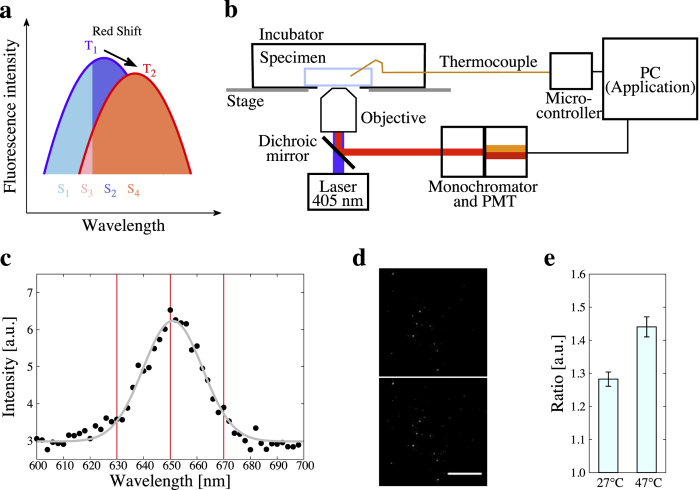
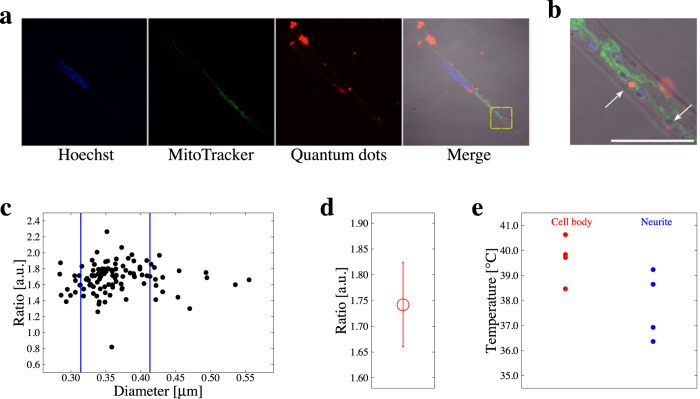
For a better understanding of the mechanisms behind cellular functions, quantification of the heterogeneity in an organism or cells is essential. Recently, the importance of quantifying temperature has been highlighted, as it correlates with biochemical reaction rates. Several methods for detecting intracellular temperature have recently been established. Here we develop a novel method for sensing temperature in living cells based on the imaging technique of fluorescence of quantum dots. We apply the method to quantify the temperature difference in a human derived neuronal cell line, SH-SY5Y. Our results show that temperatures in the cell body and neurites are different and thus suggest that inhomogeneous heat production and dissipation happen in a cell. We estimate that heterogeneous heat dissipation results from the characteristic shape of neuronal cells, which consist of several compartments formed with different surface-volume ratios. Inhomogeneous heat production is attributable to the localization of specific organelles as the heat source.
为了更好地理解细胞功能背后的机制,对生物体或细胞中的异质性进行量化至关重要。最近,量化温度的重要性得到了强调,因为它与生化反应速率相关。最近已经建立了几种检测细胞内温度的方法。在这里,我们基于量子点荧光成像技术开发了一种用于检测活细胞中温度的新方法。我们应用该方法来量化人源神经母细胞瘤细胞系SH-SY5Y中的温度差异。我们的结果表明,细胞体和神经突中的温度不同,因此表明细胞中存在不均匀的产热和散热现象。我们估计,不均匀的散热是由神经元细胞的特征形状导致的,神经元细胞由几个具有不同表面积与体积比的隔室组成。不均匀的产热归因于特定细胞器作为热源的定位。