Khattak Rehman Mehmood, Khattak Muhammad Nasir Khan, Ittermann Till, Völzke Henry
Institute for Community Medicine, Walther-Rathenau, Greifswald, Germany; Department of Zoology, Islamia College Peshawar (CU), Pakistan.
Department of Zoology, Hazara University, Mansehra, Pakistan.
J Epidemiol. 2017 Jun;27(6):249-257. doi: 10.1016/j.je.2016.04.003. Epub 2017 Feb 16.
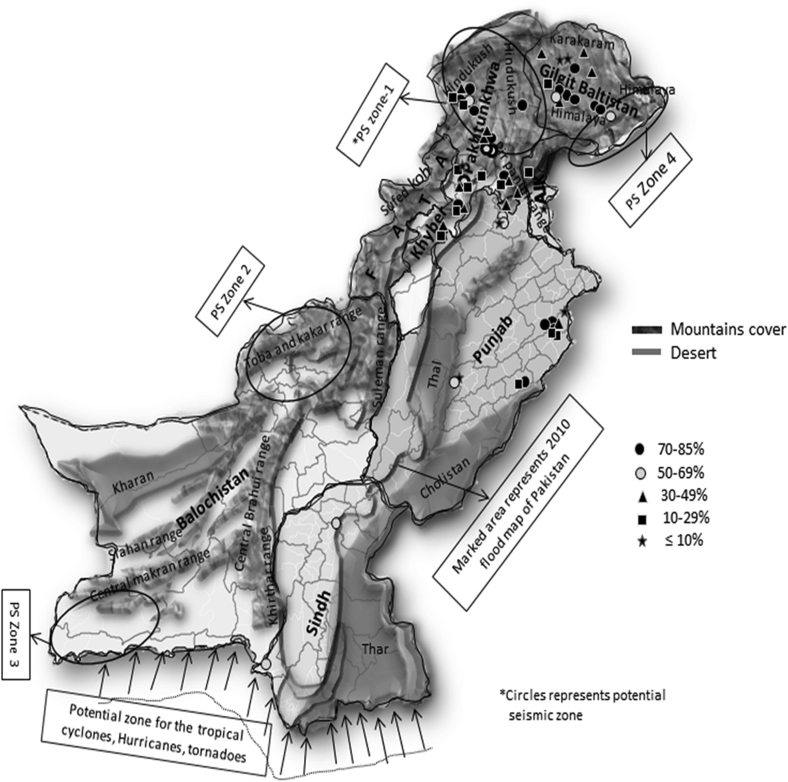
Iodine deficiency remains a considerable challenge worldwide, even after decades of efforts to address the problem. The aim of this review is to present the current situation in historically iodine-deficient Pakistan regarding iodine nutritional status and place it in a global perspective. We collected relevant articles from online bibliographic databases and websites of concerned organizations that addressed prevalence of goiter/iodine deficiency and barriers to sustainable control. We divided the studies into pre- and post-1994, a landmark year when Pakistan formally adopted the universal salt iodization (USI) programme. Overall, 56 studies reported goiter/iodine deficiency prevalence in Pakistan. Before 1994, six studies (30%) reported a goiter prevalence ≥70%, while nine studies (45%) reported a goiter prevalence between 30% and 70%. Only five studies (25%) found a goiter prevalence less than 30%, of which only two studies reported prevalence <10%. From 1994 onwards, 15 studies (41.7%) reported a goiter/iodine deficiency (ID) prevalence ≥50%, of which seven studies reported prevalence ≥70%, while three studies (8.3%) found a goiter prevalence of 30%-49%, nine studies (25%) found a goiter prevalence of 10%-29%, and five studies (13.9%) reported prevalence of <10%. Four studies (11.1%) reported lower goiter prevalence but higher prevalence of iodine deficiency. The efforts in the past two decades resulted in up to a 50% decline in iodine deficiency disorders (IDD). Variable remaining factors and the recent results, however, indicate that this decline may be non-uniform and even over-estimated. Coordinated and regionally adopted efforts for eradication of IDD from all stakeholders should be pursued. Policy makers should take steps to protect future generations and alert concerned organizations about the importance of careful assessments and estimates of iodine nutritional status.
即使经过数十年解决碘缺乏问题的努力,碘缺乏在全球范围内仍是一项重大挑战。本综述的目的是介绍历史上碘缺乏的巴基斯坦目前碘营养状况,并将其置于全球背景下考量。我们从在线书目数据库和相关组织网站收集了涉及甲状腺肿/碘缺乏患病率及可持续控制障碍的相关文章。我们将研究分为1994年之前和之后,1994年是巴基斯坦正式采用全民食盐碘化(USI)计划的标志性年份。总体而言,56项研究报告了巴基斯坦甲状腺肿/碘缺乏患病率。1994年之前,6项研究(30%)报告甲状腺肿患病率≥70%,9项研究(45%)报告甲状腺肿患病率在30%至70%之间。只有5项研究(25%)发现甲状腺肿患病率低于30%,其中只有2项研究报告患病率<10%。从1994年起,15项研究(41.7%)报告甲状腺肿/碘缺乏(ID)患病率≥50%,其中7项研究报告患病率≥70%;3项研究(8.3%)发现甲状腺肿患病率为30%-49%,9项研究(25%)发现甲状腺肿患病率为10%-29%,5项研究(13.9%)报告患病率<10%。4项研究(11.1%)报告甲状腺肿患病率较低但碘缺乏患病率较高。过去二十年的努力使碘缺乏病(IDD)患病率下降了高达50%。然而,各种残留因素和近期结果表明,这种下降可能并不均匀,甚至可能被高估。所有利益相关者应采取协调一致且在区域内采用的努力来消除碘缺乏病。政策制定者应采取措施保护后代,并提醒相关组织注意仔细评估和估计碘营养状况的重要性。