Asadzadeh-Aghdaee Hamid, Shahrokh Shabnam, Norouzinia Mohsen, Hosseini Mostafa, Keramatinia Aliasghar, Jamalan Mostafa, Naghibzadeh Bijan, Sadeghi Ali, Jahani Sherafat Somayeh, Zali Mohammad Reza
Basic and Molecular Epidemiology of Gastrointestinal Disorders Research Center, Research institute for Gastroenterology and Liver Diseases, Shahid Beheshti University of Medical Sciences, Tehran, Iran.
Gastroenterology and Liver Diseases Research Center, Research Institute for Gastroenterology and Liver Diseases, Shahid Beheshti University of Medical Sciences, Tehran, Iran.
Gastroenterol Hepatol Bed Bench. 2016 Dec;9(Suppl1):S8-S13.
In the present study, a protein-protein interaction network construction is conducted for IBD.
Inflammatory bowel diseases as serious chronic gastrointestinal disorders attracted many molecular investigations. Diverse molecular information is present for IBD. However, these molecular findings are not highlighted based on interactome analysis. On the other hand, PPI network analysis is a powerful method for study of molecular interactions in the protein level that provide useful information for highlighting the desired key proteins.
Cytoscape is the used software with its plug-ins for detailed analysis. Two centrality parameters including degree and betweenness are determined and the crucial proteins based on these parameters are introduced.
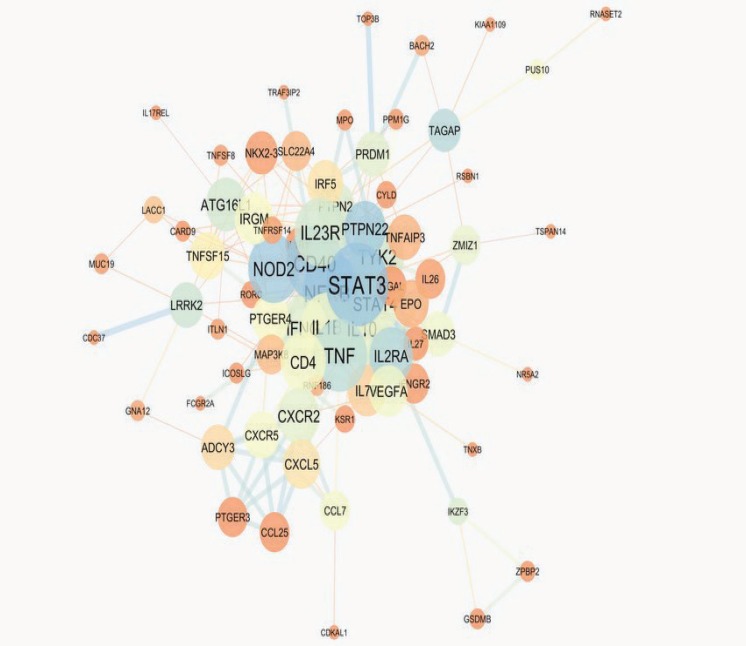
The 75 proteins among 100 initial proteins are included in the network of IBD. Seventy-five nodes and 260 edges constructed the network as a scale free network. The findings indicate that there are seven hub-bottleneck proteins in the IBD network.
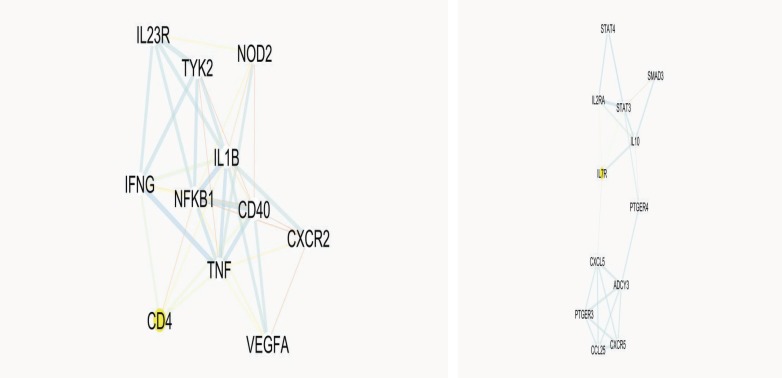
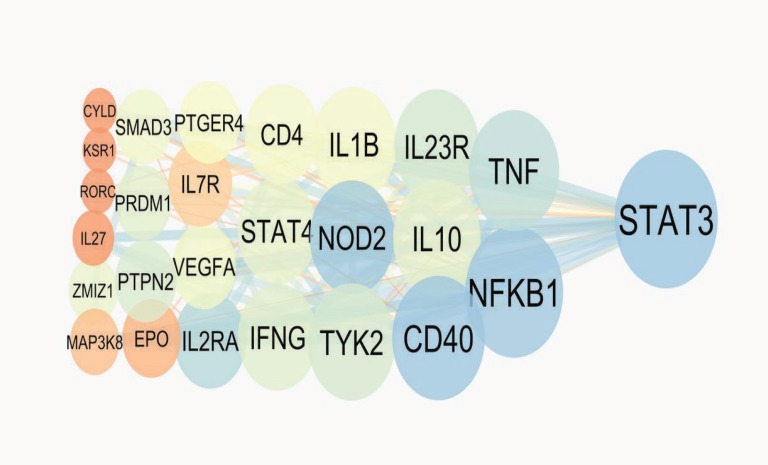
More examination revealed the essential roles of these key proteins in the integrity of the network. Finally, the indicator panel including NFKB1, CD40, TNFA, TYK2, NOD2, IL23R, and STAT3 is presented as a possible molecular index for IBD.
在本研究中,针对炎症性肠病构建蛋白质-蛋白质相互作用网络。
炎症性肠病作为严重的慢性胃肠疾病吸引了众多分子研究。关于炎症性肠病存在多样的分子信息。然而,基于相互作用组分析,这些分子发现并未得到突出体现。另一方面,蛋白质-蛋白质相互作用网络分析是在蛋白质水平研究分子相互作用的有力方法,可为突出所需关键蛋白质提供有用信息。
使用Cytoscape软件及其插件进行详细分析。确定了包括度和介数在内的两个中心性参数,并基于这些参数引入关键蛋白质。
100个初始蛋白质中的75个蛋白质包含在炎症性肠病网络中。75个节点和260条边构成了该无标度网络。研究结果表明炎症性肠病网络中有7个枢纽-瓶颈蛋白。
更多研究揭示了这些关键蛋白质在网络完整性中的重要作用。最后,提出了包括NFKB1、CD40、TNFA、TYK2、NOD2、IL23R和STAT3的指标面板作为炎症性肠病可能的分子指标。