Rostami-Nejad Mohammad, Rezaei Tavirani Sina, Mansouri Vahid, Jahani-Sherafat Somayeh, Moravvej Farshi Hamideh
Gastroenterology and Liver Diseases Research Center, Research Institute for Gastroenterology and Liver Diseases, Shahid Beheshti University of Medical Sciences, Tehran, Iran.
Proteomics Research Center, Faculty of Paramedical Sciences, Shahid Beheshti University of Medical Sciences, Tehran, Iran.
Gastroenterol Hepatol Bed Bench. 2019 Winter;12(1):60-66.
Gene expression profile analysis of colon cancer grade II into grade III transition by using system biology.
Colon cancer is one of lethal cancer in men and women. Treatment in advanced colon cancer is difficult and survival rate is low.
Gene expression profiles of children patients with non-preforated appendicitis in comparison with the samples with non- appendicitis abdominal pain are analysis via protein - protein interaction PPI and the critical compounds are introduced by STITCH.
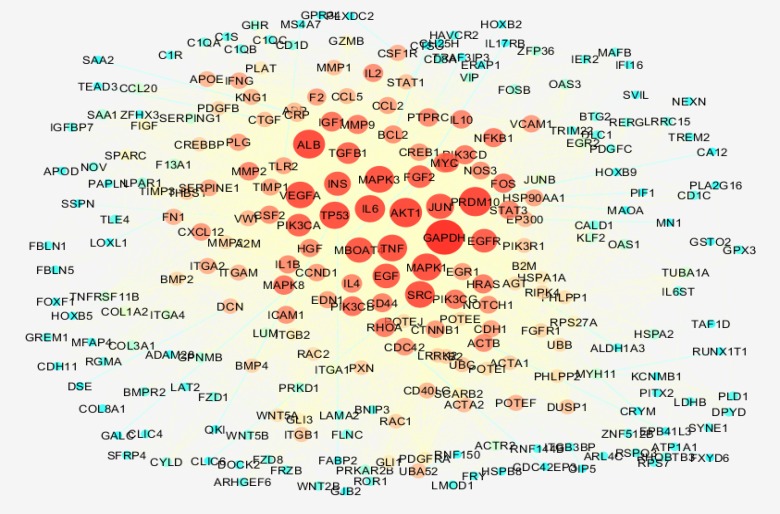
Six critical genes including MAPK3, AKT1, SRC, TP53, GAPDH, and ALB were identified as a possible biomarker panel related to colon cancer grade II to III transition. Among these critical genes roles of MAPK3, AKT1, SRC, TP53 are highlighted.
It was concluded that target therapy to regulate SRC and TP53 may be the effective therapeutic way to treatment of colon cancer and more researches in necessary to design drugs for these purposes.
运用系统生物学方法分析结肠癌二级向三级转变的基因表达谱。
结肠癌是男性和女性中致死性癌症之一。晚期结肠癌治疗困难且生存率低。
通过蛋白质-蛋白质相互作用(PPI)分析儿童非穿孔性阑尾炎患者与非阑尾炎腹痛患者样本的基因表达谱,并由STITCH介绍关键化合物。
鉴定出包括MAPK3、AKT1、SRC、TP53、GAPDH和ALB在内的六个关键基因,作为与结肠癌二级向三级转变相关的可能生物标志物组。其中突出了MAPK3、AKT1、SRC、TP53在这些关键基因中的作用。
得出结论,调节SRC和TP53的靶向治疗可能是治疗结肠癌的有效治疗方法,并且需要更多研究来为此目的设计药物。