Karbalaei Reza, Piran Mehran, Rezaei-Tavirani Mostafa, Asadzadeh-Aghdaei Hamid, Heidari Mohammad Hossein
Proteomics Research Center, Faculty of Paramedical Sciences, Shahid Beheshti University of Medical Sciences, Tehran, Iran.
Drug Design and Bioinformatics Unit, Medical Biotechnology Department, Biotechnology Research Center, Pasteur Institute of Iran, Tehran, Iran.
Gastroenterol Hepatol Bed Bench. 2017 Summer;10(3):194-201.
Analysis reconstruction networks from two diseases, IBD and NASH and their relationship, based on systems biology methods.
IBD and NASH are two complex diseases, with progressive prevalence and high cost for countries. There are some reports on co-existence of these two diseases. In addition, they have some similar risk factors such as age, obesity, and insulin resistance. Therefore, systems biology approach can help to discover their relationship.
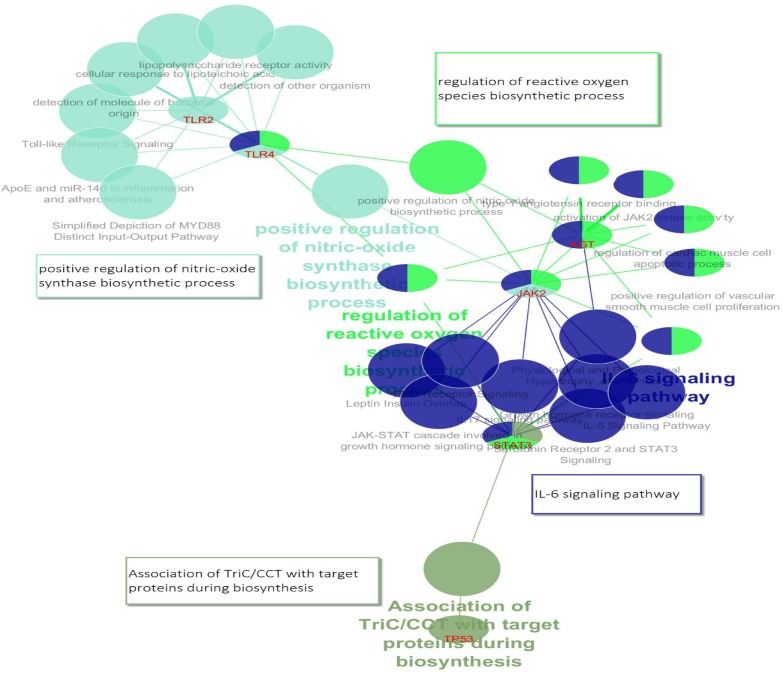
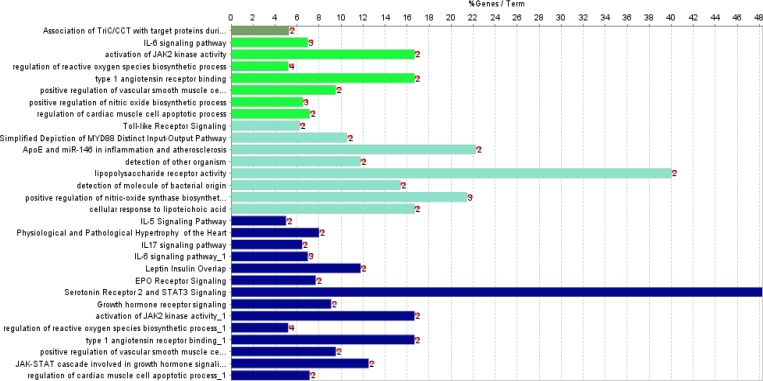
DisGeNET and STRING databases were sources of disease genes and constructing networks. Three plugins of Cytoscape software, including ClusterONE, ClueGO and CluePedia, were used to analyze and cluster networks and enrichment of pathways. Based on degree and Betweenness, hubs and bottleneck nodes were defined.
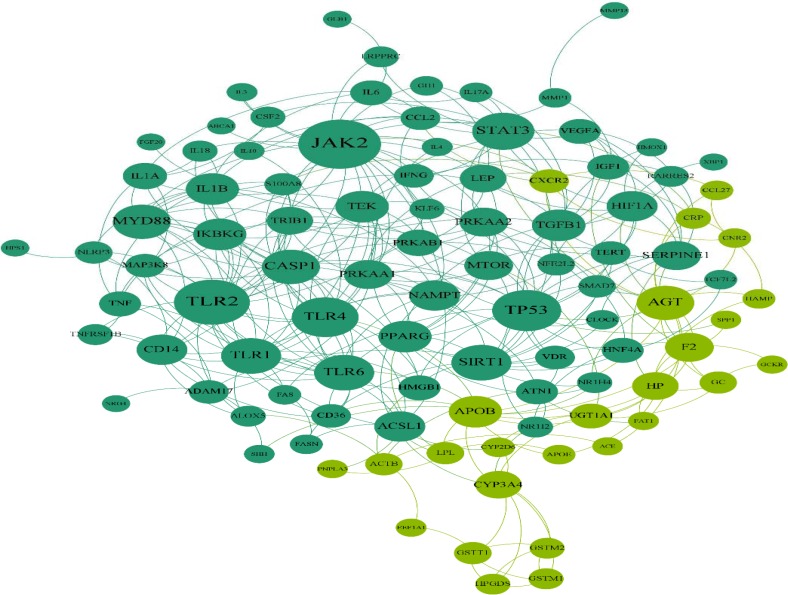
Common genes between IBD and NASH construct a network with 99 nodes. Common genes between IBD and NASH were extracted and imported to STRING database to construct PPI network. The resulting network contained 99 nodes and 333 edges. Five genes were selected as hubs: JAK2, TLR2, TP53, TLR4 and STAT3 and five genes were selected as bottleneck including: JAK2, TP53, AGT, CYP3A4 and TLR4. These genes were hubs in analysis network that was constructed from hubs of NASH and IBD networks.
Systems biology methods, specifically PPI networks, can be useful for analyzing complicated related diseases. Finding Hub and bottleneck proteins should be the goal of drug designing and introducing disease markers.
基于系统生物学方法分析炎症性肠病(IBD)和非酒精性脂肪性肝炎(NASH)这两种疾病的重建网络及其关系。
IBD和NASH是两种复杂疾病,其患病率呈上升趋势,给各国带来高昂成本。有一些关于这两种疾病共存的报道。此外,它们有一些相似的风险因素,如年龄、肥胖和胰岛素抵抗。因此,系统生物学方法有助于发现它们之间的关系。
DisGeNET和STRING数据库作为疾病基因来源并用于构建网络。Cytoscape软件的三个插件,包括ClusterONE、ClueGO和CluePedia,用于分析和聚类网络以及通路富集分析。基于度和介数定义枢纽节点和瓶颈节点。
IBD和NASH之间的共同基因构建了一个包含99个节点的网络。提取IBD和NASH之间的共同基因并导入STRING数据库构建蛋白质-蛋白质相互作用(PPI)网络。所得网络包含99个节点和333条边。选择五个基因作为枢纽节点:JAK2、TLR2、TP53、TLR4和STAT3,选择五个基因作为瓶颈节点,包括:JAK2、TP53、AGT、CYP3A4和TLR4。这些基因是由NASH和IBD网络的枢纽节点构建的分析网络中的枢纽节点。
系统生物学方法,特别是PPI网络,可用于分析复杂的相关疾病。寻找枢纽蛋白和瓶颈蛋白应成为药物设计和引入疾病标志物的目标。