Langeland N, Holmsen H, Lillehaug J R, Haarr L
Department of Biochemistry, University of Bergen, Norway.
J Virol. 1987 Nov;61(11):3388-93. doi: 10.1128/JVI.61.11.3388-3393.1987.
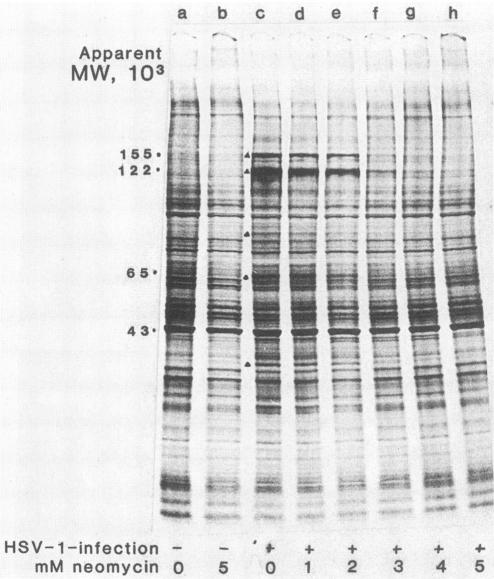
The effect of neomycin, a phosphoinositide-binding aminoglycoside, on herpes simplex virus type 1 (HSV-1) infection of BHK cells was studied. We showed earlier that it specifically inhibits HSV-1 production but not HSV-2 production (Langeland et al., Biochem Biophys. Res. Commun. 141:198-203, 1986). We now show that neomycin had no effect on cellular protein synthesis, as judged by the appearance of 35S-labeled polypeptides separated by polyacrylamide gel electrophoresis. Virus-induced polypeptides, however, were strongly inhibited at neomycin concentrations above 2 mM. Comparison among different aminoglycosides showed a variation in inhibition of HSV-1 production that paralleled the cationic charge of the aminoglycosides. HSV-1 receptor binding at 4 degrees C was completely inhibited by neomycin. At 37 degrees C both receptor binding and internalization, as measured by an indirect assay, appeared to be inhibited by more than 90%. The effect of neomycin on the infection was almost immediate upon the addition of the drug and preceded virus internalization. Possible mechanisms of the neomycin effect are discussed.
研究了新霉素(一种结合磷酸肌醇的氨基糖苷)对BHK细胞单纯疱疹病毒1型(HSV-1)感染的影响。我们之前表明它能特异性抑制HSV-1的产生,但不抑制HSV-2的产生(Langeland等人,《生物化学与生物物理研究通讯》141:198 - 203,1986年)。我们现在表明,通过聚丙烯酰胺凝胶电泳分离的35S标记多肽的出现判断,新霉素对细胞蛋白质合成没有影响。然而,在新霉素浓度高于2 mM时,病毒诱导的多肽受到强烈抑制。不同氨基糖苷之间的比较显示,对HSV-1产生的抑制存在差异,这与氨基糖苷的阳离子电荷平行。新霉素完全抑制了4℃时HSV-1受体的结合。在37℃时,通过间接测定法测量,受体结合和内化似乎都受到了90%以上的抑制。加入药物后,新霉素对感染的影响几乎立即出现,且先于病毒内化。讨论了新霉素作用的可能机制。