Llewellyn Clare H, Fildes Alison
Department of Behavioural Science and Health, University College London, London, UK.
School of Psychology, University of Leeds, Leeds, UK.
Curr Obes Rep. 2017 Mar;6(1):38-45. doi: 10.1007/s13679-017-0247-x.
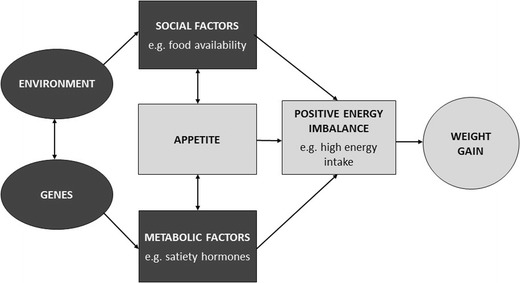
There is considerable variability in human body weight, despite the ubiquity of the 'obesogenic' environment. Human body weight has a strong genetic basis and it has been hypothesised that genetic susceptibility to the environment explains variation in human body weight, with differences in appetite being implicated as the mediating mechanism; so-called 'behavioural susceptibility theory' (BST), first described by Professor Jane Wardle. This review summarises the evidence for the role of appetite as a mediator of genetic risk of obesity.
Variation in appetitive traits is observable from infancy, drives early weight gain and is highly heritable in infancy and childhood. Obesity-related common genetic variants identified through genome-wide association studies show associations with appetitive traits, and appetite mediates part of the observed association between genetic risk and adiposity. Obesity results from an interaction between genetic susceptibility to overeating and exposure to an 'obesogenic' food environment.
尽管“致肥胖”环境普遍存在,但人体体重仍存在很大差异。人体体重有很强的遗传基础,有人提出,对环境的遗传易感性解释了人体体重的差异,其中食欲差异被认为是介导机制;这就是所谓的“行为易感性理论”(BST),由简·沃德尔教授首次提出。本综述总结了食欲作为肥胖遗传风险介导因素作用的证据。
食欲特征的差异在婴儿期就可观察到,会推动早期体重增加,并且在婴儿期和儿童期具有高度遗传性。通过全基因组关联研究确定的与肥胖相关的常见基因变异显示出与食欲特征的关联,并且食欲介导了遗传风险与肥胖之间观察到的部分关联。肥胖是暴饮暴食的遗传易感性与接触“致肥胖”食物环境之间相互作用的结果。