Garn Heinrich, Coronel Carmina, Waser Markus, Caravias Georg, Ransmayr Gerhard
AIT Austrian Institute of Technology GmbH, Donau-City-Straße 1, 1220, Vienna, Austria.
, Brunnenweg 2, 4810, Gmunden, Austria.
J Neural Transm (Vienna). 2017 May;124(5):569-581. doi: 10.1007/s00702-017-1699-6. Epub 2017 Feb 27.
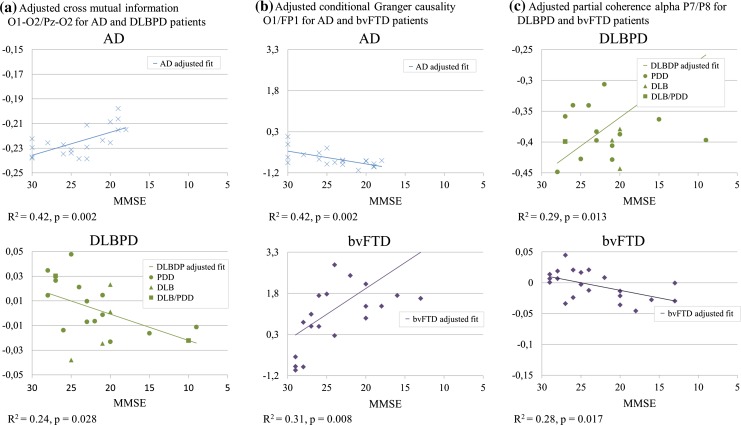
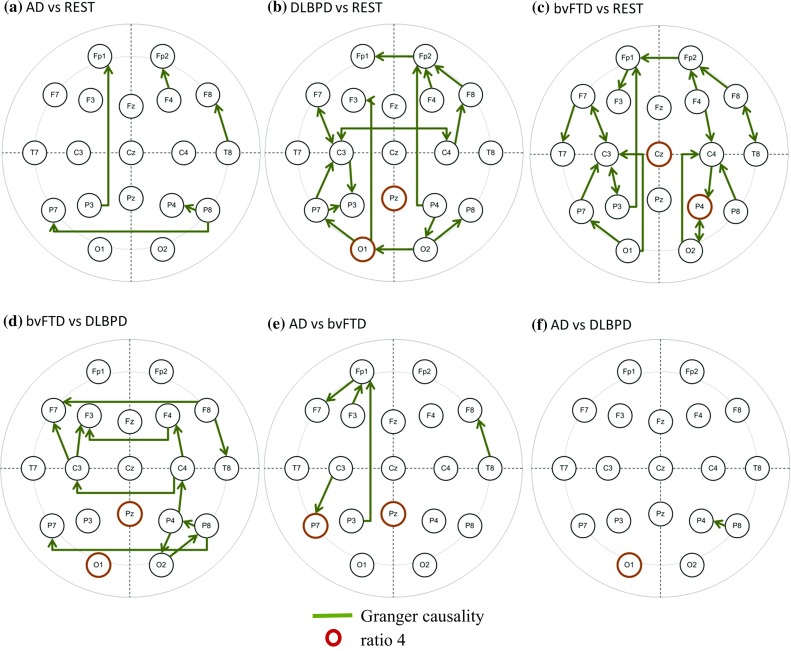
The objective of this work was to develop and evaluate a classifier for differentiating probable Alzheimer's disease (AD) from Parkinson's disease dementia (PDD) or dementia with Lewy bodies (DLB) and from frontotemporal dementia, behavioral variant (bvFTD) based on quantitative electroencephalography (QEEG). We compared 25 QEEG features in 61 dementia patients (20 patients with probable AD, 20 patients with PDD or probable DLB (DLBPD), and 21 patients with bvFTD). Support vector machine classifiers were trained to distinguish among the three groups. Out of the 25 features, 23 turned out to be significantly different between AD and DLBPD, 17 for AD versus bvFTD, and 12 for bvFTD versus DLBPD. Using leave-one-out cross validation, the classification achieved an accuracy, sensitivity, and specificity of 100% using only the QEEG features Granger causality and the ratio of theta and beta1 band powers. These results indicate that classifiers trained with selected QEEG features can provide a valuable input in distinguishing among AD, DLB or PDD, and bvFTD patients. In this study with 61 patients, no misclassifications occurred. Therefore, further studies should investigate the potential of this method to be applied not only on group level but also in diagnostic support for individual subjects.
这项工作的目的是基于定量脑电图(QEEG)开发并评估一种分类器,用于区分可能的阿尔茨海默病(AD)与帕金森病痴呆(PDD)或路易体痴呆(DLB),以及与行为变异型额颞叶痴呆(bvFTD)。我们比较了61例痴呆患者(20例可能患有AD的患者、20例患有PDD或可能患有DLB的患者(DLBPD)以及21例患有bvFTD的患者)的25项QEEG特征。训练支持向量机分类器以区分这三组。在这25项特征中,23项在AD和DLBPD之间存在显著差异,17项在AD与bvFTD之间存在显著差异,12项在bvFTD与DLBPD之间存在显著差异。使用留一法交叉验证,仅使用QEEG特征格兰杰因果关系以及θ波和β1波频段功率之比时,分类的准确率、灵敏度和特异性达到了100%。这些结果表明,用选定的QEEG特征训练的分类器在区分AD、DLB或PDD以及bvFTD患者方面可以提供有价值的信息。在这项有61例患者的研究中,没有发生误分类。因此,进一步的研究应调查这种方法不仅在群体层面,而且在个体受试者诊断支持方面的应用潜力。