Mbaeyi Chukwuma, Ryan Michael J, Smith Philip, Mahamud Abdirahman, Farag Noha, Haithami Salah, Sharaf Magdi, Jorba Jaume C, Ehrhardt Derek
MMWR Morb Mortal Wkly Rep. 2017 Mar 3;66(8):227-231. doi: 10.15585/mmwr.mm6608a6.
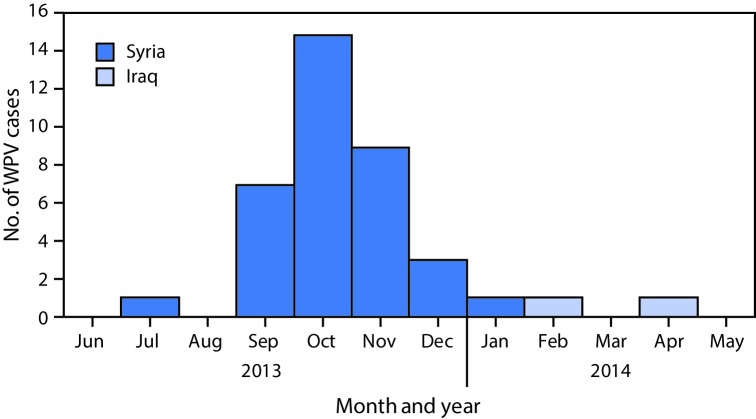
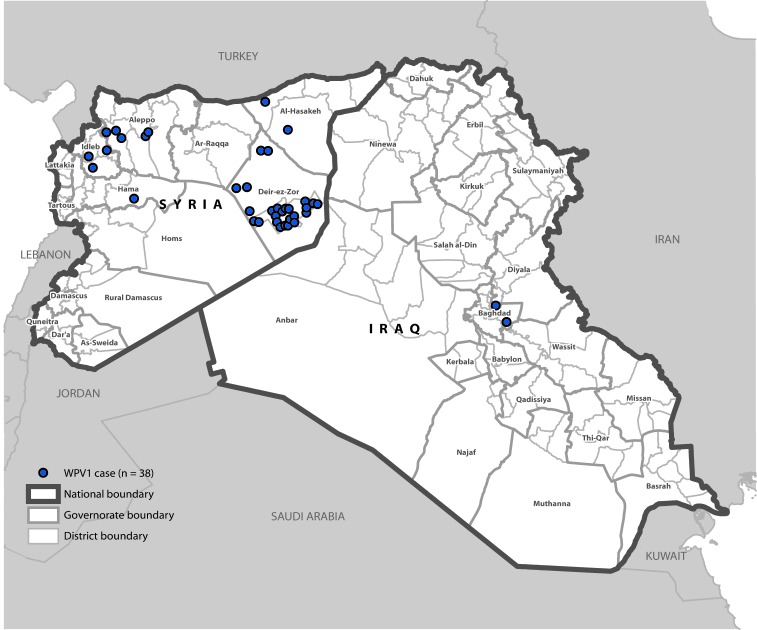
As the world advances toward the eradication of polio, outbreaks of wild poliovirus (WPV) in polio-free regions pose a substantial risk to the timeline for global eradication. Countries and regions experiencing active conflict, chronic insecurity, and large-scale displacement of persons are particularly vulnerable to outbreaks because of the disruption of health care and immunization services (1). A polio outbreak occurred in the Middle East, beginning in Syria in 2013 with subsequent spread to Iraq (2). The outbreak occurred 2 years after the onset of the Syrian civil war, resulted in 38 cases, and was the first time WPV was detected in Syria in approximately a decade (3,4). The national governments of eight countries designated the outbreak a public health emergency and collaborated with partners in the Global Polio Eradication Initiative (GPEI) to develop a multiphase outbreak response plan focused on improving the quality of acute flaccid paralysis (AFP) surveillance* and administering polio vaccines to >27 million children during multiple rounds of supplementary immunization activities (SIAs). Successful implementation of the response plan led to containment and interruption of the outbreak within 6 months of its identification. The concerted approach adopted in response to this outbreak could serve as a model for responding to polio outbreaks in settings of conflict and political instability.
随着世界朝着根除脊髓灰质炎的目标迈进,在无脊髓灰质炎地区出现野生脊髓灰质炎病毒(WPV)疫情对全球根除计划的时间表构成了重大风险。由于医疗保健和免疫服务中断,经历持续冲突、长期不安全以及大规模人员流离失所的国家和地区尤其容易爆发疫情(1)。中东地区发生了一次脊髓灰质炎疫情,2013年始于叙利亚,随后蔓延至伊拉克(2)。此次疫情发生在叙利亚内战爆发两年后,导致38例病例,是近十年来首次在叙利亚检测到WPV(3,4)。八个国家的政府将此次疫情定为公共卫生紧急事件,并与全球根除脊髓灰质炎行动(GPEI)的合作伙伴合作,制定了一个多阶段疫情应对计划,重点是提高急性弛缓性麻痹(AFP)监测*的质量,并在多轮补充免疫活动(SIAs)中为超过2700万儿童接种脊髓灰质炎疫苗。应对计划的成功实施导致疫情在发现后的6个月内得到控制和阻断。针对此次疫情所采取的协同方法可作为在冲突和政治不稳定环境中应对脊髓灰质炎疫情的范例。