Timms P, Eaves F W, Girjes A A, Lavin M F
Animal Research Institute, Queensland Department of Primary Industries, Yeerongpilly, Australia.
Infect Immun. 1988 Jan;56(1):287-90. doi: 10.1128/iai.56.1.287-290.1988.
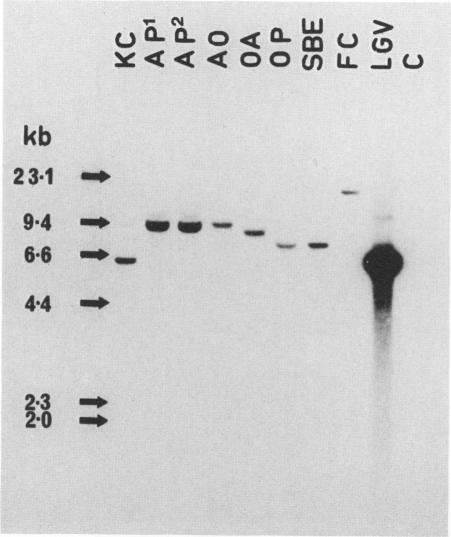
DNAs from eight Chlamydia psittaci isolates (koala conjunctivitis, avian psittacosis, avian ornithosis, ovine abortion, ovine polyarthritis, sporadic bovine encephalomyelitis, and feline conjunctivitis) and one Chlamydia trachomatis isolate (lymphogranuloma venereum) were compared by restriction endonuclease and DNA probe analyses. Digestion with HindIII yielded a series of discrete fragments which allowed the differentiation of most isolates. A gene probe, pFEN207, which encodes the chlamydia-specific component of the lipopolysaccharide group antigen was used in Southern hybridizations. The probe was chlamydia specific and hybridized to a single BamHI fragment and multiple HindIII fragments in each isolate. The variation in size of the hybridizing fragments allowed easy differentiation of the isolates and may eventually lead to a meaningful subgrouping of the diverse group of disease agents presently included in the species C. psittaci.
通过限制性内切酶和DNA探针分析,对来自8株鹦鹉热衣原体分离株(考拉结膜炎、禽鹦鹉热、禽鸟疫、绵羊流产、绵羊多关节炎、散发性牛脑脊髓炎和猫结膜炎)和1株沙眼衣原体分离株(性病性淋巴肉芽肿)的DNA进行了比较。用HindIII消化产生了一系列离散片段,这些片段可用于区分大多数分离株。在Southern杂交中使用了一种基因探针pFEN207,它编码脂多糖基团抗原的衣原体特异性成分。该探针具有衣原体特异性,可与每个分离株中的单个BamHI片段和多个HindIII片段杂交。杂交片段大小的差异使分离株易于区分,并最终可能导致对目前包含在鹦鹉热衣原体种中的多种病原体进行有意义的亚分组。