Baradat Claire, Degboé Yannick, Constantin Arnaud, Cantagrel Alain, Ruyssen-Witrand Adeline
Rheumatology Center, Purpan Teaching Hospital, CHU of Toulouse, Toulouse, France; Paul Sabatier University, Toulouse, France.
Rheumatology Center, Purpan Teaching Hospital, CHU of Toulouse, Toulouse, France; Paul Sabatier University, Toulouse, France; Inserm, UMR 1043, Toulouse, France.
RMD Open. 2017 Feb 22;3(1):e000352. doi: 10.1136/rmdopen-2016-000352. eCollection 2017.
To compare the risk of serious adverse events, serious infections and death caused by methotrexate and biological disease-modifying antirheumatic drug (bDMARD) combination therapy versus a bDMARD prescribed as monotherapy in rheumatoid arthritis (RA).
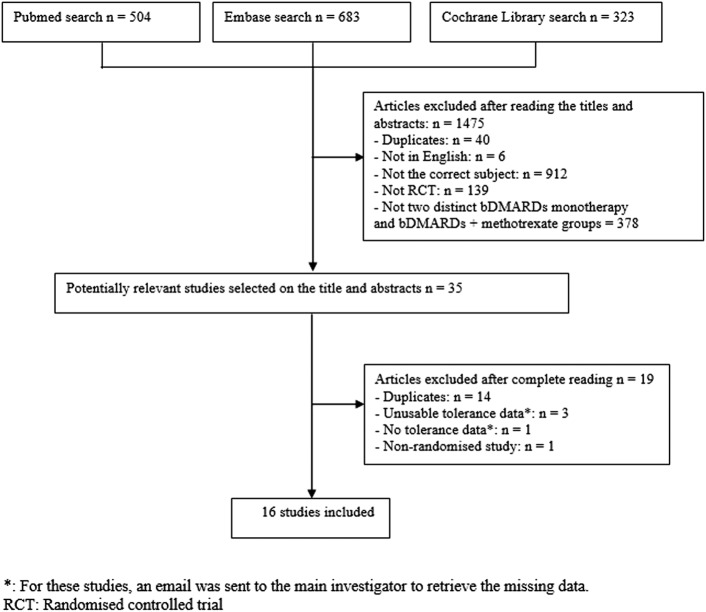
A systematic literature review was conducted until February 2016 in PubMed, Embase and Cochrane Library databases by selecting randomised controlled trials comparing methotrexate and bDMARD combination therapy to bDMARD monotherapy in RA. The meta-analysis compared the occurrence of (1) serious adverse events, (2) serious infections and (3) death among these groups by the Mantel-Haenszel method.
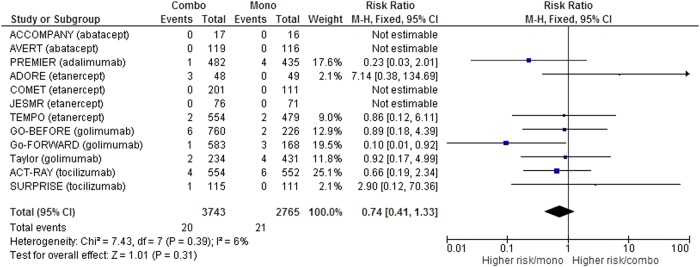
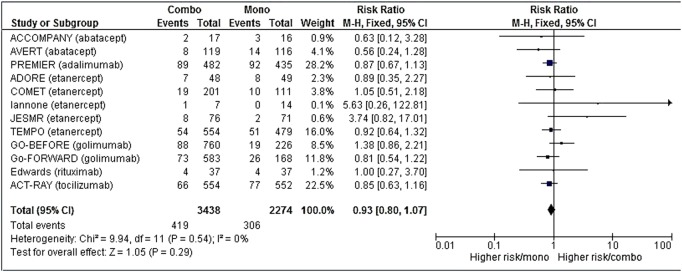
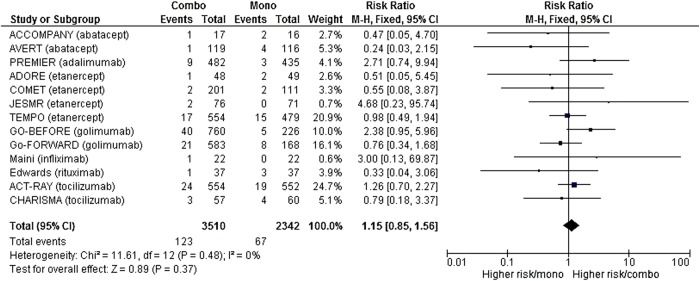
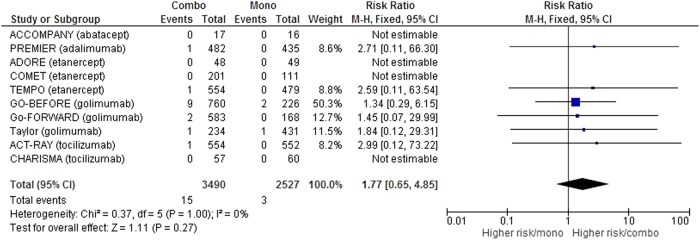
The literature review selected 16 controlled trials comparing methotrexate and bDMARD combination therapy to bDMARD monotherapy. After meta-analysis comparing patients under monotherapy to those under combination therapy: (1) the risk of occurrence of serious adverse events was comparable in 12 trials: RR (95% CI) 0.92 (0.78 to 1.08). (2) No significant difference was observed in the risk of occurrence of serious infections in 13 trials: RR (95% CI) 1.15 (0.84 to 1.58). We noted a trend, although insignificant, towards a high risk of the occurrence of tuberculosis in 10 studies: RR (95% CI) 1.78 (0.63 to 4.99). (3) The risk of death was comparable in 12 trials: RR (95% CI) 0.73 (0.40 to 1.35).
The results showed no significant difference between the two groups, confirming that the use of methotrexate and bDMARD combination therapy in RA does not cause an increased risk of serious adverse events or serious infections or death compared with bDMARD monotherapy.
比较甲氨蝶呤与生物性改善病情抗风湿药(bDMARD)联合治疗与bDMARD单药治疗在类风湿关节炎(RA)中导致严重不良事件、严重感染及死亡的风险。
截至2016年2月,在PubMed、Embase和Cochrane图书馆数据库中进行系统文献回顾,选择比较甲氨蝶呤与bDMARD联合治疗和bDMARD单药治疗RA的随机对照试验。采用Mantel-Haenszel方法对这些组间(1)严重不良事件、(2)严重感染和(3)死亡的发生率进行荟萃分析。
文献回顾筛选出16项比较甲氨蝶呤与bDMARD联合治疗和bDMARD单药治疗的对照试验。在对单药治疗患者与联合治疗患者进行荟萃分析后:(1)12项试验中严重不良事件的发生风险相当:RR(95%CI)0.92(0.78至1.08)。(2)13项试验中严重感染的发生风险未观察到显著差异:RR(95%CI)1.15(0.84至1.58)。在10项研究中,我们注意到结核病发生风险有升高趋势,尽管不显著:RR(95%CI)1.78(0.63至4.99)。(3)12项试验中死亡风险相当:RR(95%CI)0.73(0.40至1.35)。
结果显示两组间无显著差异,证实与bDMARD单药治疗相比,RA中使用甲氨蝶呤与bDMARD联合治疗不会增加严重不良事件、严重感染或死亡的风险。