Regier Yvonne, Ballhorn Wibke, Kempf Volkhard A J
University Hospital, Goethe-University, Institute for Medical Microbiology and Infection Control, Frankfurt am Main, Germany.
Parasit Vectors. 2017 Mar 13;10(1):105. doi: 10.1186/s13071-017-2042-7.
Bartonella henselae is a highly prevalent, vector-borne pathogen. Transmission to humans and animals by ticks is discussed controversially. Here, we present a case report, where eleven Ixodes ricinus ticks all harbouring B. henselae DNA were removed from one single cat.
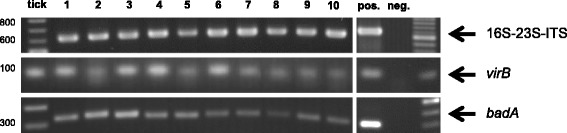
The first feeding tick was tested positive for B. henselae DNA. The cat was also found to be seropositive for anti-B. henselae IgG antibodies (titer 1:640). Bartonella henselae was not cultivatable from cat blood. Ten more feeding ticks removed 7 months later contained also B. henselae DNA. Sequence analysis of the 16SrDNA and the 16S-23S internal transcribed spacer (ITS) region revealed 100% sequence homology between all ticks. Bartonella adhesin A (badA) and VirB/VirD4 type IV secretion system (virB) DNA were also detected in all ticks.
Our results indicate that cats may serve as a reservoir for adult ticks to acquire B. henselae. Whether this observation implies an increased threat for human and animal health needs to be resolved.
汉赛巴尔通体是一种高度流行的媒介传播病原体。蜱向人类和动物的传播存在争议。在此,我们报告一例病例,从一只猫身上移除了11只均携带汉赛巴尔通体DNA的蓖麻硬蜱。
第一只正在吸血的蜱经检测汉赛巴尔通体DNA呈阳性。该猫抗汉赛巴尔通体IgG抗体血清学检测也呈阳性(效价1:640)。从猫血液中未培养出汉赛巴尔通体。7个月后又移除了10只正在吸血的蜱,它们也都含有汉赛巴尔通体DNA。对16SrDNA和16S - 23S内转录间隔区(ITS)区域的序列分析显示,所有蜱之间的序列同源性为100%。在所有蜱中还检测到了巴尔通体黏附素A(badA)和VirB/VirD4 IV型分泌系统(virB)的DNA。
我们的结果表明,猫可能是成年蜱获取汉赛巴尔通体的宿主。这一观察结果是否意味着对人类和动物健康的威胁增加尚需解决。