Weldingh Nina Mickelson, Jørgensen-Kaur Lena, Becher Rune, Holme Jørn A, Bodin Johanna, Nygaard Unni C, Bølling Anette Kocbach
Domain of Infection Control and Environmental Health, Norwegian Institute of Public Health, P.O. Box 4404, Nydalen, 0403 Oslo, Norway.
Biomed Res Int. 2017;2017:4614379. doi: 10.1155/2017/4614379. Epub 2017 Feb 13.
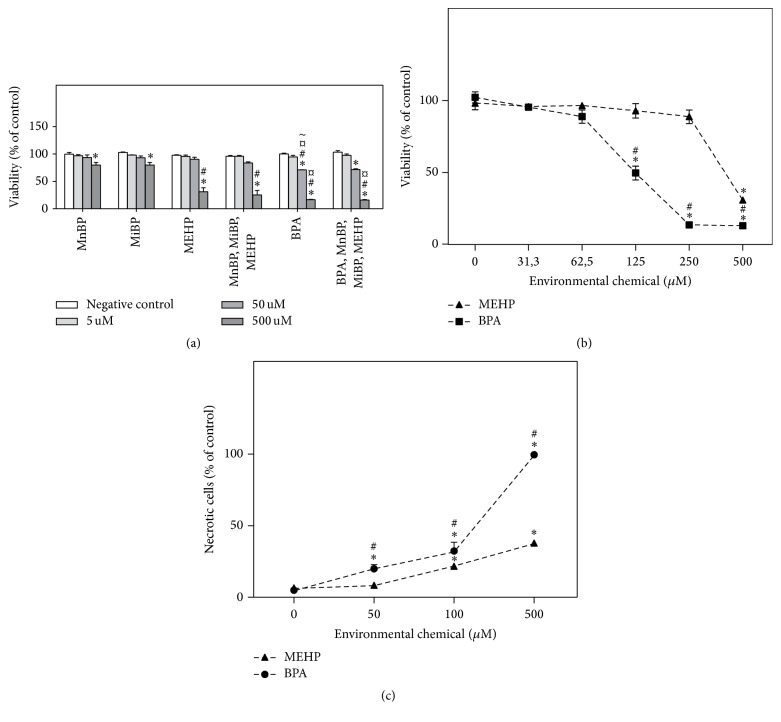
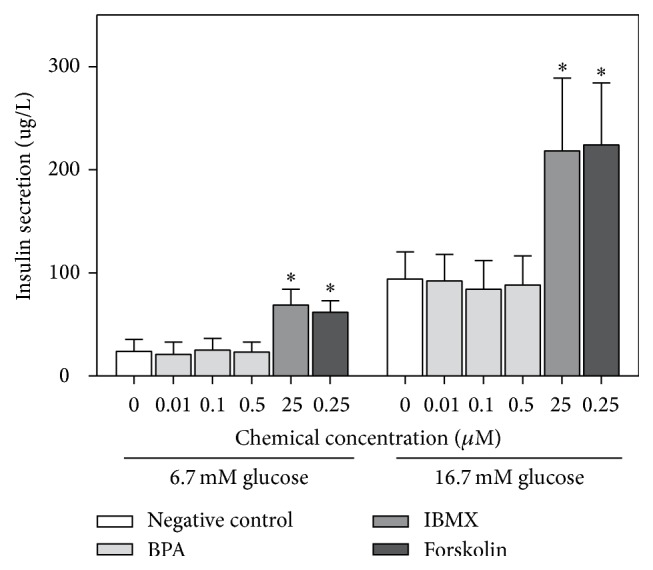
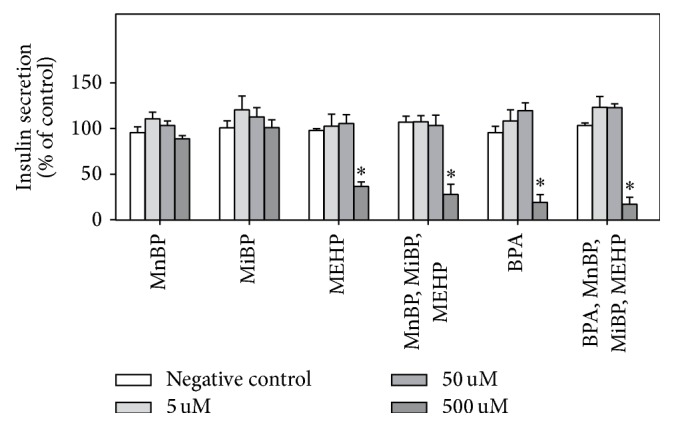
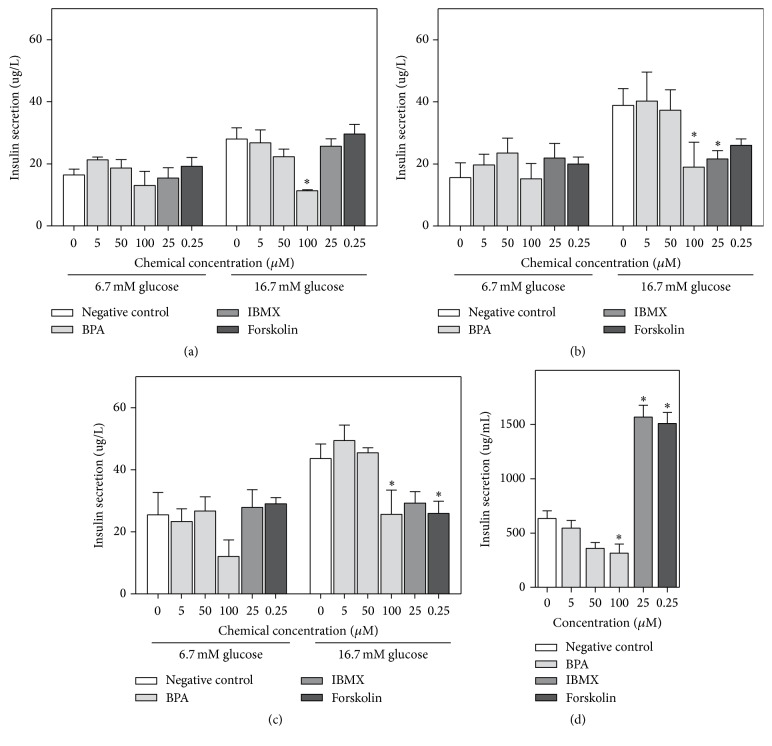
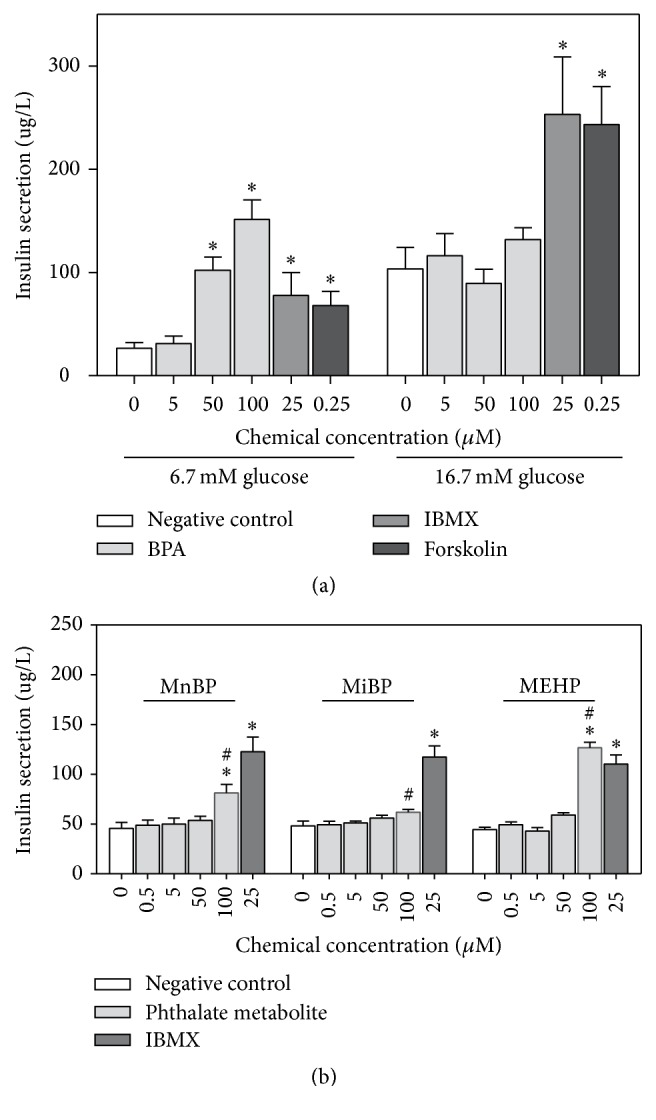
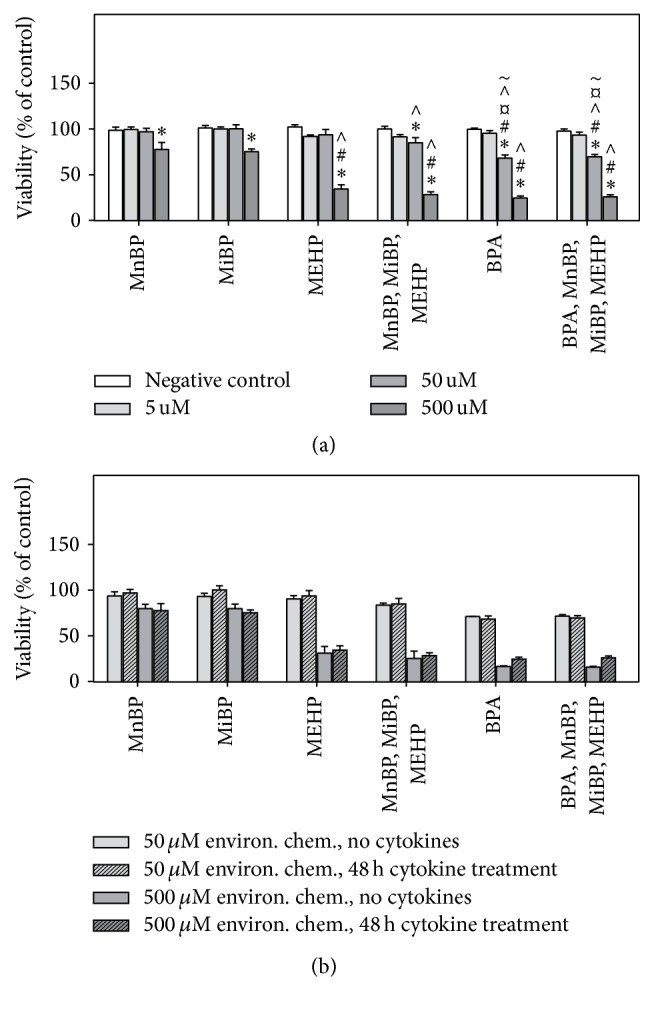
Bisphenol A (BPA) and phthalates are common environmental contaminants that have been proposed to influence incidence and development of types 1 and 2 diabetes. Thus, effects of BPA and three phthalate metabolites (monoisobutyl phthalate (MiBP), mono-n-butyl phthalate (MnBP), and mono-(2-ethylhexyl) phthalate (MEHP)) were studied in the pancreatic -cell line INS-1E, after 2-72 h of exposure to 5-500 M. Three endpoints relevant to accelerated development of types 1 or 2 diabetes were investigated: -cell viability, glucose-induced insulin secretion, and -cell susceptibility to cytokine-induced cell death. BPA and the phthalate metabolites reduced cellular viability after 72 h of exposure, with BPA as the most potent chemical. Moreover, BPA, MEHP, and MnBP increased insulin secretion after 2 h of simultaneous exposure to chemicals and glucose, with potency BPA > MEHP > MnBP. Longer chemical exposures (24-72 h) showed no consistent effects on glucose-induced insulin secretion, and none of the environmental chemicals affected susceptibility to cytokine-induced cell death. Overall, BPA was more potent than the investigated phthalate metabolites in affecting insulin secretion and viability in the INS-1E pancreatic -cells. In contrast to recent literature, concentrations with relevance to human exposures (1-500 nM) did not affect the investigated endpoints, suggesting that this experimental model displayed relatively low sensitivity to environmental chemical exposure.
双酚A(BPA)和邻苯二甲酸盐是常见的环境污染物,有人提出它们会影响1型和2型糖尿病的发病率和发展。因此,研究了双酚A和三种邻苯二甲酸酯代谢物(邻苯二甲酸单异丁酯(MiBP)、邻苯二甲酸单正丁酯(MnBP)和邻苯二甲酸单(2-乙基己基)酯(MEHP))在胰腺β细胞系INS-1E中,暴露于5-500μM 2-72小时后的影响。研究了与1型或2型糖尿病加速发展相关的三个终点:β细胞活力、葡萄糖诱导的胰岛素分泌以及β细胞对细胞因子诱导的细胞死亡的敏感性。暴露72小时后,双酚A和邻苯二甲酸酯代谢物降低了细胞活力,其中双酚A是最有效的化学物质。此外,在同时暴露于化学物质和葡萄糖2小时后,双酚A、MEHP和MnBP增加了胰岛素分泌,效力为双酚A>MEHP>MnBP。更长时间的化学暴露(24-72小时)对葡萄糖诱导的胰岛素分泌没有一致的影响,并且没有一种环境化学物质影响对细胞因子诱导的细胞死亡的敏感性。总体而言,在影响INS-1E胰腺β细胞的胰岛素分泌和活力方面,双酚A比所研究的邻苯二甲酸酯代谢物更有效。与最近的文献相反,与人类暴露相关的浓度(1-500 nM)并未影响所研究的终点,这表明该实验模型对环境化学暴露的敏感性相对较低。