Parsanezhad Mohammad Ebrahim, Jahromi Bahia Namavar, Rezaee Solmaz, Kooshesh Leila, Alaee Sanaz
Infertility Research Center, Shiraz University of Medical Sciences, Shiraz, Iran; Department of Obstetrics and Gynecology, School of Medicine, Shiraz University of Medical Sciences, Shiraz, Iran.
Infertility Research Center, Shiraz University of Medical Sciences, Shiraz, Iran; Department of Obstetrics and Gynecology, School of Medicine, Shiraz University of Medical Sciences, Shiraz, Iran; Reproductive Biology Research Center, Shiraz University of Medical Sciences, Shiraz, Iran.
Iran J Med Sci. 2017 Jan;42(1):57-65.
Despite the large number of papers published on the efficiency of different exogenous gonadotropins, no confirmed protocol exists. Therefore, the aim of the present study was to compare the efficacy of 4 exogenous gonadotropins in IVF/ICSI cycles.
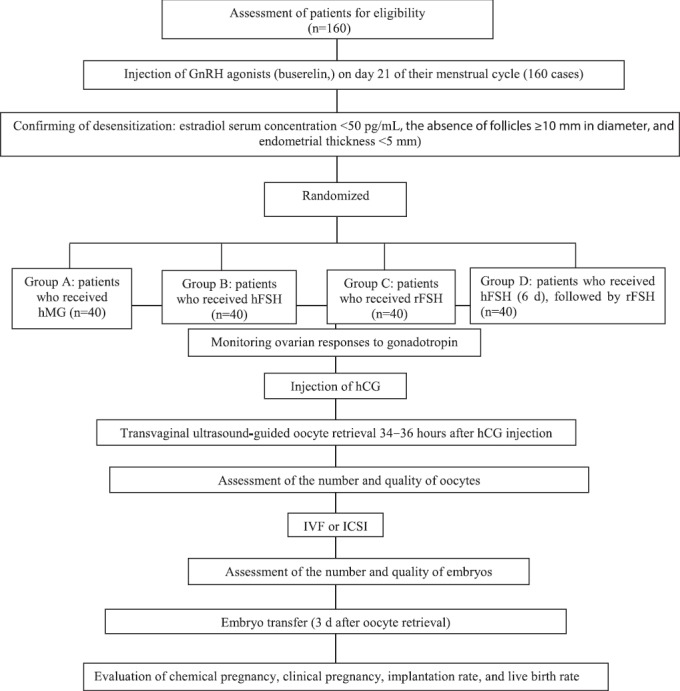
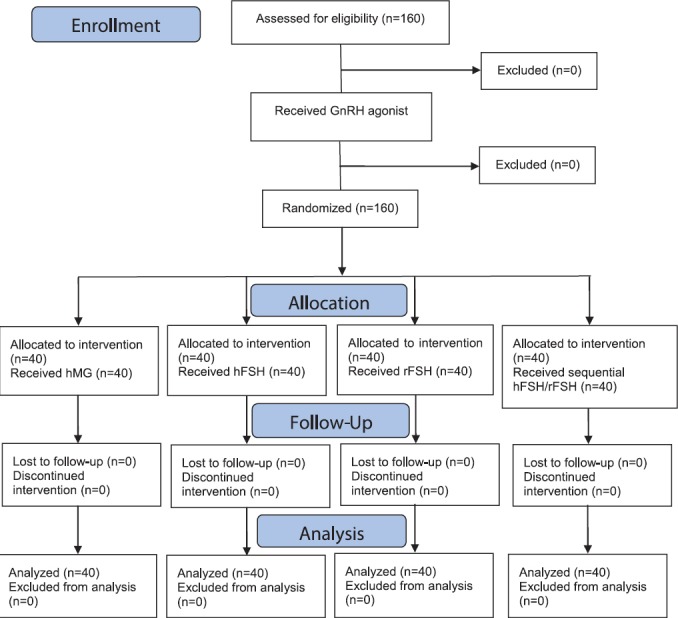
This study, performed from January 2014 to May 2014, recruited 160 women referred to Ghadir Mother and Child Hospital and Dena Hospital, Shiraz, Iran. The patients underwent standard downregulation and were randomly divided into 4 groups of A, B, C, and D and were administered hMG, hFSH, rFSH, and combined sequential hFSH/rFSH, respectively. Then, the duration of stimulation, number of oocytes and embryos as well as their quality, implantation rate, biochemical and clinical pregnancy rate, and live birth rate in each group were evaluated.
Group D patients required significantly fewer ampoules of FSH than did the women in groups A, B, and C (P=0.004). The duration of stimulation was significantly longer in group C than in groups A and D (P=0.030). The serum estradiol level was significantly higher in group D than in groups B and C (P=0.005). A significantly higher number of large-sized follicles was observed in group D than in group B (P=0.036).
Our data revealed no statistically significant differences in the mean oocyte number, embryo quality, clinical pregnancy rate, or live birth rate between the hMG, hFSH, rFSH, and sequential hFSH/rFSH protocols. However, several differences in the duration of stimulation, serum estradiol levels, and number of large-sized follicles were detected between the groups. IRCT201408116541N7.
尽管已发表了大量关于不同外源性促性腺激素有效性的论文,但尚无经证实的方案。因此,本研究的目的是比较4种外源性促性腺激素在体外受精/卵胞浆内单精子注射(IVF/ICSI)周期中的疗效。
本研究于2014年1月至2014年5月进行,招募了160名转诊至伊朗设拉子加迪尔母婴医院和德纳医院的女性。患者接受标准的降调节治疗,并随机分为A、B、C、D四组,分别给予人绝经期促性腺激素(hMG)、人卵泡刺激素(hFSH)、重组卵泡刺激素(rFSH)以及序贯应用hFSH/rFSH。然后,评估每组的刺激持续时间、卵母细胞和胚胎数量及其质量、着床率、生化妊娠率和临床妊娠率以及活产率。
D组患者所需的FSH安瓿数明显少于A、B、C组女性(P = 0.004)。C组的刺激持续时间明显长于A组和D组(P = 0.030)。D组的血清雌二醇水平明显高于B组和C组(P = 0.005)。D组观察到的大型卵泡数量明显多于B组(P = 0.036)。
我们的数据显示,hMG、hFSH、rFSH和序贯hFSH/rFSH方案在平均卵母细胞数量、胚胎质量、临床妊娠率或活产率方面无统计学显著差异。然而,各组之间在刺激持续时间、血清雌二醇水平和大型卵泡数量方面存在一些差异。IRCT201408116541N7。