Berry Vincent, Basson Laurent, Bogart Emilie, Mir Olivier, Blay Jean-Yves, Italiano Antoine, Bertucci François, Chevreau Christine, Clisant-Delaine Stéphanie, Liegl-Antzager Bernadette, Tresch-Bruneel Emmanuelle, Wallet Jennifer, Taieb Sophie, Decoupigny Emilie, Le Cesne Axel, Brodowicz Thomas, Penel Nicolas
Medical Oncology Department, Oscar Lambret Center, Lille, France.
Methodology and Clinical Research Platform, SIRIC OncoLille, Lille, France.
Cancer. 2017 Jun 15;123(12):2294-2302. doi: 10.1002/cncr.30661. Epub 2017 Mar 10.
In a placebo-controlled, randomized phase 2 trial (ClinicalTrials.gov identifier NCT01900743), regorafenib improved progression-free survival (PFS) for patients with doxorubicin-pretreated advanced nonadipocytic sarcoma. A quality-adjusted time without symptoms of progression or toxicity (Q-TWiST) post hoc exploratory analysis was applied to provide an integrated measure of its clinical benefit.
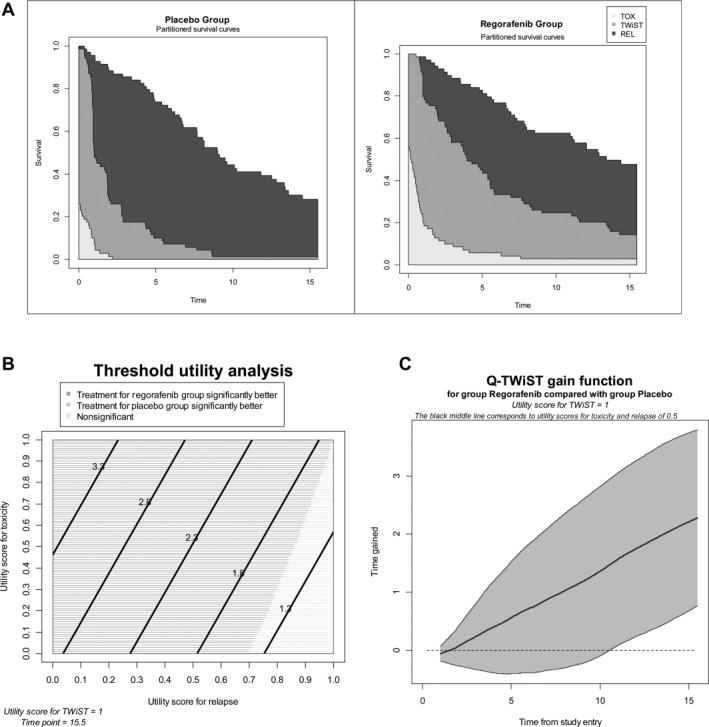
In the base-case analysis, each patient's overall survival (OS) was partitioned into 3 mutually exclusive health states: the time with a grade 3 or 4 adverse event (TOX), the time without symptoms of disease or grade 3 or 4 toxicity from treatment, and the time after tumor progression or relapse. The time spent in each state was weighted with a health-state utility associated with that state and was summed to calculate the Q-TWiST. The stability of the base-case analysis was explored with several sensitivity analyses.
In nonadipocytic sarcoma, the PFS was (4.0 months [2.6-5.5 months] with regorafenib vs 1.0 month [0.9-1.8 months] with a placebo; hazard ratio, 0.36 [0.25-0.53]; P < .0001); the OS was 13.4 months (8.6-17.3 months) with regorafenib and 9.0 months (6.8-12.5 months) with a placebo (hazard ratio, 0.67 [0.44-1.02]). With the classic definition of TOX (including all grade 3 and 4 clinical adverse events), the Q-TWiSTs were 8.0 months (7.0-9.0 months) with regorafenib and 5.7 months (4.9-6.4 months) with a placebo (P < .001).
For patients with doxorubicin-pretreated soft-tissue sarcoma, regorafenib significantly improved quality-adjusted survival in comparison with a placebo. Cancer 2017;123:2294-2302. © 2017 The Authors. Cancer published by Wiley Periodicals, Inc. on behalf of American Cancer Society. This is an open access article under the terms of the Creative Commons Attribution NonCommercial License, which permits use, distribution and reproduction in any medium, provided the original work is properly cited and is not used for commercial purposes.
在一项安慰剂对照的随机2期试验(ClinicalTrials.gov标识符NCT01900743)中,瑞戈非尼改善了多柔比星预处理的晚期非脂肪肉瘤患者的无进展生存期(PFS)。进行了一项事后探索性分析,采用质量调整的无进展或毒性症状时间(Q-TWiST)来综合衡量其临床获益。
在基础病例分析中,将每位患者的总生存期(OS)分为3个相互排斥的健康状态:发生3级或4级不良事件的时间(TOX)、无疾病症状或治疗引起的3级或4级毒性的时间,以及肿瘤进展或复发后的时间。每个状态所花费的时间用与该状态相关的健康状态效用值加权,并求和以计算Q-TWiST。通过多项敏感性分析探讨了基础病例分析的稳定性。
在非脂肪肉瘤中,瑞戈非尼组的PFS为4.0个月(2.6 - 5.5个月),安慰剂组为1.0个月(0.9 - 1.8个月);风险比为0.36(0.25 - 0.53);P <.0001);瑞戈非尼组的OS为13.4个月(8.6 - 17.3个月),安慰剂组为9.0个月(6.8 - 12.5个月)(风险比,0.67 [0.44 - 1.02])。按照TOX的经典定义(包括所有3级和4级临床不良事件),瑞戈非尼组的Q-TWiST为8.0个月(7.0 - 9.0个月),安慰剂组为5.7个月(4.9 - 6.4个月)(P <.001)。
对于多柔比星预处理的软组织肉瘤患者,与安慰剂相比,瑞戈非尼显著改善了质量调整生存期。《癌症》2017年;123:2294 - 2302。© 2017作者。《癌症》由威利期刊公司代表美国癌症协会出版。这是一篇根据知识共享署名非商业许可协议发布的开放获取文章,允许在任何媒介中使用、分发和复制,前提是正确引用原始作品且不用于商业目的。