Njunda Anna L, Nsagha Dickson S, Assob Jules C N, Kamga Henri L, Teyim Pride
Department of Medical Laboratory Sciences, Faculty of Health Sciences, University of Buea.
Department of Public Health and Hygiene, Faculty of Health Sciences, University of Buea.
J Public Health Afr. 2012 May 7;3(1):e2. doi: 10.4081/jphia.2012.e2. eCollection 2012 Mar 7.
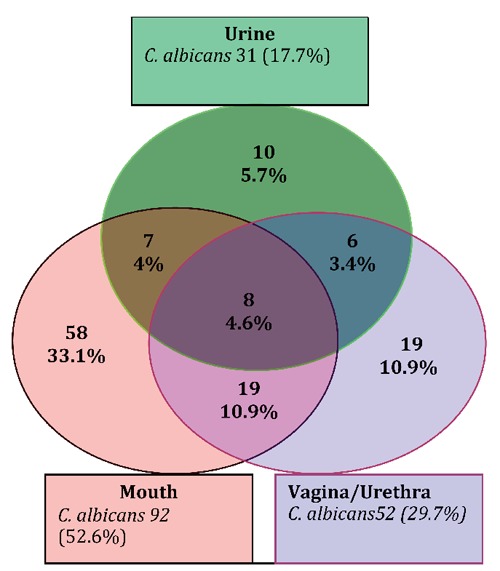
HIV and AIDS are major public health problems in Cameroon where the HIV prevalence is 5.5%. Candidiasis is the leading opportunistic mycosis in HIV and AIDS patients. The objective of this study was to determine the antifungal susceptibility pattern of in HIV and AIDS patients to eight antifungal agents in the Nylon Health District of Douala in Cameroon. Three hundred and four HIV and AIDS patients were recruited between March and August 2007 to participate in a cross-sectional study. All subjects who fulfilled the inclusion criteria were enrolled. Informed consent was obtained from all subjects before samples were collected. Three samples comprising oral swabs, vagina/urethra swabs and a mid-stream urine were collected from each subject. Specimens were cultured on sabouraud dextrose agar and isolates were identified using the germ tube technique. The disk diffusion method was used for antifungal susceptibility testing using eight antifungal agents. The prevalence of candidiasis in the study population was 67.8% (95% CI: 62.5-73.1%) and that of was 42.8% (95% CI: 37.2-48.4%). Oral swabs had the highest prevalence of followed by vaginal/urethral samples (52.6% vs. 29.7% respectively). Forty (30.8%) subjects had infection at more than one collection site. There was a statistically significant difference in the infectivity of with age, sex and site of infection (P<0.05). isolates were most sensitive to ketoconazole (80%) followed by econazole (64.6%) while fluconazole and 5-flurocytosin recorded the poorest sensitivities (22.9% 24.6%, respectively). There was a statistically significant difference in the sensitivity pattern of antifungal agents with respect to the site of isolation of the organism (P<0.05). Ketoconazole is the drug of choice for the treatment of infection in HIV and AIDS patients in the Nylon Health District of Douala, Cameroon.
在喀麦隆,艾滋病毒和艾滋病是主要的公共卫生问题,该国的艾滋病毒感染率为5.5%。念珠菌病是艾滋病毒和艾滋病患者中最主要的机会性真菌病。本研究的目的是确定喀麦隆杜阿拉尼龙卫生区艾滋病毒和艾滋病患者对八种抗真菌药物的抗真菌药敏模式。2007年3月至8月招募了304名艾滋病毒和艾滋病患者参与一项横断面研究。所有符合纳入标准的受试者均被纳入。在采集样本前,所有受试者均签署了知情同意书。从每位受试者采集三份样本,包括口腔拭子、阴道/尿道拭子和一份中段尿。标本接种于沙氏葡萄糖琼脂培养基上,采用芽管技术鉴定分离株。采用纸片扩散法使用八种抗真菌药物进行抗真菌药敏试验。研究人群中念珠菌病的患病率为67.8%(95%置信区间:62.5 - 73.1%),[此处原文缺失一种真菌名称]的患病率为42.8%(95%置信区间:37.2 - 48.4%)。口腔拭子中[该真菌名称]的患病率最高,其次是阴道/尿道样本(分别为52.6%和29.7%)。40名(30.8%)受试者在多个采集部位感染了[该真菌名称]。[该真菌名称]的感染率在年龄、性别和感染部位方面存在统计学显著差异(P<0.05)。[该真菌名称]分离株对酮康唑最敏感(80%),其次是益康唑(64.6%),而氟康唑和5-氟胞嘧啶的敏感性最差(分别为22.9%和24.6%)。抗真菌药物的药敏模式在分离该生物体的部位方面存在统计学显著差异(P<0.05)。在喀麦隆杜阿拉尼龙卫生区,酮康唑是治疗艾滋病毒和艾滋病患者[该真菌名称]感染的首选药物。