Lamichhane Keshav, Adhikari Nabaraj, Bastola Anup, Devkota Lina, Bhandari Parmananda, Dhungel Binod, Thapa Shrestha Upendra, Adhikari Bipin, Banjara Megha Raj, Rijal Komal Raj, Ghimire Prakash
Central Department of Microbiology, Tribhuvan University, Kathmandu, Nepal.
Sukraraj Tropical and Infectious Disease Hospital, Teku, Kathmandu, Nepal.
HIV AIDS (Auckl). 2020 Jun 15;12:211-220. doi: 10.2147/HIV.S255698. eCollection 2020.
Oropharyngeal candidiasis are the commonest fungal infections among HIV-positive patients. The main objective of this study was to explore biofilm-producing species causing oropharyngeal infections among HIV patients attending Sukraraj Tropical and Infectious Diseases Hospital (STIDH) in Kathmandu, Nepal.
Oropharyngeal swabs were collected from the HIV-positive patients between July and December 2019. A total of 174 oropharyngeal swabs were cultured on Sabouraud Dextrose Agar (SDA). All samples were inoculated on SDA slants supplemented with chloramphenicol and underwent incubation at 37°C for 24-48 hours. Any visible growth reported was processed for the identification of the species. species were differentiated based on the growth and colour of the isolates on CHROM agar candida. Biofilm production in species was determined by the microtiter plate method (MPM). Antifungal susceptibility testing was performed using the disc diffusion method.
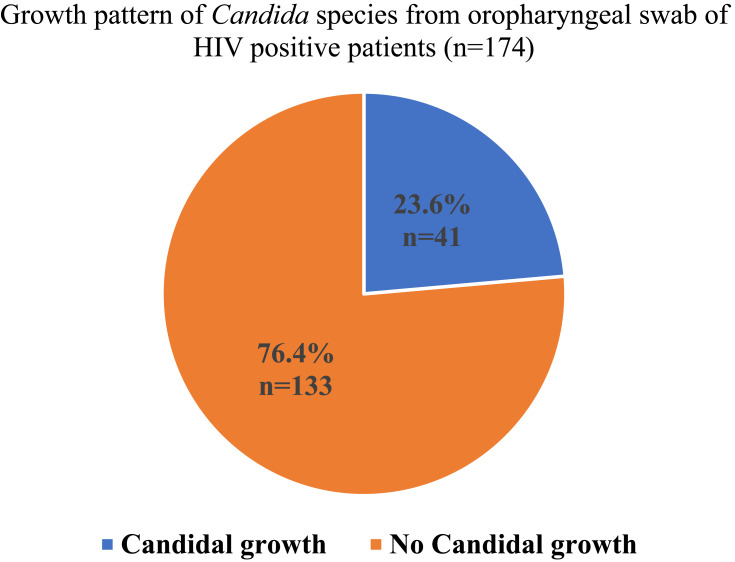
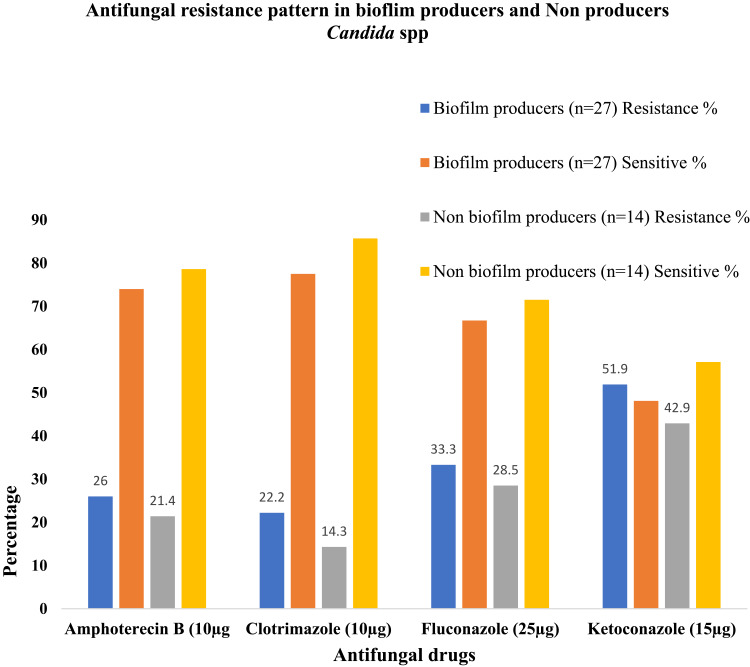
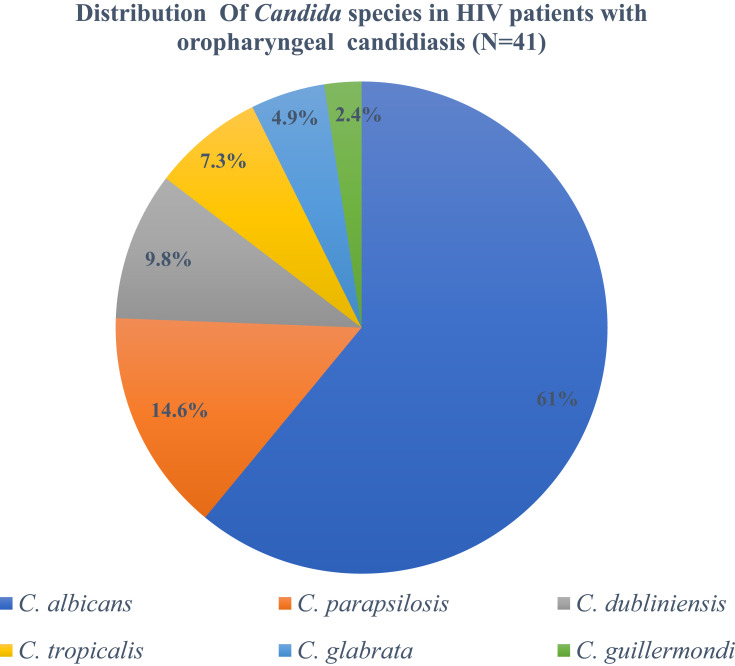
Among 174 oropharyngeal samples, 23.6% (n=41/174) of them had oropharyngeal infections and 36.6% of the oropharyngeal infections (15/41) had CD4 T-lymphocytes count below 200 cells/mm who were also active tobacco users (p<0.05). Among Candidial growth, 61% (25/41) were and 39% (16/41) were non-albicans. Of 41 spp., 65% (27/41) were biofilm producers. An equal proportion of (4 isolates) and non-albicans (4 isolates) were strong biofilm producers. isolates were sensitive towards clotrimazole (96%; 24/25) and fluconazole (92%; 23/25), whereas sensitivity towards ketoconazole was only 48% (12/25). Non-albicans was highly sensitive to amphotericin-B (62.5%; 10/16) followed by clotrimazole (56.2%; 9/16). The biofilm-producing isolates showed the highest resistivity (51.9%; 14/27) to ketoconazole and lowest (22.2%; 6/27) to clotrimazole.
Oropharyngeal candidiasis is a common opportunistic infection among HIV-infected individuals. The majority of cases of oropharyngeal candidiasis are caused by biofilm producers and non-albicans . Biofilm producers were more resistant towards commonly used antifungal drugs.
口腔念珠菌病是艾滋病毒阳性患者中最常见的真菌感染。本研究的主要目的是探索在尼泊尔加德满都苏克拉拉杰热带和传染病医院(STIDH)就诊的艾滋病毒患者中引起口腔感染的生物膜产生菌。
于2019年7月至12月从艾滋病毒阳性患者中采集口腔拭子。总共174份口腔拭子在沙氏葡萄糖琼脂(SDA)上培养。所有样本接种在添加氯霉素的SDA斜面上,于37°C孵育24 - 48小时。对任何报告的可见生长物进行菌种鉴定。根据念珠菌显色琼脂上分离菌的生长情况和颜色区分菌种。采用微量滴定板法(MPM)测定菌种中的生物膜形成情况。使用纸片扩散法进行抗真菌药敏试验。
在174份口腔样本中,23.6%(n = 41/174)有口腔感染,且36.6%的口腔感染患者(15/41)CD4 T淋巴细胞计数低于200个细胞/mm³且为现吸烟者(p<0.05)。在念珠菌生长中,61%(25/41)为白色念珠菌,39%(16/41)为非白色念珠菌。在41株念珠菌中,65%(27/41)为生物膜产生菌。白色念珠菌(4株)和非白色念珠菌(4株)中生物膜强产生菌的比例相同。白色念珠菌分离株对克霉唑敏感(96%;24/25)和氟康唑敏感(92%;23/25),而对酮康唑的敏感性仅为48%(12/25)。非白色念珠菌对两性霉素B高度敏感(62.5%;10/16),其次是克霉唑(56.2%;9/16)。产生生物膜的白色念珠菌分离株对酮康唑的耐药性最高(51.9%;14/27),对克霉唑的耐药性最低(22.2%;6/27)。
口腔念珠菌病是艾滋病毒感染者中常见的机会性感染。大多数口腔念珠菌病病例由生物膜产生菌白色念珠菌和非白色念珠菌引起。产生生物膜的白色念珠菌对常用抗真菌药物的耐药性更强。