Wertli Maria M, Brunner Florian, Steurer Johann, Held Ulrike
Horten Centre for Patient Oriented Research and Knowledge Transfer, University of Zurich, Pestalozzistrasse 24, Zurich, Switzerland.
Division of General Internal Medicine, Bern University Hospital, Bern University, Freiburgstrasse 8, Bern, Switzerland.
PLoS One. 2017 Mar 16;12(3):e0173688. doi: 10.1371/journal.pone.0173688. eCollection 2017.
Since 2007, the Budapest criteria are recommended for the diagnosis of Complex Regional Pain Syndrome (CRPS) 1. The usefulness of bone scintigraphy (BS, index test) for the diagnosis of CRPS 1 remains controversial. Imperfect reference tests (RT) result in underestimation of the diagnostic accuracy of BS. Further, biased results can occur when a dependency between the RT and BS exists. The objective was to assess the impact of different RTs, specifically the Budapest criteria, and the assumed imperfect nature of the RT on the diagnostic accuracy of BS. Further, we analyzed the association between baseline characteristics and positive BS in patients with CRPS 1.
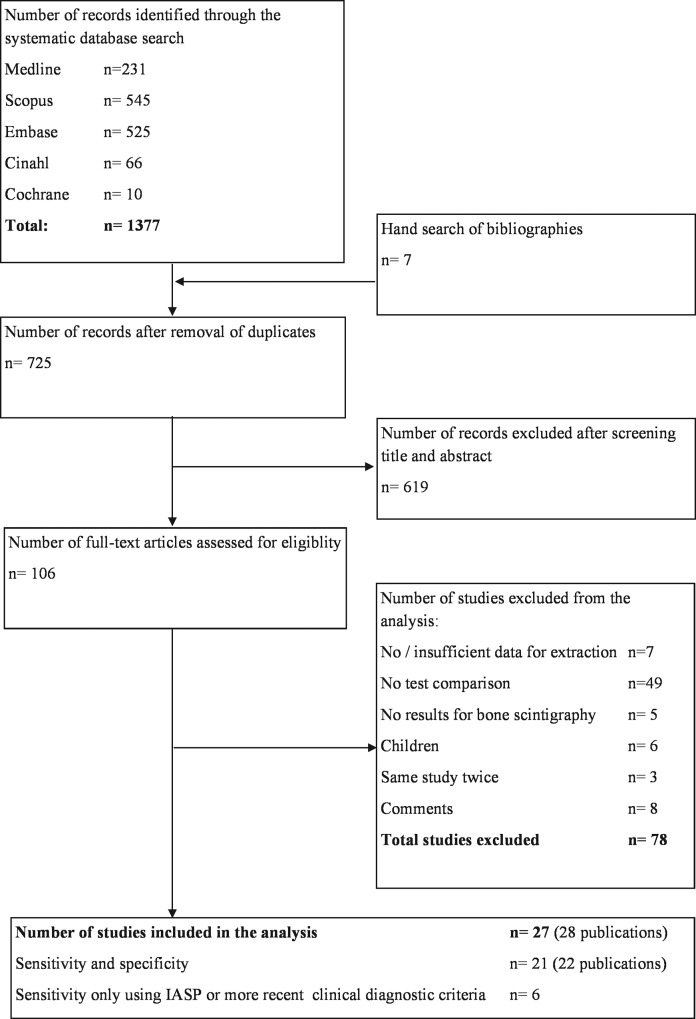
Systematic literature review and Bayesian meta-analysis to assess the test accuracy of BS with and without accounting for the imperfect nature of the RT. We examined correlations (Spearman correlation coefficients / Wilcoxon tests) between baseline characteristics and the proportion of positive BS in patients with CRPS 1.
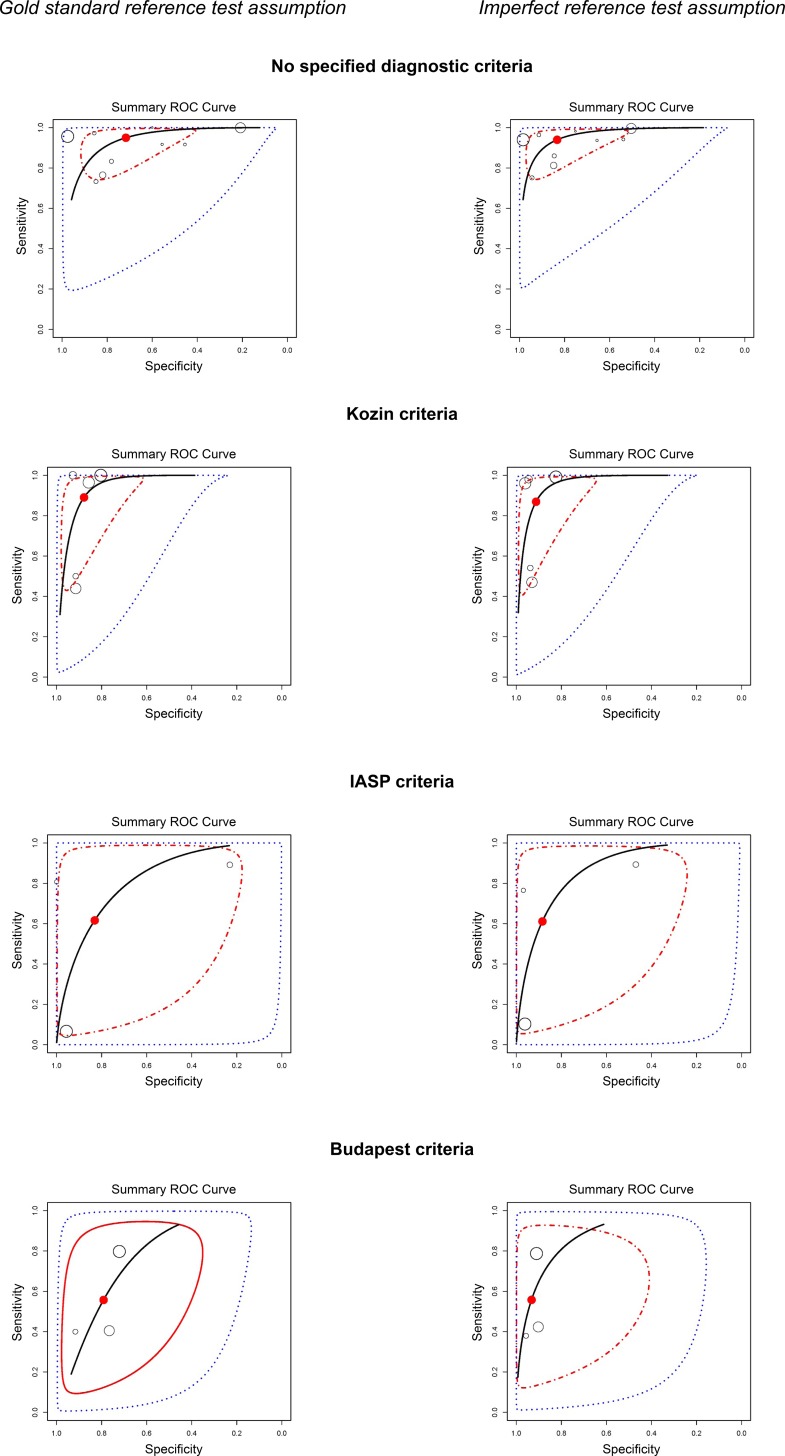
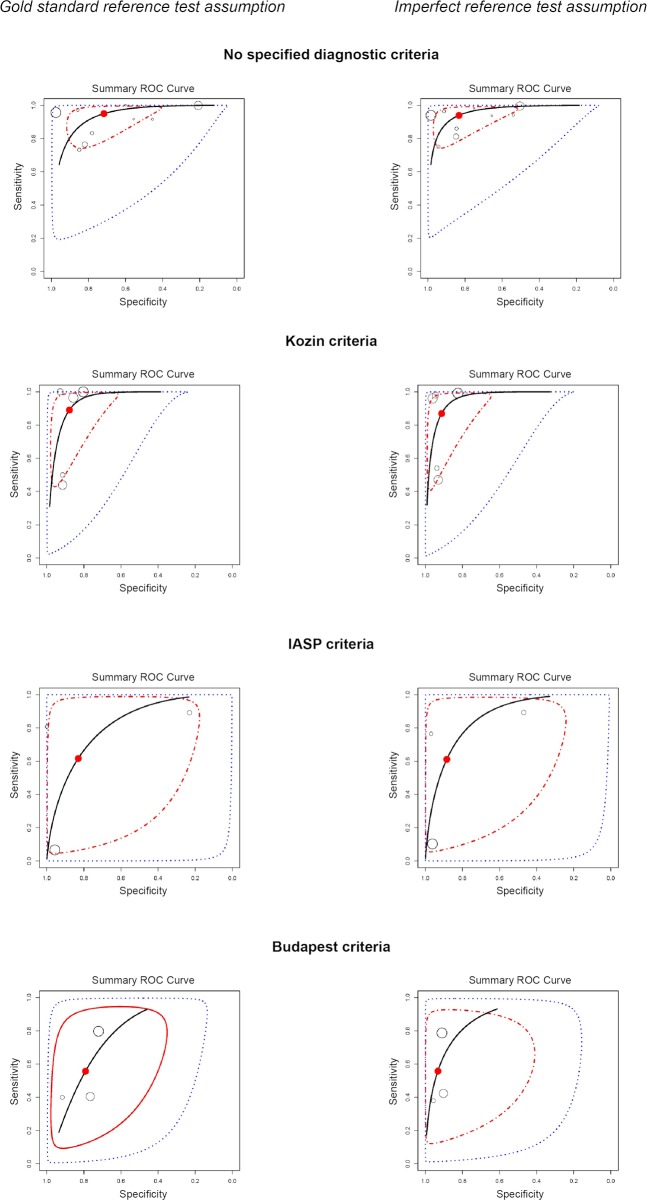
The pooled sensitivity was 0.804 (95% credible interval (CI) 0.225-1.0, 21 studies) and specificity 0.853 (95%CI 0.278-1.00). Sensitivity and specificity of BS increased when accounting for the imperfect nature of the RT. However, in studies using Budapest criteria as reference, the sensitivity decreased (0.551; 95% CI 0.046-1) and the specificity increased (0.935; 95% CI 0.306-1). Shorter disease duration and a higher proportion of males were associated with a higher proportion of positive BS (27 studies, disease duration <52 weeks Wilcoxon test p = 0.047, female proportion Spearman correlation -0.63, p = 0.009).
Compared to the accepted Budapest diagnostic criteria BS cannot be used to rule-in the diagnosis of CRPS 1. In patients with negative BS CRPS 1 is less likely the underlying illness. Studies using older or no diagnostic criteria should not be used to evaluate the diagnostic accuracy of BS in CRPS 1.
自2007年以来,布达佩斯标准被推荐用于诊断复杂性区域疼痛综合征(CRPS)1型。骨闪烁显像(BS,索引测试)对CRPS 1型诊断的有用性仍存在争议。不完善的参考测试(RT)会导致对BS诊断准确性的低估。此外,当RT和BS之间存在依赖性时,可能会出现有偏差的结果。目的是评估不同的RT,特别是布达佩斯标准,以及RT假定的不完善性质对BS诊断准确性的影响。此外,我们分析了CRPS 1型患者的基线特征与阳性BS之间的关联。
进行系统文献综述和贝叶斯荟萃分析,以评估考虑和不考虑RT不完善性质时BS的测试准确性。我们检查了CRPS 1型患者基线特征与阳性BS比例之间的相关性(斯皮尔曼相关系数/威尔科克森检验)。
合并敏感性为0.804(95%可信区间(CI)0.225 - 1.0,21项研究),特异性为0.853(95%CI 0.278 - 1.00)。考虑RT的不完善性质时,BS的敏感性和特异性增加。然而,在使用布达佩斯标准作为参考的研究中,敏感性降低(0.551;95%CI 0.046 - 1),特异性增加(0.935;95%CI 0.306 - 1)。病程较短和男性比例较高与阳性BS比例较高相关(27项研究,病程<52周,威尔科克森检验p = 0.047,女性比例斯皮尔曼相关系数 -0.63,p = 0.009)。
与公认的布达佩斯诊断标准相比,BS不能用于确诊CRPS 1型。BS结果为阴性的患者,CRPS 1型作为潜在疾病的可能性较小。使用较旧或无诊断标准的研究不应被用于评估BS对CRPS 1型的诊断准确性。