Lorenz Katrin, Scheller Yvonne, Bell Katharina, Grus Franz, Ponto Katharina A, Bock Felix, Cursiefen Claus, Flach Jens, Gehring Marta, Peto Tunde, Silva Rufino, Tal Yossi, Pfeiffer Norbert
Department of Ophthalmology, University Medical Center, Johannes Gutenberg-University Mainz, Langenbeckstr. 1, D-55131, Mainz, Germany.
Center for Thrombosis and Hemostasis, University Medical Center, Johannes Gutenberg-University Mainz, Langenbeckstr. 1, 55131, Mainz, Germany.
Trials. 2017 Mar 16;18(1):128. doi: 10.1186/s13063-017-1861-3.
Neovascular glaucoma (NVG) is rare, comprising only 3.9% of all glaucoma cases. The most common cause of NVG is ischaemic central retinal vein occlusion (iCRVO). NVG frequently results in blindness and painful end-stage glaucomatous damage leading to the need for enucleation. Currently, there is no preventive therapy for NVG following iCRVO. Rescue treatments have severe drawbacks. Accordingly, there is a great need for preventing the often visually devastating outcomes of NVG. The STRONG study is designed to test whether the topically active anti-angiogenic agent aganirsen is able to inhibit the formation of neovascularisation leading to the development of secondary NVG in eyes with iCRVO. At the same time, STRONG will provide important information on the natural course of iCRVO and NVG in a large and well-characterised cohort of such patients.
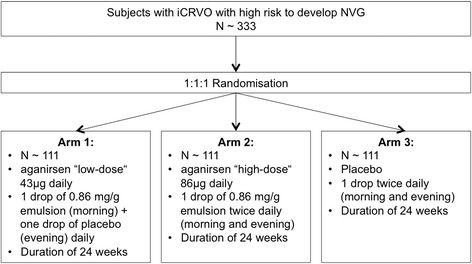
METHODS/DESIGN: This protocol describes a phase II/III, prospective, randomised, placebo-controlled, double-masked, three-armed multicentre study for the investigation of aganirsen, a new topical treatment for iCRVO in order to prevent NVG. The study will evaluate the efficacy of two different doses of this newly developed antisense oligonucleotide formulated in an eye emulsion to avoid new vessel formation by blocking insulin receptor substrate-1 (IRS)-1. This leads to subsequent down-regulation of both angiogenic as well as proinflammatory growth factors such as vascular endothelial growth factor (VEGF) and tumour necrosis factor (TNF). Eligible patients (n = 333) will be treated with topical aganirsen or placebo for a period of 24 weeks. They will also be invited to participate in substudies involving analysis of gonioscopic images, detection of biomarkers for NVG and risk factors for iCRVO.
The STRONG study has the potential to offer a new treatment modality for patients suffering from iCRVO with a high risk of developing NVG. The topical administration can reduce patients' burden and risk related to rescue treatment, such as destructive laser treatment or enucleation, but requires a high level of patient compliance.
EudraCT: 2014-000239-18; ClinicalTrials.gov, ID: NCT02947867 . (Registered on 15 October 2016); see also http://strong-nvg.com .
新生血管性青光眼(NVG)较为罕见,仅占所有青光眼病例的3.9%。NVG最常见的病因是缺血性视网膜中央静脉阻塞(iCRVO)。NVG常导致失明和疼痛性终末期青光眼性损害,进而需要进行眼球摘除术。目前,对于iCRVO后发生的NVG尚无预防性治疗方法。挽救性治疗存在严重缺陷。因此,迫切需要预防NVG通常会导致的严重视力损害后果。STRONG研究旨在测试局部活性抗血管生成药物阿加尼森是否能够抑制新生血管形成,从而预防iCRVO患者发生继发性NVG。同时,STRONG研究将在一大组特征明确的此类患者中提供有关iCRVO和NVG自然病程的重要信息。
方法/设计:本方案描述了一项II/III期、前瞻性、随机、安慰剂对照、双盲、三臂多中心研究,旨在研究阿加尼森(一种用于预防iCRVO患者发生NVG的新型局部治疗药物)。该研究将评估两种不同剂量的这种新开发的反义寡核苷酸(配制成眼用乳剂)的疗效,其通过阻断胰岛素受体底物-1(IRS)-1来避免新血管形成。这会导致血管生成和促炎生长因子(如血管内皮生长因子(VEGF)和肿瘤坏死因子(TNF))随后下调。符合条件的患者(n = 333)将接受局部阿加尼森或安慰剂治疗24周。他们还将被邀请参加涉及房角镜图像分析、检测NVG生物标志物和iCRVO危险因素的子研究。
STRONG研究有可能为有发生NVG高风险的iCRVO患者提供一种新的治疗方式。局部给药可减轻患者与挽救性治疗相关(如破坏性激光治疗或眼球摘除术)的负担和风险,但需要患者高度依从。
欧洲临床试验数据库(EudraCT):2014-000239-18;美国国立医学图书馆临床试验注册库(ClinicalTrials.gov),标识符:NCT02947867。(于2016年10月15日注册);另见http://strong-nvg.com 。