Quinlivan Leah, Cooper Jayne, Meehan Declan, Longson Damien, Potokar John, Hulme Tom, Marsden Jennifer, Brand Fiona, Lange Kezia, Riseborough Elena, Page Lisa, Metcalfe Chris, Davies Linda, O'Connor Rory, Hawton Keith, Gunnell David, Kapur Nav
Leah Quinlivan, PhD, Jayne Cooper, PhD, Centre for Suicide Prevention, Manchester Academic Health Science Centre, University of Manchester, Manchester; Declan Meehan, RMN, Damien Longson, FRCPsych, Greater Manchester Mental Health and NHS Foundation Trust, Manchester; John Potokar, MRCPsych, Avon & Wiltshire Mental Health Foundation Trust, Bristol, University Hospitals Bristol, NHS Foundation Trust, Bristol and School of Social and Community Medicine, University of Bristol, Bristol; Tom Hulme, MSc, University Hospitals Bristol, NHS Foundation Trust, Bristol, Bristol; Jennifer Marsden, BA, Derbyshire Healthcare NHS Foundation Trust, Derby; Fiona Brand, RMN, Kezia Lange, MRCPsych, Oxford Health NHS Foundation Trust, Oxford; Elena Riseborough, RMN, Lisa Page, PhD, Sussex Partnership NHS Foundation Trust, Worthing; Chris Metcalfe, PhD, School of Social and Community Medicine, University of Bristol, Bristol; Linda Davies, Institute of Population Health, University of Manchester, Manchester; Rory O' Connor, PhD, Institute of Health and Wellbeing, University of Glasgow, Glasgow; Keith Hawton, DSc, Centre for Suicide Research, University Department of Psychiatry, Warneford Hospital, Oxford; David Gunnell, DSc, School of Social and Community Medicine, University of Bristol, Bristol; Nav Kapur, MBChB, MMedSci, MD, FRCPsych, Centre for Suicide Prevention, Manchester Academic Health Science Centre, University of Manchester, and Greater Manchester Mental Health NHS Foundation Trust, Manchester, UK
Leah Quinlivan, PhD, Jayne Cooper, PhD, Centre for Suicide Prevention, Manchester Academic Health Science Centre, University of Manchester, Manchester; Declan Meehan, RMN, Damien Longson, FRCPsych, Greater Manchester Mental Health and NHS Foundation Trust, Manchester; John Potokar, MRCPsych, Avon & Wiltshire Mental Health Foundation Trust, Bristol, University Hospitals Bristol, NHS Foundation Trust, Bristol and School of Social and Community Medicine, University of Bristol, Bristol; Tom Hulme, MSc, University Hospitals Bristol, NHS Foundation Trust, Bristol, Bristol; Jennifer Marsden, BA, Derbyshire Healthcare NHS Foundation Trust, Derby; Fiona Brand, RMN, Kezia Lange, MRCPsych, Oxford Health NHS Foundation Trust, Oxford; Elena Riseborough, RMN, Lisa Page, PhD, Sussex Partnership NHS Foundation Trust, Worthing; Chris Metcalfe, PhD, School of Social and Community Medicine, University of Bristol, Bristol; Linda Davies, Institute of Population Health, University of Manchester, Manchester; Rory O' Connor, PhD, Institute of Health and Wellbeing, University of Glasgow, Glasgow; Keith Hawton, DSc, Centre for Suicide Research, University Department of Psychiatry, Warneford Hospital, Oxford; David Gunnell, DSc, School of Social and Community Medicine, University of Bristol, Bristol; Nav Kapur, MBChB, MMedSci, MD, FRCPsych, Centre for Suicide Prevention, Manchester Academic Health Science Centre, University of Manchester, and Greater Manchester Mental Health NHS Foundation Trust, Manchester, UK.
Br J Psychiatry. 2017 Jun;210(6):429-436. doi: 10.1192/bjp.bp.116.189993. Epub 2017 Mar 16.
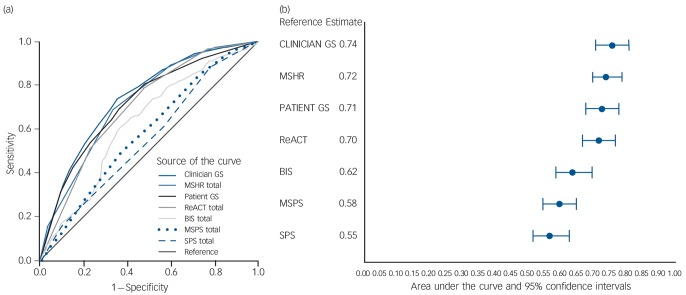
Scales are widely used in psychiatric assessments following self-harm. Robust evidence for their diagnostic use is lacking.To evaluate the performance of risk scales (Manchester Self-Harm Rule, ReACT Self-Harm Rule, SAD PERSONS scale, Modified SAD PERSONS scale, Barratt Impulsiveness Scale); and patient and clinician estimates of risk in identifying patients who repeat self-harm within 6 months.A multisite prospective cohort study was conducted of adults aged 18 years and over referred to liaison psychiatry services following self-harm. Scale cut-offs were evaluated using diagnostic accuracy statistics. The area under the curve (AUC) was used to determine optimal cut-offs and compare global accuracy.In total, 483 episodes of self-harm were included in the study. The episode-based 6-month repetition rate was 30% ( = 145). Sensitivity ranged from 1% (95% CI 0-5) for the SAD PERSONS scale, to 97% (95% CI 93-99) for the Manchester Self-Harm Rule. Positive predictive values ranged from 13% (95% CI 2-47) for the Modified SAD PERSONS Scale to 47% (95% CI 41-53) for the clinician assessment of risk. The AUC ranged from 0.55 (95% CI 0.50-0.61) for the SAD PERSONS scale to 0.74 (95% CI 0.69-0.79) for the clinician global scale. The remaining scales performed significantly worse than clinician and patient estimates of risk (<0.001).Risk scales following self-harm have limited clinical utility and may waste valuable resources. Most scales performed no better than clinician or patient ratings of risk. Some performed considerably worse. Positive predictive values were modest. In line with national guidelines, risk scales should not be used to determine patient management or predict self-harm.
量表在自伤后的精神科评估中被广泛使用。但其用于诊断的有力证据尚缺。为评估风险量表(曼彻斯特自伤规则、ReACT自伤规则、SAD PERSONS量表、改良SAD PERSONS量表、巴拉特冲动性量表);以及患者和临床医生对风险的评估在识别6个月内再次自伤患者方面的表现。对18岁及以上因自伤转诊至联络精神科服务的成年人进行了一项多中心前瞻性队列研究。使用诊断准确性统计数据评估量表的临界值。曲线下面积(AUC)用于确定最佳临界值并比较整体准确性。
该研究共纳入483例自伤事件。基于事件的6个月重复率为30%(=145)。敏感性范围从SAD PERSONS量表的1%(95%CI 0 - 5)到曼彻斯特自伤规则的97%(95%CI 93 - 99)。阳性预测值范围从改良SAD PERSONS量表的13%(95%CI 2 - 47)到临床医生风险评估的47%(95%CI 41 - 53)。AUC范围从SAD PERSONS量表的0.55(95%CI 0.50 - 0.61)到临床医生整体量表的0.74(95%CI 0.69 - 0.79)。其余量表的表现明显比临床医生和患者对风险的评估差(<0.001)。
自伤后的风险量表临床效用有限,可能会浪费宝贵资源。大多数量表的表现并不优于临床医生或患者对风险的评级。有些则差得多。阳性预测值适中。根据国家指南,风险量表不应被用于确定患者管理或预测自伤。