Seo Ga Young, Lim Yoongho, Koh Dongsoo, Huh Jung Sik, Hyun Changlim, Kim Young Mee, Cho Moonjae
Department of Biochemistry School of Medicine, Jeju National University, Jeju, Korea.
Division of Bioscience and Biotechnology, Konkuk University, Seoul, Korea.
Exp Mol Med. 2017 Mar 17;49(3):e302. doi: 10.1038/emm.2016.167.
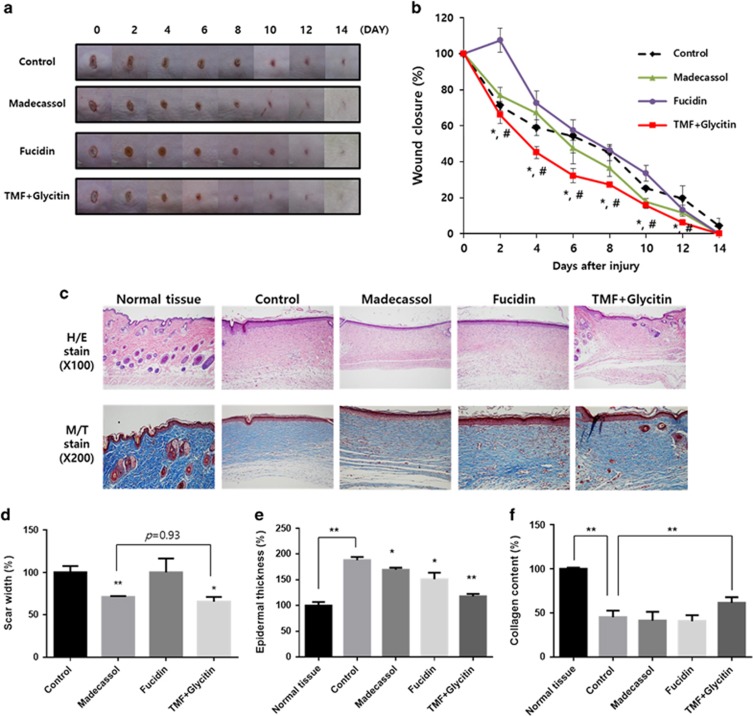
Keratinocyte-fibroblast interactions are critical for skin repair after injury. During the proliferative phase of wound healing, proliferation, migration and differentiation of these cells are the major mechanisms leading to tissue remodeling. We have previously reported that glycitin, a major soy isoflavone, stimulates dermal fibroblast proliferation; and the phytochemical, 4',6,7-trimethoxyisoflavone (TMF), induces migration of HaCaT keratinocyte cells. We therefore investigated whether these compounds display synergistic effects on skin cells during wound healing in vitro and in vivo. Co-treatment with TMF and glycitin synergistically promotes the proliferation and migration of both keratinocytes and dermal fibroblasts, with a 1:1 ratio of these compounds showing the greatest efficacy in our co-culture system. This keratinocyte-fibroblast interaction occurred via the secretion of TGF-β, and the induction of differentiation and proliferation was confirmed in both indirect and direct co-culture assays. In an excisional and burn wound animal model, mice treated with a 1:1 ratio of TMF and glycitin showed faster wound closure, regeneration and scar reduction than even the positive control drug. These data indicate that two isoflavones, TMF and glycitin, act synergistically to promote wound healing and anti-scarring and could potentially be developed together as a bioactive therapeutic for wound treatment.
角质形成细胞与成纤维细胞的相互作用对损伤后的皮肤修复至关重要。在伤口愈合的增殖阶段,这些细胞的增殖、迁移和分化是导致组织重塑的主要机制。我们之前报道过,大豆主要异黄酮黄豆黄素能刺激真皮成纤维细胞增殖;植物化学物质4',6,7-三甲氧基异黄酮(TMF)能诱导HaCaT角质形成细胞迁移。因此,我们研究了这些化合物在体外和体内伤口愈合过程中对皮肤细胞是否具有协同作用。TMF与黄豆黄素联合处理可协同促进角质形成细胞和真皮成纤维细胞的增殖与迁移,在我们的共培养系统中,这两种化合物以1:1的比例显示出最大功效。这种角质形成细胞与成纤维细胞的相互作用是通过转化生长因子-β(TGF-β)的分泌发生的,并且在间接和直接共培养试验中均证实了分化和增殖的诱导。在切除性和烧伤伤口动物模型中,用1:1比例的TMF和黄豆黄素处理的小鼠显示出比阳性对照药物更快的伤口闭合、再生和瘢痕减轻。这些数据表明,两种异黄酮TMF和黄豆黄素协同作用促进伤口愈合和抗瘢痕形成,并且有可能一起开发成为用于伤口治疗的生物活性疗法。