Kim Misun, Jeffery Kate J, Maguire Eleanor A
Wellcome Trust Centre for Neuroimaging, Institute of Neurology, University College London, London WC1N 3BG, United Kingdom, and.
Institute of Behavioural Neuroscience, Division of Psychology and Language Sciences, University College London, London WC1E 6BT, United Kingdom.
J Neurosci. 2017 Apr 19;37(16):4270-4279. doi: 10.1523/JNEUROSCI.2703-16.2017. Epub 2017 Mar 20.
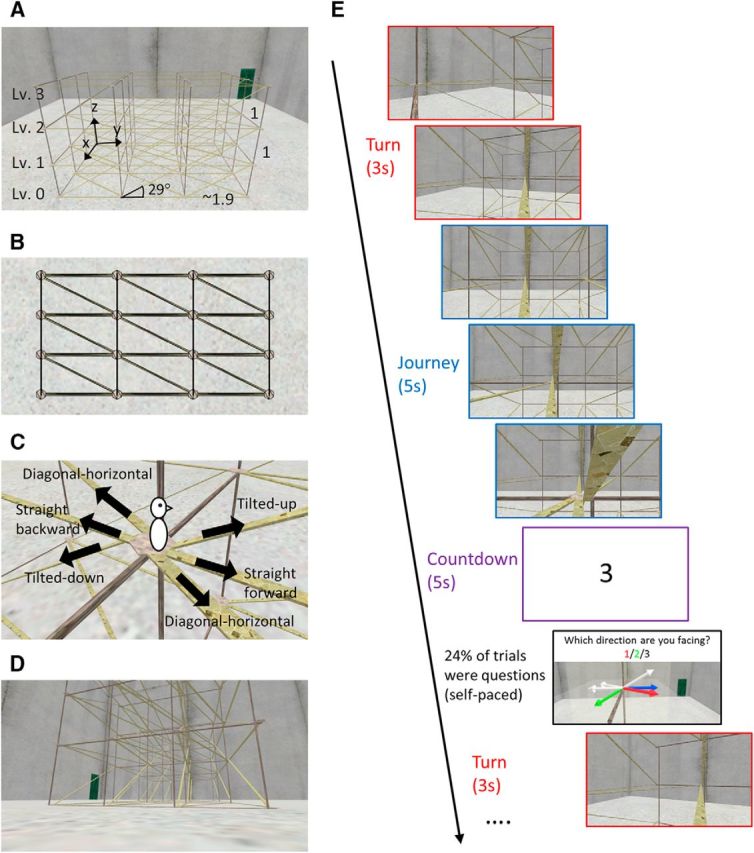
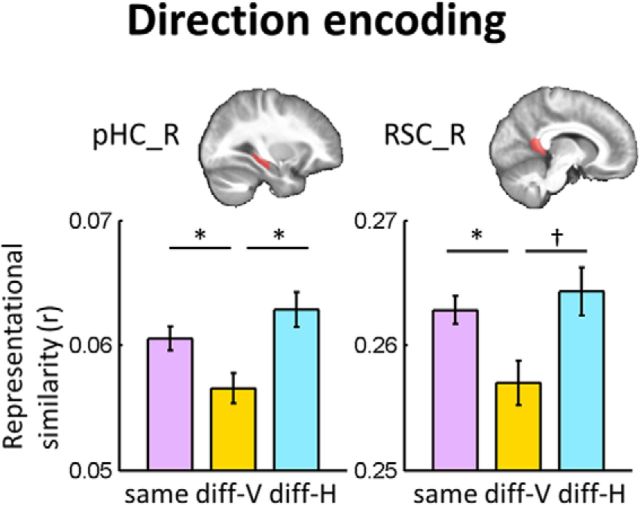
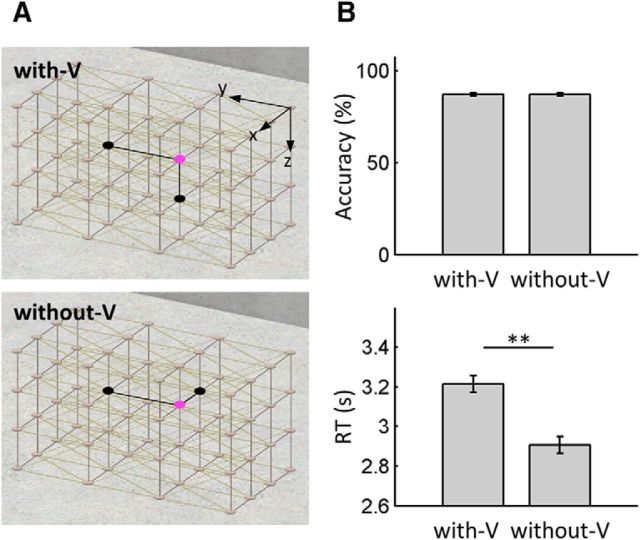
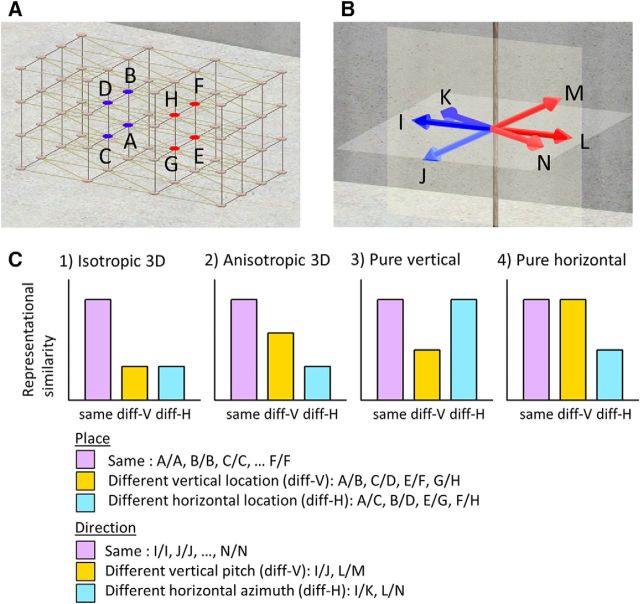
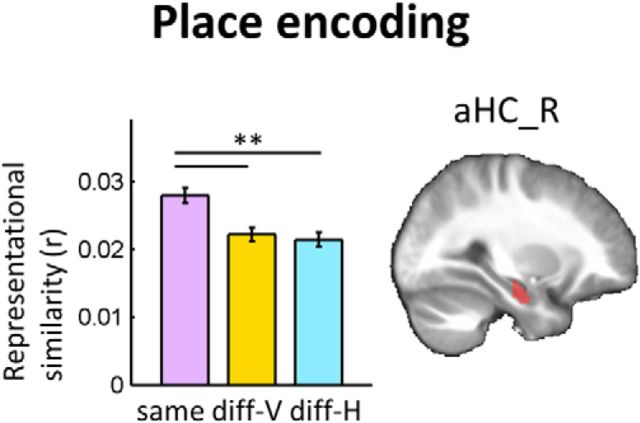
The spatial world is three dimensional (3D) and humans and other animals move both horizontally and vertically within it. Extant neuroscientific studies have typically investigated spatial navigation on a horizontal 2D plane, leaving much unknown about how 3D spatial information is represented in the brain. Specifically, horizontal and vertical information may be encoded in the same or different neural structures with equal or unequal sensitivity. Here, we investigated these possibilities using fMRI while participants were passively moved within a 3D lattice structure as if riding a rollercoaster. Multivoxel pattern analysis was used to test for the existence of information relating to where and in which direction participants were heading in this virtual environment. Behaviorally, participants had similarly accurate memory for vertical and horizontal locations and the right anterior hippocampus (HC) expressed place information that was sensitive to changes along both horizontal and vertical axes. This is suggestive of isotropic 3D place encoding. In contrast, participants indicated their heading direction faster and more accurately when they were heading in a tilted-up or tilted-down direction. This direction information was expressed in the right retrosplenial cortex and posterior HC and was only sensitive to vertical pitch, which could reflect the importance of the vertical (gravity) axis as a reference frame. Overall, our findings extend previous knowledge of how we represent the spatial world and navigate within it by taking into account the important third dimension. The spatial world is 3D. We can move horizontally across surfaces, but also vertically, going up slopes or stairs. Little is known about how the brain supports representations of 3D space. A key question is whether horizontal and vertical information is equally well represented. Here, we measured fMRI response patterns while participants moved within a virtual 3D environment and found that the anterior hippocampus (HC) expressed location information that was sensitive to the vertical and horizontal axes. In contrast, information about heading direction, found in retrosplenial cortex and posterior HC, favored the vertical axis, perhaps due to gravity effects. These findings provide new insights into how we represent our spatial 3D world and navigate within it.
空间世界是三维的(3D),人类和其他动物在其中进行水平和垂直移动。现有的神经科学研究通常在水平二维平面上研究空间导航,对于三维空间信息在大脑中如何表征仍知之甚少。具体而言,水平和垂直信息可能以相同或不同的神经结构进行编码,且敏感度相等或不等。在此,我们使用功能磁共振成像(fMRI)研究了这些可能性,让参与者在三维晶格结构中被动移动,就像坐过山车一样。多体素模式分析用于测试在这个虚拟环境中与参与者所在位置及前进方向相关信息的存在情况。在行为上,参与者对垂直和水平位置具有相似的准确记忆,右侧前海马体(HC)表达了对水平和垂直轴变化敏感的位置信息。这表明存在各向同性的三维位置编码。相比之下,当参与者向上或向下倾斜方向前进时,他们能更快、更准确地指出前进方向。这种方向信息在右侧压后皮质和海马体后部表达,并且仅对垂直俯仰敏感,这可能反映了垂直(重力)轴作为参考框架的重要性。总体而言,我们的研究结果扩展了此前关于我们如何表征空间世界并在其中导航的知识,通过考虑重要的第三维度。空间世界是三维的。我们可以在水平面上横向移动,但也能垂直移动,比如爬坡或上楼梯。关于大脑如何支持三维空间表征,我们知之甚少。一个关键问题是水平和垂直信息是否得到同等良好的表征。在此,我们在参与者在虚拟三维环境中移动时测量了功能磁共振成像响应模式,发现前海马体(HC)表达了对垂直和水平轴敏感的位置信息。相比之下,在压后皮质和海马体后部发现的关于前进方向的信息更倾向于垂直轴,这可能是由于重力效应。这些发现为我们如何表征三维空间世界并在其中导航提供了新的见解。