Medical Research Council Brain Network Dynamics Unit, Nuffield Department of Clinical Neurosciences, University of Oxford, Mansfield Road, Oxford OX1 3TH, UK.
Wellcome Centre for Integrative Neuroimaging, University of Oxford, FMRIB, John Radcliffe Hospital, Oxford OX3 9DU, UK.
Philos Trans R Soc Lond B Biol Sci. 2021 Jan 4;376(1815):20190633. doi: 10.1098/rstb.2019.0633. Epub 2020 Nov 16.
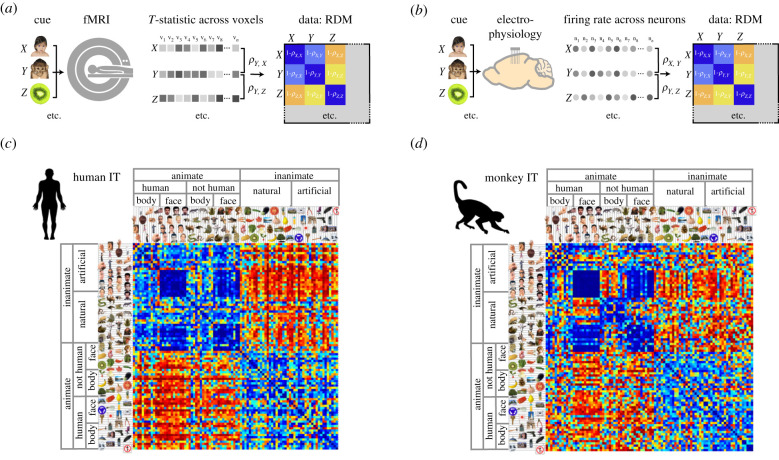
Neuroscience has seen substantial development in non-invasive methods available for investigating the living human brain. However, these tools are limited to coarse macroscopic measures of neural activity that aggregate the diverse responses of thousands of cells. To access neural activity at the cellular and circuit level, researchers instead rely on invasive recordings in animals. Recent advances in invasive methods now permit large-scale recording and circuit-level manipulations with exquisite spatio-temporal precision. Yet, there has been limited progress in relating these microcircuit measures to complex cognition and behaviour observed in humans. Contemporary neuroscience thus faces an explanatory gap between macroscopic descriptions of the human brain and microscopic descriptions in animal models. To close the explanatory gap, we propose adopting a cross-species approach. Despite dramatic differences in the size of mammalian brains, this approach is broadly justified by preserved homology. Here, we outline a three-armed approach for effective cross-species investigation that highlights the need to translate different measures of neural activity into a common space. We discuss how a cross-species approach has the potential to transform basic neuroscience while also benefiting neuropsychiatric drug development where clinical translation has, to date, seen minimal success. This article is part of the theme issue 'Key relationships between non-invasive functional neuroimaging and the underlying neuronal activity'.
神经科学在研究活体人脑的非侵入性方法方面取得了重大进展。然而,这些工具仅限于对数千个细胞的各种反应进行汇总的神经活动的粗略宏观测量。为了在细胞和电路水平上获取神经活动,研究人员转而依赖于动物的侵入性记录。最近的侵入性方法的进步现在允许以极高的时空精度进行大规模记录和电路级操作。然而,在将这些微电路测量与在人类中观察到的复杂认知和行为相关联方面,进展有限。因此,当代神经科学在人类大脑的宏观描述和动物模型中的微观描述之间存在解释差距。为了弥合这一差距,我们建议采用跨物种方法。尽管哺乳动物大脑的大小存在显著差异,但这种方法在很大程度上是合理的,因为存在同源性。在这里,我们概述了一种有效的跨物种研究的三管齐下的方法,强调了将不同的神经活动测量转化为共同空间的必要性。我们讨论了跨物种方法如何具有改变基础神经科学的潜力,同时也有益于神经精神药物开发,迄今为止,临床转化的成功微乎其微。本文是主题为“非侵入性功能神经影像学与基础神经元活动之间的关键关系”的特刊的一部分。