Nelson Aaron B, Moisello Clara, Lin Jing, Panday Priya, Ricci Serena, Canessa Andrea, Di Rocco Alessandro, Quartarone Angelo, Frazzitta Giuseppe, Isaias Ioannis U, Tononi Giulio, Cirelli Chiara, Ghilardi M Felice
Department of Physiology, Pharmacology and Neuroscience, City University of New York School of Medicine New York, NY, USA.
Department of Physiology, Pharmacology and Neuroscience, City University of New York School of MedicineNew York, NY, USA; Department of Informatics, Bioengineering, Robotics and System Engineering, University of GenoaGenoa, Italy.
Front Hum Neurosci. 2017 Mar 7;11:104. doi: 10.3389/fnhum.2017.00104. eCollection 2017.
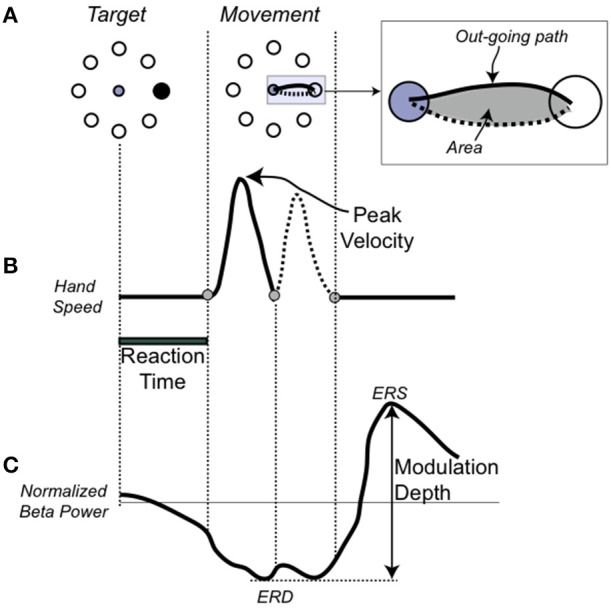
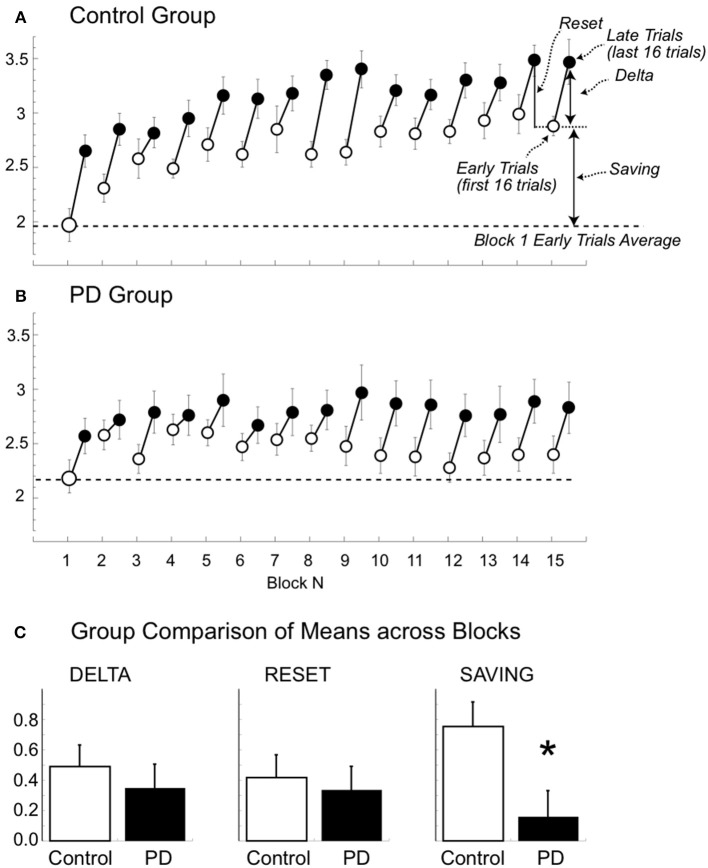
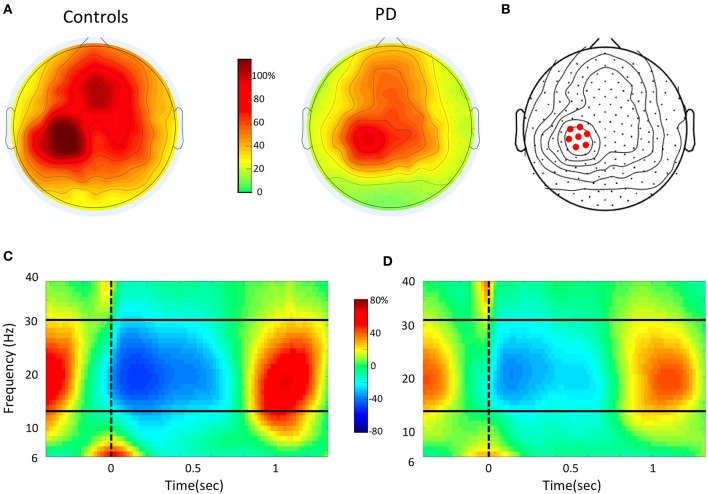
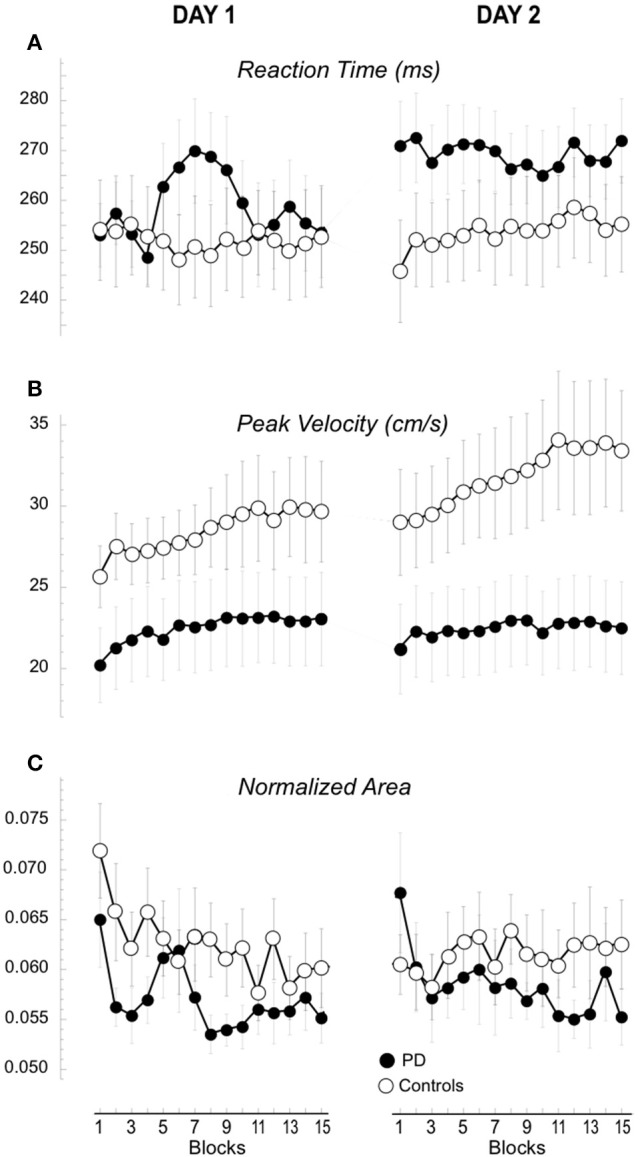
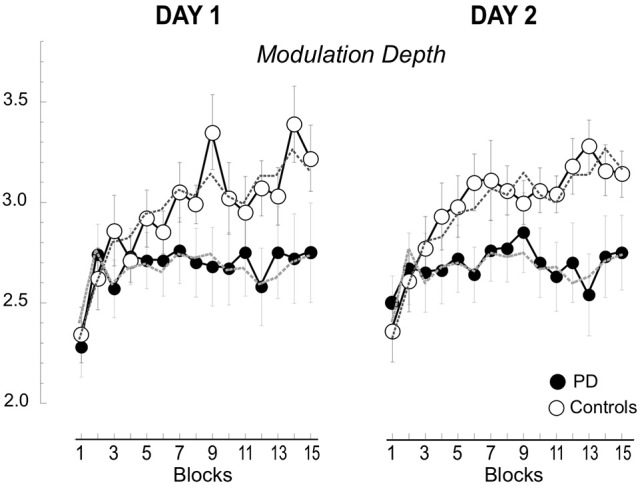
Recently we found that modulation depth of beta power during movement increases with practice over sensory-motor areas in normal subjects but not in patients with Parkinson's disease (PD). As such changes might reflect use-dependent modifications, we concluded that reduction of beta enhancement in PD represents saturation of cortical plasticity. A few questions remained open: What is the relation between these EEG changes and retention of motor skills? Would a second task exposure restore beta modulation enhancement in PD? Do practice-induced increases of beta modulation occur within each block? We thus recorded EEG in patients with PD and age-matched controls in two consecutive days during a 40-min reaching task divided in fifteen blocks of 56 movements each. The results confirmed that, with practice, beta modulation depth over the contralateral sensory-motor area significantly increased across blocks in controls but not in PD, while performance improved in both groups without significant correlations between behavioral and EEG data. The same changes were seen the following day in both groups. Also, beta modulation increased within each block with similar values in both groups and such increases were partially transferred to the successive block in controls, but not in PD. Retention of performance improvement was present in the controls but not in the patients and correlated with the increase in day 1 modulation depth. Therefore, the lack of practice-related increase beta modulation in PD is likely due to deficient potentiation mechanisms that permit between-block saving of beta power enhancement and trigger mechanisms of memory formation.
最近我们发现,正常受试者在运动过程中β波功率的调制深度会随着感觉运动区域的练习而增加,但帕金森病(PD)患者则不然。由于这种变化可能反映了使用依赖的修饰,我们得出结论,PD患者中β波增强的减少代表了皮质可塑性的饱和。仍有几个问题悬而未决:这些脑电图变化与运动技能的保留之间有什么关系?第二次任务暴露能否恢复PD患者的β波调制增强?练习引起的β波调制增加是否发生在每个块内?因此,我们在一项40分钟的伸手任务中,将其分为15个块,每个块包含56次运动,连续两天记录了PD患者和年龄匹配的对照组的脑电图。结果证实,随着练习,对照组对侧感觉运动区域的β波调制深度在各块之间显著增加,而PD患者则没有,同时两组的表现均有所改善,行为数据和脑电图数据之间没有显著相关性。两组在第二天都出现了相同的变化。此外,两组在每个块内β波调制均增加,且增加幅度相似,对照组中这种增加部分转移到了连续的块中,但PD患者没有。对照组存在表现改善的保留,而患者则没有,且与第1天调制深度的增加相关。因此,PD患者缺乏与练习相关的β波调制增加可能是由于增强机制不足,这种机制允许在块间保存β波功率增强以及记忆形成的触发机制。