Teixeira Ana L, Dias Francisca, Gomes Mónica, Fernandes Mara, Medeiros Rui
Molecular Oncology and Viral Pathology Group, Portuguese Institute of Oncology of Porto, Porto, Portugal; Research Department, Portuguese League Against Cancer (NRNorte), Porto, Portugal; Abel Salazar Institute for the Biomedical Sciences (ICBAS) of University of Porto, Porto, Portugal; Faculty of Health Sciences of Fernando Pessoa University, Porto, Portugal.
J Kidney Cancer VHL. 2014 Dec 24;1(8):84-98. doi: 10.15586/jkcvhl.2014.19. eCollection 2014.
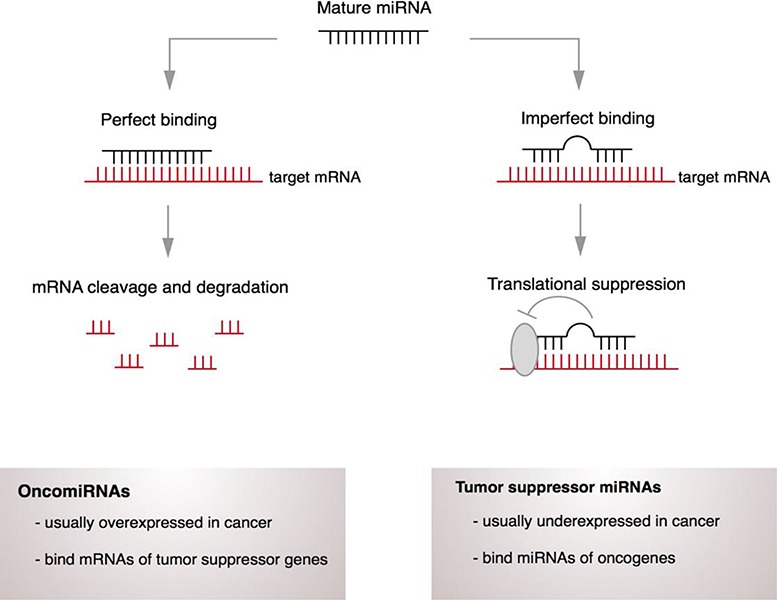
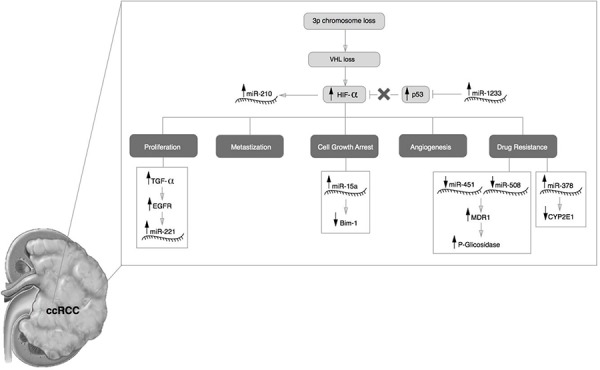
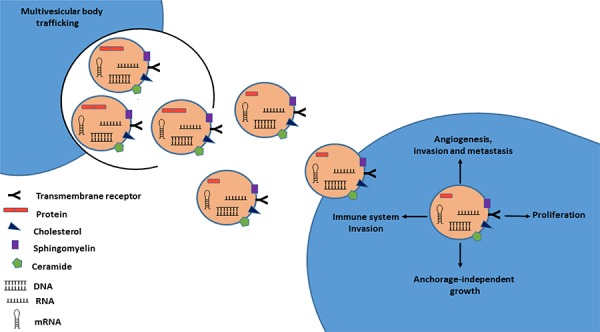
Renal cell carcinoma (RCC) is a lethal urological cancer, with incidence and mortality rates increasing by 2-3% per decade. The lack of standard screening tests contributes to the fact that one-third of patients are diagnosed with locally invasive or metastatic disease. Moreover, 20-40% of RCC patients submitted to surgical nephrectomy will develop metastasis. MicroRNAs (miRNAs) are small non-coding RNAs responsible for gene regulation at a post-transcriptional level. It is accepted that they are deregulated in cancer and can influence tumor development. Thus, miRNAs are promising RCC biomarkers, since they can be detected using non-invasive methods. They are highly stable and easier to quantify in circulating biofluids. The elevated miRNA stability in circulating samples may be the consequence of their capacity to circulate inside of extracellular microvesicles (EMVs), for example, the exosomes. The EMVs are bilayered membrane vesicles secreted by all cell types. They can be released in the interstitial space or into circulating biofluids, which allows the travelling, binding and entrance of these vesicles in receptor cells. This type of cell communication can shuttle bioactive molecules between cells, allowing the horizontal transference of genetic material. In this review, we focus on circulating miRNAs (miR-210, miR-1233, miR-221, miR-15a, miR-451, miR-508, miR-378) in the biofluids of RCC patients and attempt to establish the diagnostic and prognostic accuracy, their synergic effects, and the pathways involved in RCC biology.
肾细胞癌(RCC)是一种致命的泌尿系统癌症,其发病率和死亡率每十年增长2%-3%。缺乏标准的筛查测试导致三分之一的患者被诊断为局部侵袭性或转移性疾病。此外,接受手术肾切除术的RCC患者中有20%-40%会发生转移。微小RNA(miRNA)是小分子非编码RNA,负责转录后水平的基因调控。人们认为它们在癌症中失调,并可影响肿瘤发展。因此,miRNA有望成为RCC生物标志物,因为它们可以通过非侵入性方法检测。它们高度稳定,在循环生物流体中更容易定量。循环样本中miRNA稳定性升高可能是其在细胞外微泡(EMV)(例如外泌体)内循环能力的结果。EMV是所有细胞类型分泌的双层膜囊泡。它们可以释放到间质空间或循环生物流体中,这使得这些囊泡能够在受体细胞中移动、结合和进入。这种类型的细胞通讯可以在细胞之间穿梭生物活性分子,允许遗传物质的水平转移。在本综述中,我们关注RCC患者生物流体中的循环miRNA(miR-210、miR-1233、miR-221、miR-15a、miR-451、miR-508、miR-378),并试图确定其诊断和预后准确性、协同作用以及RCC生物学中涉及的途径。