Sebo Paul, Maisonneuve Hubert, Cerutti Bernard, Fournier Jean Pascal, Senn Nicolas, Haller Dagmar M
Primary Care Unit, Faculty of Medicine, University of Geneva, Geneva, Switzerland.
Unit of Research and Development in Medical Education, Faculty of Medicine, University of Geneva, Geneva, Switzerland.
J Med Internet Res. 2017 Mar 22;19(3):e83. doi: 10.2196/jmir.6308.
Web-based surveys have become a new and popular method for collecting data, but only a few studies have directly compared postal and Web-based surveys among physicians, and none to our knowledge among general practitioners (GPs).
Our aim is to compare two modes of survey delivery (postal and Web-based) in terms of participation rates, response times, and completeness of questionnaires in a study assessing GPs' preventive practices.
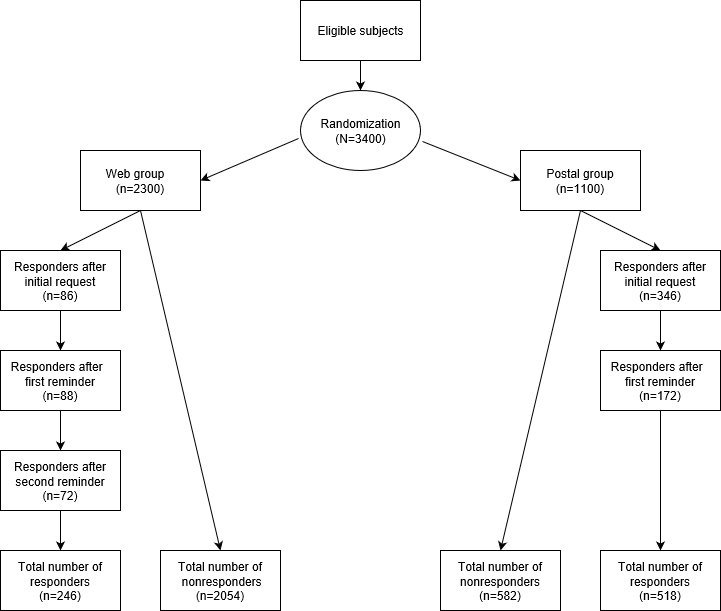
This randomized study was conducted in Western Switzerland (Geneva and Vaud) and in France (Alsace and Pays de la Loire) in 2015. A random selection of community-based GPs (1000 GPs in Switzerland and 2400 GPs in France) were randomly allocated to receive a questionnaire about preventive care activities either by post (n=700 in Switzerland, n=400 in France) or by email (n=300 in Switzerland, n=2000 in France). Reminder messages were sent once in the postal group and twice in the Web-based group. Any GPs practicing only complementary and alternative medicine were excluded from the study.
Among the 3400 contacted GPs, 764 (22.47%, 95% CI 21.07%-23.87%) returned the questionnaire. Compared to the postal group, the participation rate in the Web-based group was more than four times lower (246/2300, 10.70% vs 518/1100, 47.09%, P<.001), but median response time was much shorter (1 day vs 1-3 weeks, P<.001) and the number of GPs having fully completed the questionnaire was almost twice as high (157/246, 63.8% vs 179/518, 34.6%, P<.001).
Web-based surveys offer many advantages such as reduced response time, higher completeness of data, and large cost savings, but our findings suggest that postal surveys can be still considered for GP research. The use of mixed-mode approaches is probably a good strategy to increase GPs' participation in surveys while reducing costs.
基于网络的调查已成为一种新的且流行的数据收集方法,但只有少数研究直接比较了医生群体中邮寄调查和基于网络的调查,据我们所知,尚无针对全科医生(GP)的此类比较研究。
在一项评估全科医生预防措施的研究中,我们旨在比较两种调查方式(邮寄和基于网络)在参与率、回复时间和问卷完整性方面的差异。
这项随机研究于2015年在瑞士西部(日内瓦和沃州)以及法国(阿尔萨斯和卢瓦尔河地区)开展。随机选取社区全科医生(瑞士1000名,法国2400名),随机分配他们通过邮寄方式(瑞士700名,法国400名)或电子邮件方式(瑞士300名,法国2000名)接收一份关于预防保健活动的问卷。在邮寄组发送一次提醒信息,在基于网络的组发送两次提醒信息。仅从事补充和替代医学的全科医生被排除在研究之外。
在3400名被联系的全科医生中,764名(22.47%,95%可信区间21.07%-23.87%)返回了问卷。与邮寄组相比,基于网络的组的参与率低四倍多(246/2300,10.70%对518/1100,47.09%,P<0.001),但中位回复时间短得多(1天对1-3周,P<0.001),并且完全完成问卷的全科医生数量几乎高出一倍(157/246,63.8%对179/518,34.6%,P<0.001)。
基于网络的调查具有许多优点,如缩短回复时间、提高数据完整性以及大幅节省成本,但我们的研究结果表明,在全科医生研究中仍可考虑邮寄调查。采用混合模式方法可能是提高全科医生参与调查同时降低成本的良好策略。