Ramesh Tharmalingam, Kalle Riddhika, Rosenlund Havard, Downs Colleen T
School of Life Sciences University of KwaZulu-Natal Scottsville Pietermaritzburg KwaZulu-Natal South Africa.
School of Life Sciences University of KwaZulu-Natal Scottsville Pietermaritzburg KwaZulu-Natal South Africa; School of Ecology and Environment Studies Nalanda University Rajgir India.
Ecol Evol. 2017 Feb 23;7(6):1964-1973. doi: 10.1002/ece3.2771. eCollection 2017 Mar.
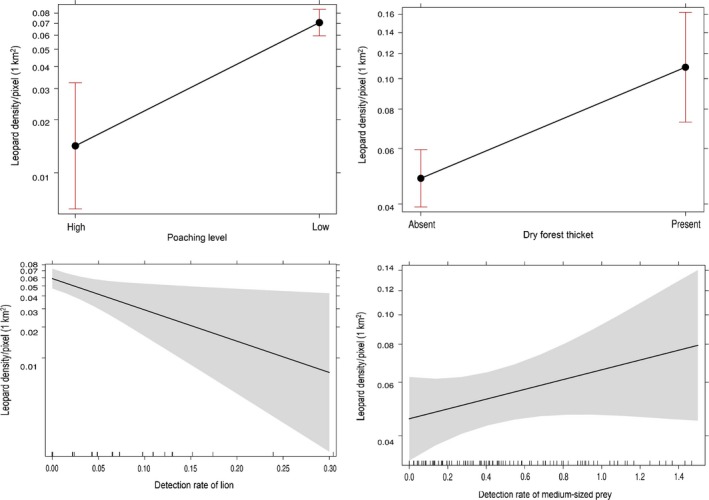
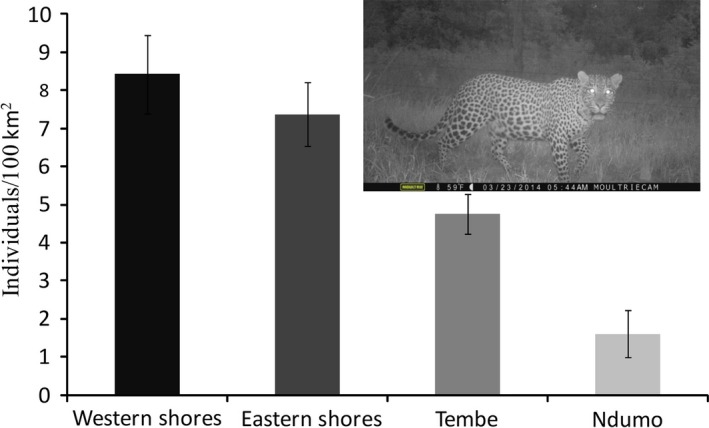
Identifying the primary causes affecting population densities and distribution of flagship species are necessary in developing sustainable management strategies for large carnivore conservation. We modeled drivers of spatial density of the common leopard () using a spatially explicit capture-recapture-Bayesian approach to understand their population dynamics in the Maputaland Conservation Unit, South Africa. We camera-trapped leopards in four protected areas (PAs) of varying sizes and disturbance levels covering 198 camera stations. Ours is the first study to explore the effects of poaching level, abundance of prey species (small, medium, and large), competitors (lion and spotted hyenas ), and habitat on the spatial distribution of common leopard density. Twenty-six male and 41 female leopards were individually identified and estimated leopard density ranged from 1.6 ± 0.62/100 km (smallest PA-Ndumo) to 8.4 ± 1.03/100 km (largest PA-western shores). Although dry forest thickets and plantation habitats largely represented the western shores, the plantation areas had extremely low leopard density compared to native forest. We found that leopard density increased in areas when low poaching levels/no poaching was recorded in dry forest thickets and with high abundance of medium-sized prey, but decreased with increasing abundance of lion. Because local leopard populations are vulnerable to extinction, particularly in smaller PAs, the long-term sustainability of leopard populations depend on developing appropriate management strategies that consider a combination of multiple factors to maintain their optimal habitats.
确定影响旗舰物种种群密度和分布的主要原因,对于制定大型食肉动物保护的可持续管理策略至关重要。我们使用空间明确的捕获-重捕-贝叶斯方法,对普通豹()的空间密度驱动因素进行建模,以了解它们在南非马普托兰保护单元的种群动态。我们在四个大小和干扰程度不同的保护区设置了相机陷阱,覆盖198个相机站点来监测豹的活动。我们的研究首次探讨了偷猎水平、猎物种类(小型、中型和大型)数量、竞争者(狮子和斑鬣狗)以及栖息地对普通豹密度空间分布的影响。共识别出26只雄性豹和41只雌性豹,估计豹的密度范围从每100平方公里1.6±0.62只(最小的保护区-恩杜莫)到每100平方公里8.4±1.03只(最大的保护区-西海岸)。尽管干燥森林灌木丛和种植园栖息地在很大程度上构成了西海岸,但与原生森林相比,种植园地区的豹密度极低。我们发现,在干燥森林灌木丛中偷猎水平低/无偷猎且中型猎物数量丰富的地区,豹的密度会增加,但随着狮子数量的增加而减少。由于当地豹种群极易灭绝,尤其是在较小的保护区,豹种群的长期可持续性取决于制定适当的管理策略,综合考虑多种因素以维持其最佳栖息地。