Hägglund Patricia, Olai Lena, Ståhlnacke Katri, Persenius Mona, Hägg Mary, Andersson Maria, Koistinen Susanne, Carlsson Eva
Oral and Maxillofacial Radiology, Department of Odontology, Faculty of Medicine, Umeå University, SE-90187, Umeå, Sweden.
School of Education, Health and Social Science, Dalarna University, Falun, Sweden.
BMC Geriatr. 2017 Mar 23;17(1):78. doi: 10.1186/s12877-017-0466-8.
Extensive studies have shown that older people are negatively impacted by impaired eating and nutrition. The abilities to eat, enjoy food, and participate in social activities associated with meals are important aspects of health-related quality of life (HRQoL) and recovery after illness. This project aims to (i) describe and analyze relationships between oral health and oral HRQoL, swallowing ability, eating ability, and nutritional risk among older individuals admitted to short-term care; (ii) compare the perceptions that older individuals and staff report on care quality related to oral hygiene and eating; and (iii) study the feasibility and effects of a training program for people with impaired swallowing (i.e., dysphagia).
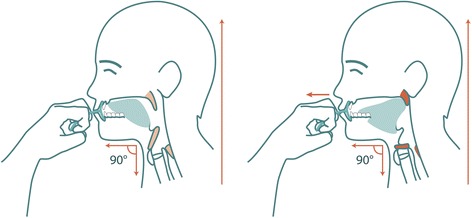
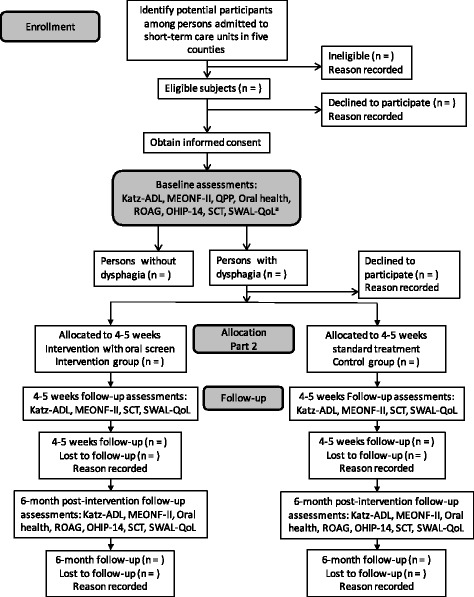
METHODS/DESIGN: This project consists of two parts, which will be performed in five Swedish counties. It will include approximately 400 older individuals and 200 healthcare professionals. Part 1 is a cross-sectional, descriptive study of older people admitted to short-term care. Subjects will be assessed by trained professionals regarding oral health status, oral HRQoL, eating and nutritional risk, and swallowing ability. Swallowing ability will be measured with a teaspoon test and a swallowing capacity test (SCT). Furthermore, subjects and staff will complete a questionnaire regarding their perceptions of care quality. Part 2 is a cluster randomized intervention trial with controls. Older participants with dysphagia (i.e., SCT <10 ml/s, measured in part 1) will be recruited consecutively to either the intervention or control group, depending on where they were admitted for short-term care. At baseline, all subjects will be assessed for oral health status, oral HRQoL, eating and nutritional risk, swallowing ability, and swallowing-related QoL. Then, the intervention group will receive 5 weeks of training with an oral screen for neuromuscular training focused on orofacial and pharyngeal muscles. After completing the intervention, and at six months post-intervention, all assessments will be repeated in both study groups.
The results will make important contributions to rehabilitation knowledge, including approaches for improving swallowing function, oral health, and food intake and for improving the quality of oral care for older people.
This trial was retrospectively registered at ClinicalTrials.gov, on July 4, 2016, identifier: NCT02825927 .
广泛研究表明,老年人受到饮食和营养受损的负面影响。进食、享受食物以及参与与进餐相关的社交活动的能力是健康相关生活质量(HRQoL)和疾病康复的重要方面。本项目旨在:(i)描述和分析入住短期护理机构的老年人的口腔健康与口腔HRQoL、吞咽能力、进食能力和营养风险之间的关系;(ii)比较老年人和工作人员对与口腔卫生和进食相关的护理质量的看法;(iii)研究针对吞咽功能受损者(即吞咽困难者)的培训项目的可行性和效果。
方法/设计:本项目由两部分组成,将在瑞典的五个县进行。将纳入约400名老年人和200名医疗保健专业人员。第1部分是对入住短期护理机构的老年人进行的横断面描述性研究。将由经过培训的专业人员对受试者的口腔健康状况、口腔HRQoL、进食和营养风险以及吞咽能力进行评估。吞咽能力将通过茶匙试验和吞咽容量测试(SCT)进行测量。此外,受试者和工作人员将完成一份关于他们对护理质量看法的问卷。第2部分是一项有对照的整群随机干预试验。吞咽困难的老年参与者(即第1部分中测量的SCT<10 ml/s)将根据他们入住短期护理机构的地点连续招募到干预组或对照组。在基线时,将对所有受试者的口腔健康状况、口腔HRQoL、进食和营养风险、吞咽能力以及与吞咽相关的生活质量进行评估。然后,干预组将接受为期5周的训练,使用口腔筛查进行神经肌肉训练,重点是口面部和咽部肌肉。干预完成后以及干预后6个月,将在两个研究组中重复所有评估。
研究结果将为康复知识做出重要贡献,包括改善吞咽功能、口腔健康和食物摄入的方法以及提高老年人口腔护理质量的方法。
本试验于2016年7月4日在ClinicalTrials.gov上进行回顾性注册,标识符:NCT02825927 。