Rübsamen Nicole, Akmatov Manas K, Castell Stefanie, Karch André, Mikolajczyk Rafael T
Department of Epidemiology, Helmholtz Centre for Infection Research, Inhoffenstr. 7, 38124 Brunswick, Germany.
PhD Programme "Epidemiology", Brunswick-Hanover, Germany.
Emerg Themes Epidemiol. 2017 Mar 21;14:4. doi: 10.1186/s12982-017-0058-2. eCollection 2017.
Increasing availability of the Internet allows using only online data collection for more epidemiological studies. We compare response patterns in a population-based health survey using two survey designs: mixed-mode (choice between paper-and-pencil and online questionnaires) and online-only design (without choice).
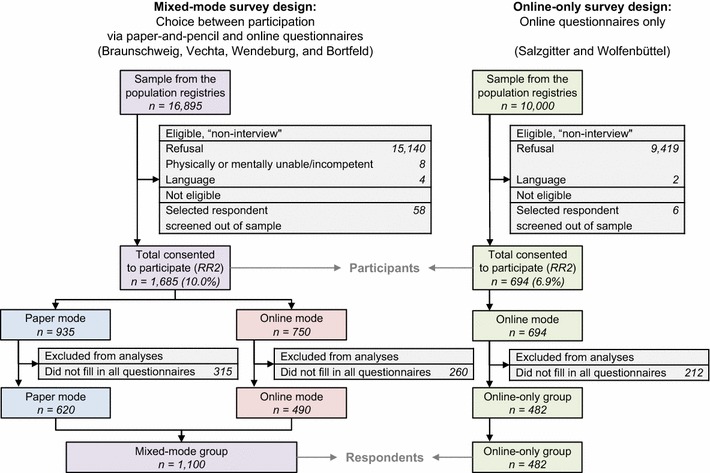
We used data from a longitudinal panel, the Hygiene and Behaviour Infectious Diseases Study (HaBIDS), conducted in 2014/2015 in four regions in Lower Saxony, Germany. Individuals were recruited using address-based probability sampling. In two regions, individuals could choose between paper-and-pencil and online questionnaires. In the other two regions, individuals were offered online-only participation. We compared sociodemographic characteristics of respondents who filled in all panel questionnaires between the mixed-mode group (n = 1110) and the online-only group (n = 482). Using 134 items, we performed multinomial logistic regression to compare responses between survey designs in terms of type (missing, "do not know" or valid response) and ordinal regression to compare responses in terms of content. We applied the false discovery rates (FDR) to control for multiple testing and investigated effects of adjusting for sociodemographic characteristic. For validation of the differential response patterns between mixed-mode and online-only, we compared the response patterns between paper and online mode among the respondents in the mixed-mode group in one region (n = 786).
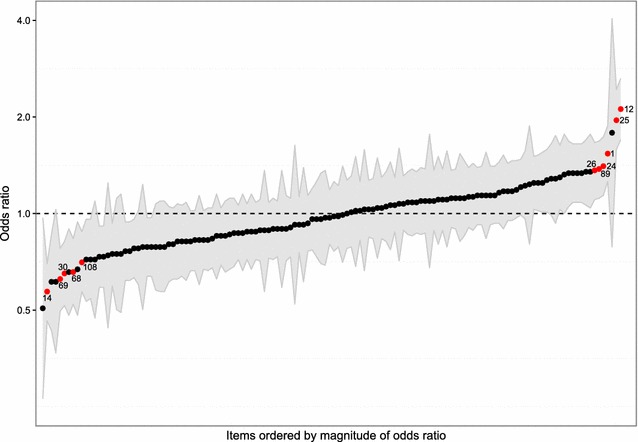
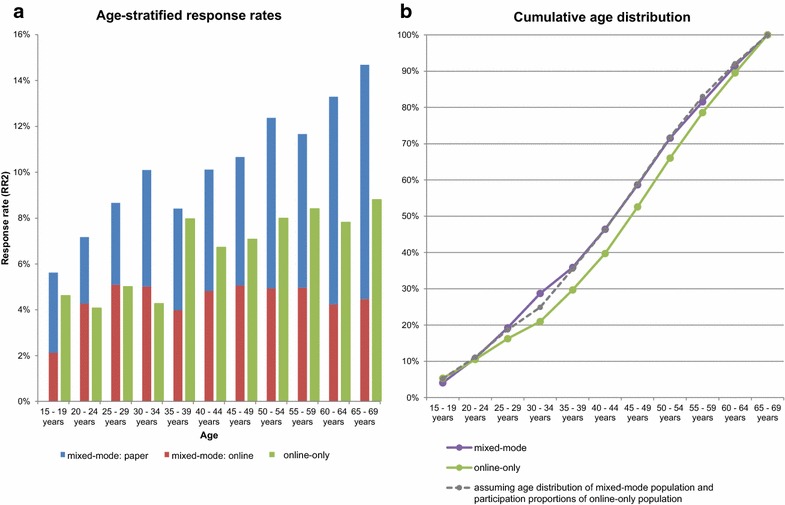
Respondents in the online-only group were older than those in the mixed-mode group, but both groups did not differ regarding sex or education. Type of response did not differ between the online-only and the mixed-mode group. Survey design was associated with different content of response in 18 of the 134 investigated items; which decreased to 11 after adjusting for sociodemographic variables. In the validation within the mixed-mode, only two of those were among the 11 significantly different items. The probability of observing by chance the same two or more significant differences in this setting was 22%.
We found similar response patterns in both survey designs with only few items being answered differently, likely attributable to chance. Our study supports the equivalence of the compared survey designs and suggests that, in the studied setting, using online-only design does not cause strong distortion of the results.
互联网的日益普及使得越来越多的流行病学研究仅采用在线数据收集方式。我们在一项基于人群的健康调查中,比较了两种调查设计的应答模式:混合模式(在纸笔问卷和在线问卷之间选择)和仅在线设计(无选择)。
我们使用了2014/2015年在德国下萨克森州四个地区进行的一项纵向面板研究——卫生与行为传染病研究(HaBIDS)的数据。采用基于地址的概率抽样招募个体。在两个地区,个体可以在纸笔问卷和在线问卷之间进行选择。在另外两个地区,个体只能选择在线参与。我们比较了混合模式组(n = 1110)和仅在线组(n = 482)中填写了所有面板问卷的应答者的社会人口学特征。使用134个项目,我们进行了多项逻辑回归,以比较两种调查设计在应答类型(缺失、“不知道”或有效应答)方面的差异,并进行有序回归以比较应答内容方面的差异。我们应用错误发现率(FDR)来控制多重检验,并研究了调整社会人口学特征的影响。为了验证混合模式和仅在线模式之间的差异应答模式,我们比较了一个地区混合模式组中应答者在纸质模式和在线模式之间的应答模式(n = 786)。
仅在线组的应答者比混合模式组的应答者年龄更大,但两组在性别或教育程度方面没有差异。仅在线组和混合模式组的应答类型没有差异。在134个被调查项目中的18个项目中,调查设计与不同的应答内容相关;在调整社会人口学变量后,这一数量降至11个。在混合模式内的验证中,在这11个显著不同的项目中,只有两个项目是这样。在这种情况下,偶然观察到相同的两个或更多显著差异的概率为22%。
我们发现两种调查设计的应答模式相似,只有少数项目的回答不同,这可能是偶然因素导致的。我们的研究支持了所比较的调查设计的等效性,并表明,在所研究的环境中,仅使用在线设计不会导致结果的严重扭曲。