Department of Epidemiology, Helmholtz Centre for Infection Research (HZI), Inhoffenstraße 7, 38124, Braunschweig, Germany.
PhD Programme "Epidemiology", Braunschweig-Hannover, Germany.
BMC Med Res Methodol. 2017 Aug 31;17(1):132. doi: 10.1186/s12874-017-0408-3.
Knowing about predictors of attrition in a panel is important to initiate early measures against loss of participants. We investigated attrition in both early and late phase of an online panel with special focus on preferences regarding mode of participation.
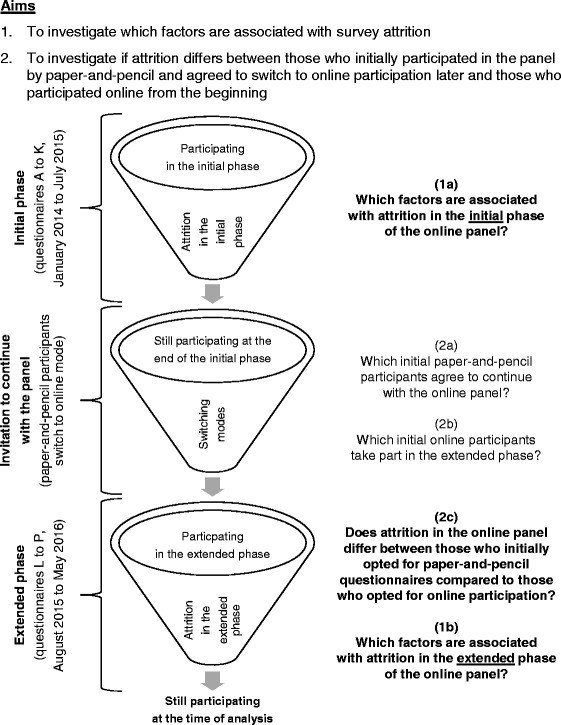
We used data from the HaBIDS panel that was designed to investigate knowledge, attitudes, and practice regarding infections in the German general population. HaBIDS was divided into two phases: an initial phase when some participants could choose their preferred mode of participation (paper-and-pencil or online) and an extended phase when participants were asked to become members of an online panel that was not limited regarding its duration (i.e. participants initially preferring paper questionnaires switched to online participation). Using competing risks regression, we investigated two types of attrition (formal withdrawal and discontinuation without withdrawal) among online participants, separately for both phases. As potential predictors of attrition, we considered sociodemographic characteristics, physical and mental health as well as auxiliary information describing the survey process, and, in the extended phase, initial mode preference.
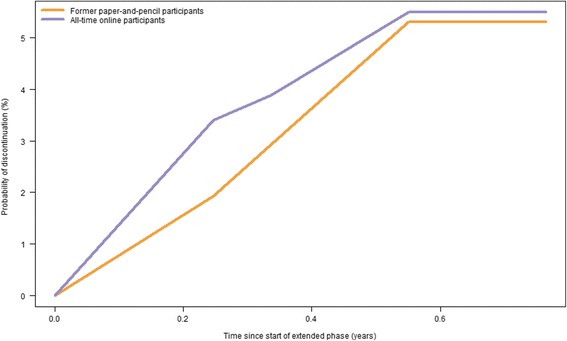
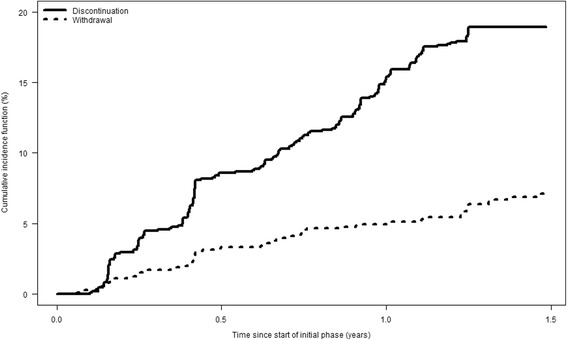
In the initial phase, higher age and less frequent Internet usage predicted withdrawal, while younger age, higher stress levels, delay in returning the consent form, and need for receiving reminder emails predicted discontinuation. In the extended phase, only need for receiving reminder emails predicted discontinuation. Numbers of withdrawal in the extended phase were too small for analysis. Initial mode preference did not predict attrition in the extended phase. Besides age, there was no evidence of differential attrition by sociodemographic factors in any phase.
Predictors of attrition were similar in both phases of the panel, but they differed by type of attrition (withdrawal vs. discontinuation). Sociodemographic characteristics only played a minor role for both types of attrition. Need for receiving a reminder was the strongest predictor of discontinuation in any phase, but no predictor of withdrawal. We found predictors of attrition, which can be identified already in the early phase of a panel so that countermeasures (e.g. special incentives) can be taken.
了解面板中退出的预测因素对于采取早期措施防止参与者流失很重要。我们研究了在线面板早期和晚期阶段的退出情况,特别关注参与方式的偏好。
我们使用了 HaBIDS 面板的数据,该面板旨在调查德国普通人群中关于感染的知识、态度和实践。HaBIDS 分为两个阶段:一个初始阶段,一些参与者可以选择他们喜欢的参与方式(纸质或在线);一个扩展阶段,参与者被要求成为一个在线面板的成员,该面板没有关于其持续时间的限制(即最初喜欢纸质问卷的参与者切换到在线参与)。使用竞争风险回归,我们分别在两个阶段调查了在线参与者的两种类型的退出(正式退出和无退出的中断)。作为退出的潜在预测因素,我们考虑了社会人口统计学特征、身体和心理健康以及描述调查过程的辅助信息,以及在扩展阶段,初始模式偏好。
在初始阶段,较高的年龄和较少的互联网使用频率预测了退出,而较年轻的年龄、较高的压力水平、延迟返回同意书以及需要接收提醒电子邮件预测了中断。在扩展阶段,只有需要接收提醒电子邮件预测了中断。扩展阶段的退出人数太少,无法进行分析。初始模式偏好并没有预测扩展阶段的退出。除了年龄之外,在任何阶段都没有证据表明社会人口统计学因素导致退出存在差异。
退出的预测因素在面板的两个阶段相似,但它们因退出类型(退出与中断)而异。社会人口统计学特征对两种类型的退出都只起次要作用。需要接收提醒是任何阶段中断的最强预测因素,但不是退出的预测因素。我们发现了退出的预测因素,这些因素可以在面板的早期阶段识别出来,以便采取对策(例如特殊激励措施)。