Bitome-Essono Paul-Yannick, Ollomo Benjamin, Arnathau Céline, Durand Patrick, Mokoudoum Nancy Diamella, Yacka-Mouele Lauriane, Okouga Alain-Prince, Boundenga Larson, Mve-Ondo Bertrand, Obame-Nkoghe Judicaël, Mbehang-Nguema Philippe, Njiokou Flobert, Makanga Boris, Wattier Rémi, Ayala Diego, Ayala Francisco J, Renaud Francois, Rougeron Virginie, Bretagnolle Francois, Prugnolle Franck, Paupy Christophe
Biogéosciences Unit, Équipe Écologie-Évolutive, UMR 6282 CNRS-université de Bourgogne-Franche Comté-EPHE-AgroSup, Dijon, France.
Équipes UBEEP-ESV, Centre International de Recherches Médicales de Franceville, Franceville, Gabon.
Elife. 2017 Mar 28;6:e22069. doi: 10.7554/eLife.22069.
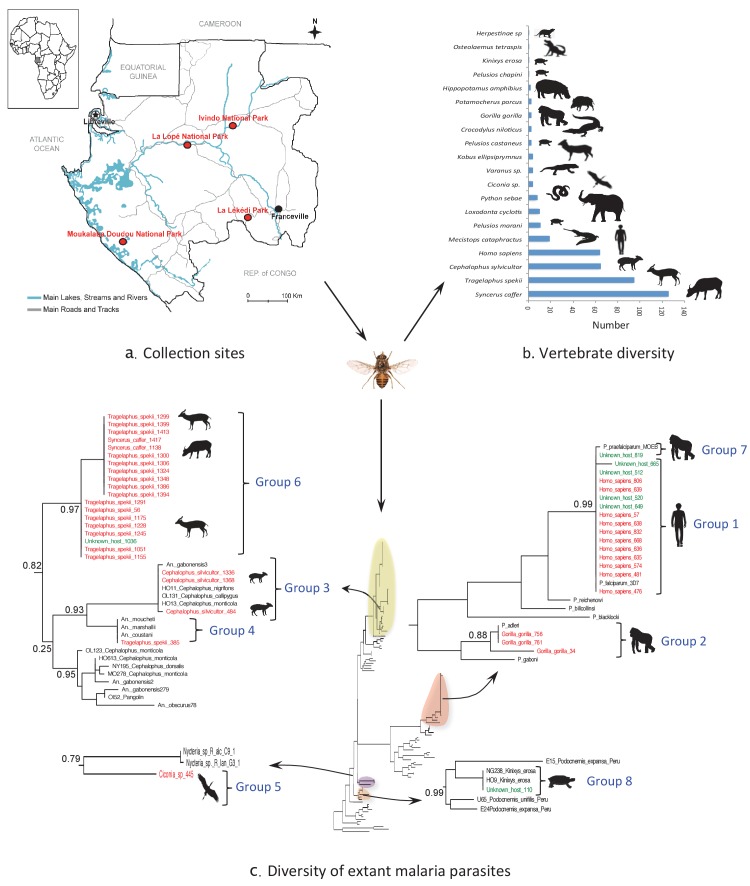
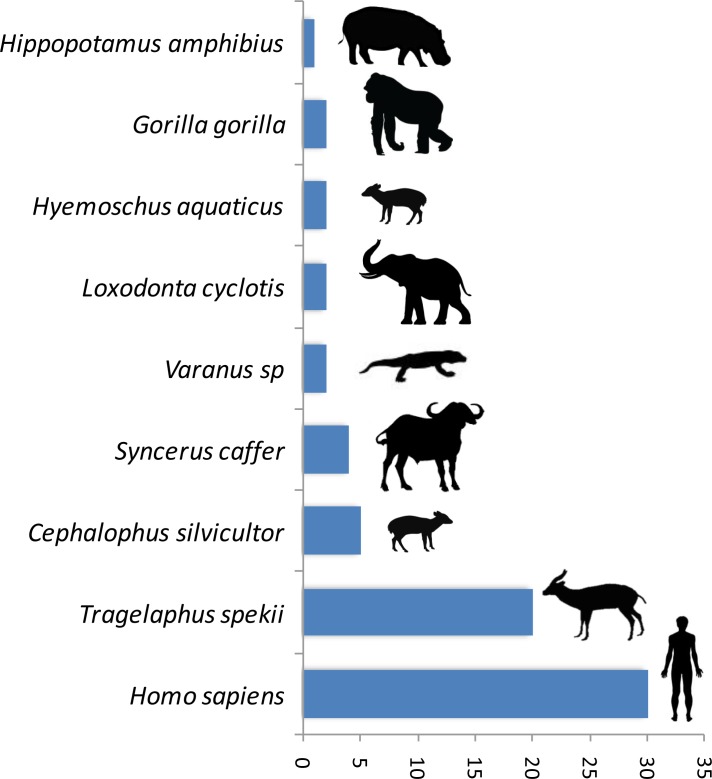
About 60% of emerging infectious diseases in humans are of zoonotic origin. Their increasing number requires the development of new methods for early detection and monitoring of infectious agents in wildlife. Here, we investigated whether blood meals from hematophagous flies could be used to identify the infectious agents circulating in wild vertebrates. To this aim, 1230 blood-engorged flies were caught in the forests of Gabon. Identified blood meals (30%) were from 20 vertebrate species including mammals, birds and reptiles. Among them, 9% were infected by different extant malaria parasites among which some belonged to known parasite species, others to new parasite species or to parasite lineages for which only the vector was known. This study demonstrates that using hematophagous flies as 'flying syringes' constitutes an interesting approach to investigate blood-borne pathogen diversity in wild vertebrates and could be used as an early detection tool of zoonotic pathogens.
人类中约60%的新发传染病源自动物。其数量不断增加,需要开发新方法来早期检测和监测野生动物中的传染源。在此,我们研究了吸血蝇的血餐是否可用于识别野生脊椎动物中传播的传染源。为此,在加蓬的森林中捕获了1230只饱血的苍蝇。已鉴定出的血餐(30%)来自20种脊椎动物,包括哺乳动物、鸟类和爬行动物。其中,9%感染了不同的现存疟原虫,其中一些属于已知的寄生虫物种,另一些属于新的寄生虫物种或仅知其传播媒介的寄生虫谱系。这项研究表明,将吸血蝇用作“飞行注射器”是一种研究野生脊椎动物血源性病原体多样性的有趣方法,可作为人畜共患病原体的早期检测工具。