Bird Kevin A, An Hong, Gazave Elodie, Gore Michael A, Pires J Chris, Robertson Larry D, Labate Joanne A
Division of Biological Sciences, University of Missouri Columbia, MO, USA.
Division of Biological Sciences, University of MissouriColumbia, MO, USA; National Key Lab of Crop Genetic Improvement, Huazhong Agricultural UniversityWuhan, China.
Front Plant Sci. 2017 Mar 13;8:321. doi: 10.3389/fpls.2017.00321. eCollection 2017.
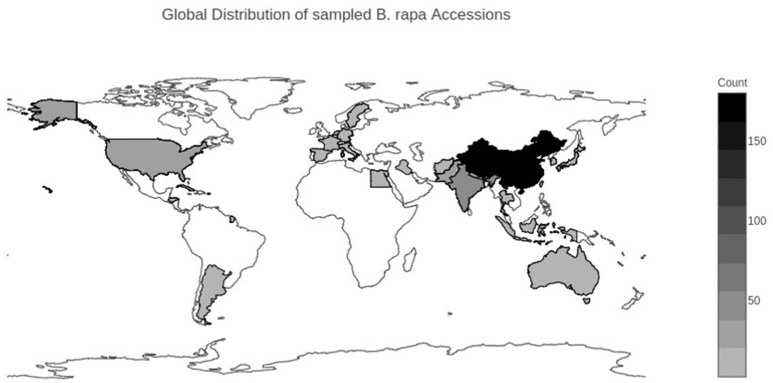
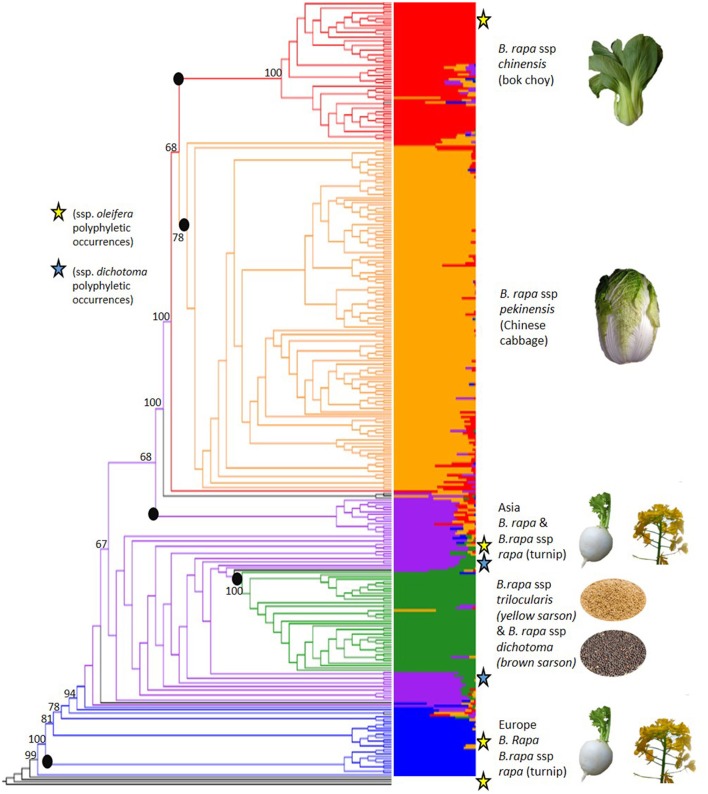
The crop species L. has significant economic importance around the world. However, the global distribution and complex evolutionary history of the species has made investigating its genetic population structure difficult. Crop domestication and improvement has resulted in extreme phenotypic diversity and subspecies that are used for oilseed, food for human consumption, and fodder for livestock. These subspecies include the oilseed morphotypes. (turnip rape), ssp. (brown sarson/toria), ssp. (yellow sarson); ssp. (turnip); and Asian leafy vegetables ssp. (Chinese cabbage), ssp. (bok choy), ssp. (mizuna/mibuna), ssp. (rapini/broccoli rabe), ssp. (tatsoi), ssp (choy sum), and ssp. (komatsuna). To date, studies have had insufficient sampling to determine the relationship of all morphotypes, especially oilseed morphotypes, and questions remain over the contribution of morphotype and geographic origin to population structure. We used genotyping-by-sequencing to score 18,272 single nucleotide polymorphism markers in a globally diverse panel of 333 National Plant Germplasm System accessions that included 10 recognized subspecies. Our population genetic and phylogenetic analyses were broadly congruent and revealed five subpopulations that were largely reflective of morphotype and geography. These subpopulations were 1. European turnips/oilseed, 2. Asian turnips/oilseed, 3. yellow/brown sarson (ssp. and ssp. ), 4. Chinese cabbage (ssp. ), and 5. bok choy, choy sum, and tatsoi (ssp. , ssp. , ssp. ). Additionally, we found evidence of polyphyly and/or paraphyly, particularly for oilseed morphotypes (ssp. and ssp. ) and turnips. The results of this study have provided improved resolution to the genetic and phylogenetic relationships of subspecies within the species . Understanding of these relationships is key to the future genetic study and improvement of this globally important crop species.
作物物种L.在全球具有重要的经济意义。然而,该物种的全球分布和复杂的进化历史使得研究其遗传种群结构变得困难。作物驯化和改良导致了极端的表型多样性以及用于油籽、人类食用粮食和牲畜饲料的亚种。这些亚种包括油籽形态类型。(芜菁油菜),ssp. (棕薹/托里亚),ssp. (黄薹);ssp. (芜菁);以及亚洲叶菜类蔬菜ssp. (大白菜),ssp. (小白菜),ssp. (水菜/米邦塔),ssp. (油菜/西兰花),ssp. (塌棵菜),ssp (菜心),和ssp. (小松菜)。迄今为止,研究的抽样不足,无法确定所有形态类型之间的关系,特别是油籽形态类型,形态类型和地理起源对种群结构的贡献仍存在疑问。我们使用简化基因组测序对333份国家植物种质系统种质的全球多样化样本中的18272个单核苷酸多态性标记进行评分,这些样本包括10个公认的亚种。我们进行的群体遗传学和系统发育分析大致一致,揭示了五个亚群,这些亚群在很大程度上反映了形态类型和地理分布。这些亚群分别是:1. 欧洲芜菁/油籽,2. 亚洲芜菁/油籽,3. 黄/棕薹(ssp. 和ssp. ),4. 大白菜(ssp. ),5. 小白菜、菜心和塌棵菜(ssp. 、ssp. 、ssp. )。此外,我们发现了多系和/或并系的证据,特别是对于油籽形态类型(ssp. 和ssp. )和芜菁。本研究结果为该物种内亚种的遗传和系统发育关系提供了更高的分辨率。了解这些关系是未来对这种全球重要作物物种进行遗传研究和改良的关键。