Stearns Jennifer C, Zulyniak Michael A, de Souza Russell J, Campbell Natalie C, Fontes Michelle, Shaikh Mateen, Sears Malcolm R, Becker Allan B, Mandhane Piushkumar J, Subbarao Padmaja, Turvey Stuart E, Gupta Milan, Beyene Joseph, Surette Michael G, Anand Sonia S
Department of Medicine, McMaster University, Hamilton, ON, Canada.
Farncombe Family Digestive Health Research Institute, McMaster University, Hamilton, ON, Canada.
Genome Med. 2017 Mar 29;9(1):32. doi: 10.1186/s13073-017-0421-5.
The infant gut is rapidly colonized by microorganisms soon after birth, and the composition of the microbiota is dynamic in the first year of life. Although a stable microbiome may not be established until 1 to 3 years after birth, the infant gut microbiota appears to be an important predictor of health outcomes in later life.
We obtained stool at one year of age from 173 white Caucasian and 182 South Asian infants from two Canadian birth cohorts to gain insight into how maternal and early infancy exposures influence the development of the gut microbiota. We investigated whether the infant gut microbiota differed by ethnicity (referring to groups of people who have certain racial, cultural, religious, or other traits in common) and by breastfeeding status, while accounting for variations in maternal and infant exposures (such as maternal antibiotic use, gestational diabetes, vegetarianism, infant milk diet, time of introduction of solid food, infant birth weight, and weight gain in the first year).
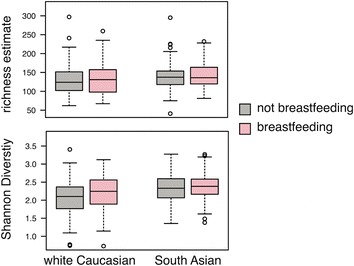
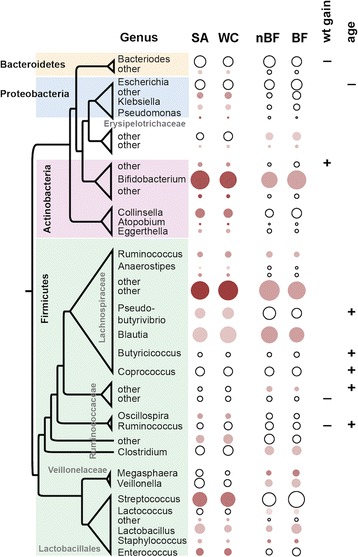
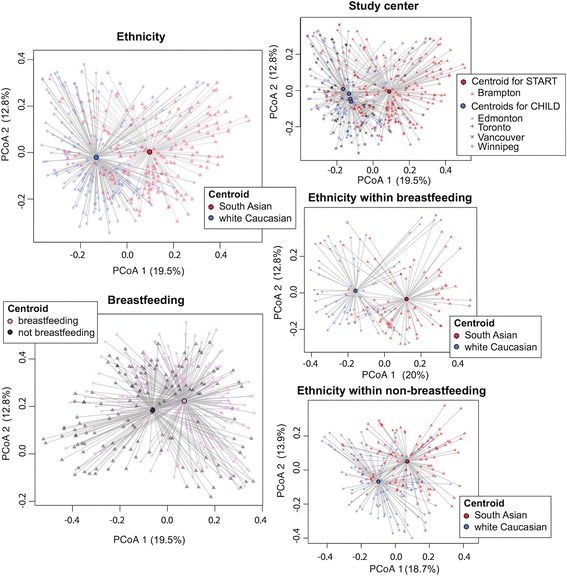
We demonstrate that ethnicity and infant feeding practices independently influence the infant gut microbiome at 1 year, and that ethnic differences can be mapped to alpha diversity as well as a higher abundance of lactic acid bacteria in South Asians and a higher abundance of genera within the order Clostridiales in white Caucasians.
The infant gut microbiome is influenced by ethnicity and breastfeeding in the first year of life. Ethnic differences in the gut microbiome may reflect maternal/infant dietary differences and whether these differences are associated with future cardiometabolic outcomes can only be determined after prospective follow-up.
婴儿肠道在出生后不久就会迅速被微生物定植,并且微生物群的组成在生命的第一年是动态变化的。尽管稳定的微生物组可能要到出生后1至3年才会建立,但婴儿肠道微生物群似乎是后期健康结果的重要预测指标。
我们从两个加拿大出生队列中的173名白人高加索婴儿和182名南亚婴儿一岁时的粪便样本中获取信息,以深入了解母亲和婴儿早期接触因素如何影响肠道微生物群的发育。我们调查了婴儿肠道微生物群是否因种族(指具有某些共同种族、文化、宗教或其他特征的人群)和母乳喂养状况而有所不同,同时考虑了母亲和婴儿接触因素的差异(如母亲使用抗生素、妊娠期糖尿病、素食主义、婴儿的奶类饮食、固体食物引入时间、婴儿出生体重以及第一年的体重增加情况)。
我们证明,种族和婴儿喂养方式在一岁时独立影响婴儿肠道微生物组,并且种族差异可以映射到α多样性,以及南亚人乳酸菌丰度较高和白人高加索人梭菌目内属的丰度较高。
婴儿肠道微生物组在生命的第一年受到种族和母乳喂养的影响。肠道微生物组的种族差异可能反映了母婴饮食差异,而这些差异是否与未来的心脏代谢结果相关,只能在进行前瞻性随访后才能确定。