Liu Xiaoran, Hill Alison M, West Sheila G, Gabauer Rachel M, McCrea Cindy E, Fleming Jennifer A, Kris-Etherton Penny M
Departments of Nutritional Sciences and.
School of Pharmacy and Medical Sciences, University of South Australia, Adelaide, Australia.
J Nutr. 2017 May;147(5):835-840. doi: 10.3945/jn.116.246785. Epub 2017 Mar 29.
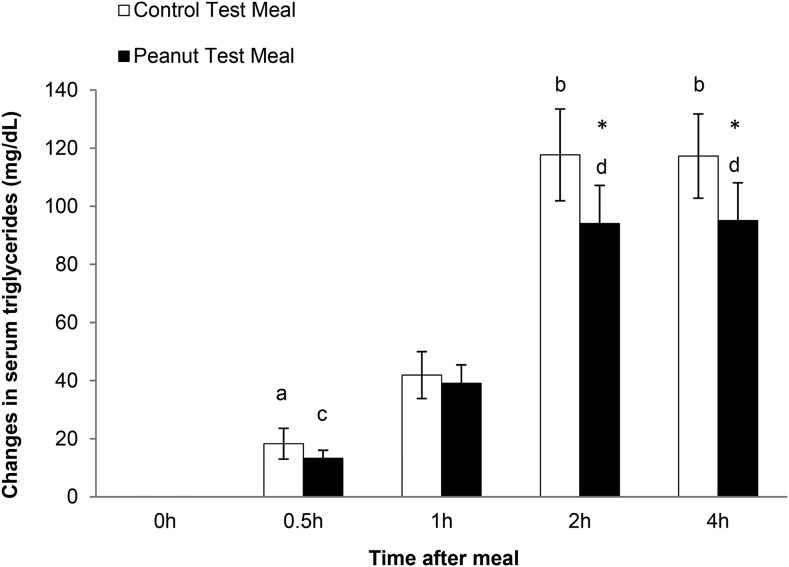
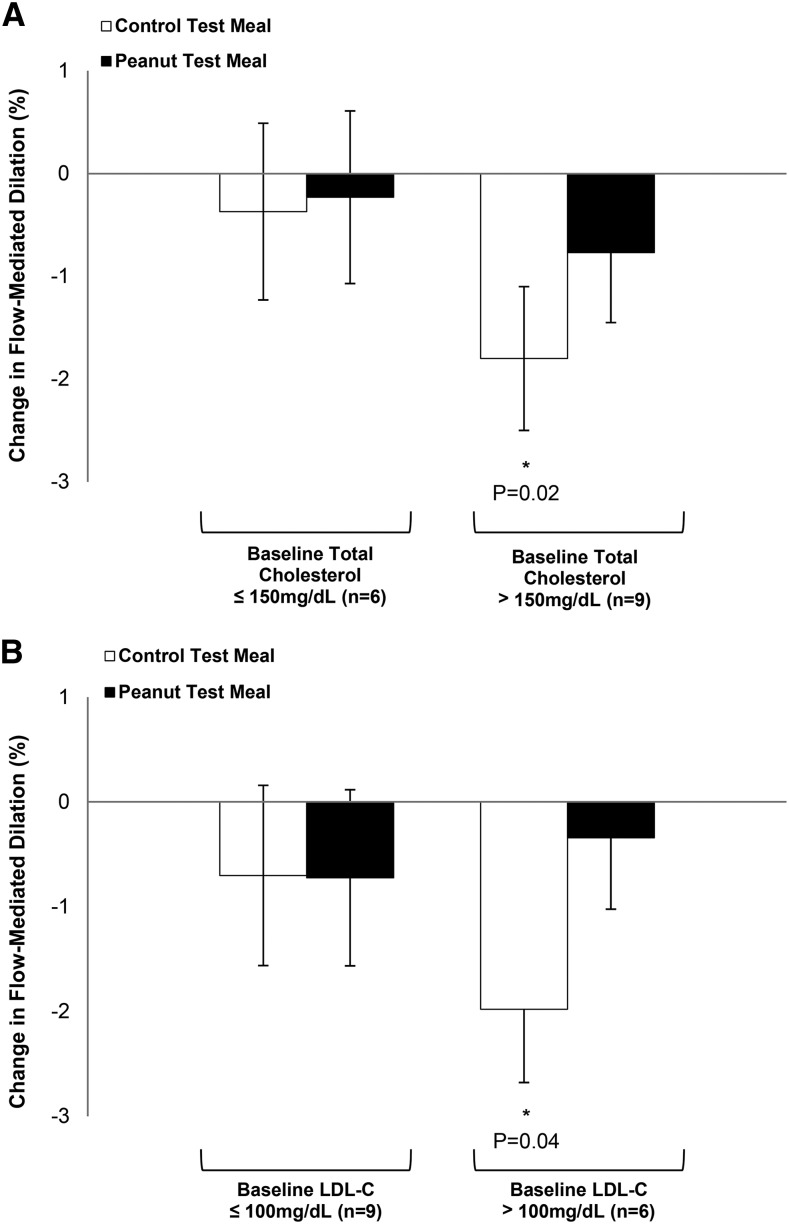
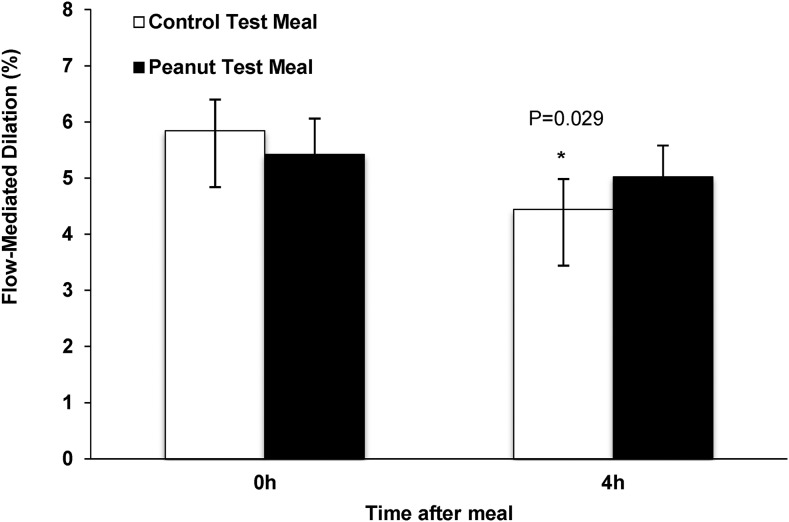
Postprandial hyperlipidemia is associated with impaired endothelial function. Peanut consumption favorably affects the lipid and lipoprotein profile; however, the effects on endothelial function remain unclear. The purpose of the study was to evaluate the effects of acute peanut consumption as part of a high-fat meal on postprandial endothelial function. We conducted a randomized, controlled, crossover postprandial study to evaluate the effect of acute peanut consumption on postprandial lipids and endothelial function as assessed by flow-mediated dilatation (FMD) of the brachial artery in 15 healthy overweight or obese men [mean age: 26.7 y; mean body mass index (in kg/m): 31.4]. Participants consumed, in a randomized order, a peanut meal containing 3 ounces (85 g) ground peanuts (1198 kcal; 40.0% carbohydrate, 47.7% fat, 19.4% saturated fat, 13.2% protein) and a control meal matched for energy and macronutrient content. Meals were in the form of a shake, scheduled ≥1 wk apart. Lipids, lipoproteins, glucose, and insulin were measured at baseline (0 min) and at 30, 60, 120, and 240 min after shake consumption. FMD was measured at baseline and at 240 min. Acute peanut consumption blunted the serum triglyceride (TG) response 120 and 240 min after consumption compared with the control meal (means ± SEMs-120 min: 188.9 ± 19.4 compared with 197.5 ± 20.7 mg/dL; 240 min: 189.9 ± 24.3 compared with 197.3 ± 18.4 mg/dL; < 0.05 for both). Total, LDL, and HDL cholesterol and glucose and insulin responses were similar between the test meals. Compared with baseline, only the control meal significantly decreased FMD at 240 min (control: -1.2% ± 0.5%; = 0.029; peanut: -0.6% ± 0.5%; = 0.3). Participants with higher baseline total (>150 mg/dL) and LDL (>100 mg/dL)-cholesterol concentrations showed a significant decrease in FMD after the control meal (-1.8%, = 0.017; -2.0%, = 0.038), whereas the peanut meal maintained endothelial function in all participants irrespective of total- and LDL-cholesterol concentrations. The inclusion of 85 g peanuts (3 ounces) as part of a high-fat meal improved the postprandial TG response and preserved endothelial function in healthy overweight or obese men. This trial was registered at clinicaltrials.gov as NCT01405300.
餐后高脂血症与内皮功能受损有关。食用花生对脂质和脂蛋白水平有有益影响;然而,其对内皮功能的影响尚不清楚。本研究的目的是评估在高脂餐中急性食用花生对餐后内皮功能的影响。我们进行了一项随机、对照、交叉餐后研究,以评估急性食用花生对餐后脂质和内皮功能的影响,通过肱动脉血流介导的扩张(FMD)来评估15名健康超重或肥胖男性[平均年龄:26.7岁;平均体重指数(kg/m²):31.4]。参与者以随机顺序食用一份含有3盎司(85克)磨碎花生的花生餐(1198千卡;40.0%碳水化合物,47.7%脂肪,19.4%饱和脂肪,13.2%蛋白质)和一份能量及宏量营养素含量匹配的对照餐。餐食为奶昔形式,间隔≥1周安排。在基线(0分钟)以及饮用奶昔后30、60、120和240分钟测量脂质、脂蛋白、葡萄糖和胰岛素。在基线和240分钟测量FMD。与对照餐相比,急性食用花生使食用后120和240分钟时的血清甘油三酯(TG)反应减弱(均值±标准误 - 120分钟:188.9±19.4对比197.5±20.7毫克/分升;240分钟:189.9±24.3对比197.3±18.4毫克/分升;两者均P<0.05)。测试餐之间的总胆固醇、低密度脂蛋白胆固醇、高密度脂蛋白胆固醇以及葡萄糖和胰岛素反应相似。与基线相比,仅对照餐在240分钟时显著降低了FMD(对照:-1.2%±0.5%;P = 0.029;花生:-0.6%±0.5%;P = 0.3)。基线总胆固醇(>150毫克/分升)和低密度脂蛋白胆固醇(>100毫克/分升)浓度较高的参与者在食用对照餐后FMD显著降低(-1.8%,P = 0.017;-2.0%,P = 0.038),而无论总胆固醇和低密度脂蛋白胆固醇浓度如何,花生餐在所有参与者中均维持了内皮功能。在高脂餐中加入85克花生(3盎司)改善了健康超重或肥胖男性的餐后TG反应并保留了内皮功能。该试验已在clinicaltrials.gov上注册,注册号为NCT01405300。