Michalski Christina, Kan Bernard, Lavoie Pascal M
British Columbia Children's Hospital Research Institute, Vancouver, BC, Canada; Department of Medicine, University of British Columbia, Vancouver, BC, Canada.
British Columbia Children's Hospital Research Institute, Vancouver, BC, Canada; Department of Medicine, University of British Columbia, Vancouver, BC, Canada; Department of Pediatrics, University of British Columbia, Vancouver, BC, Canada.
Front Immunol. 2017 Mar 15;8:281. doi: 10.3389/fimmu.2017.00281. eCollection 2017.
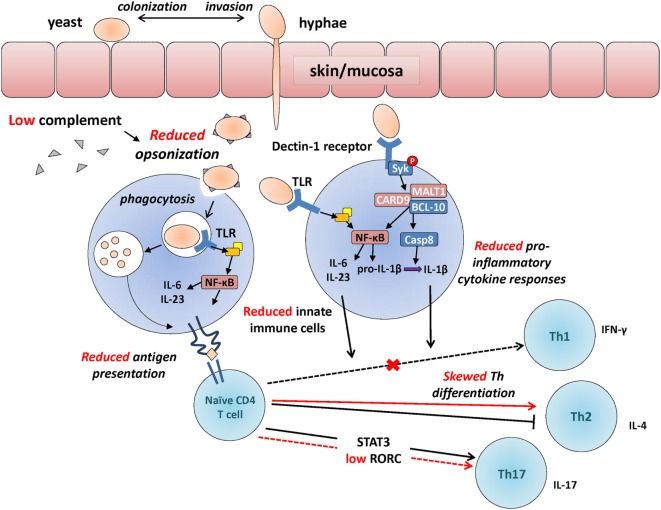
Newborns are prone to fungal infections, largely due to species. The immunological basis for this vulnerability is not yet fully understood. However, useful insights can be gained from the knowledge of the maturation of immune pathways during ontogeny, particularly when placed in context with how rare genetic mutations in humans predispose to fungal diseases. In this article, we review these most current data on immune functions in human newborns, highlighting pathways most relevant to the response to . While discussing these data, we propose a framework of why deficiencies in these pathways make newborns particularly vulnerable to this opportunistic pathogen.
新生儿容易发生真菌感染,这在很大程度上归因于物种。这种易感性的免疫学基础尚未完全了解。然而,从个体发育过程中免疫途径成熟的知识中可以获得有用的见解,特别是当结合人类罕见基因突变如何易患真菌疾病的情况时。在本文中,我们综述了关于人类新生儿免疫功能的这些最新数据,突出了与对……反应最相关的途径。在讨论这些数据时,我们提出了一个框架,解释为什么这些途径的缺陷会使新生儿特别容易受到这种机会性病原体的侵害。