Kwok Richard K, Engel Lawrence S, Miller Aubrey K, Blair Aaron, Curry Matthew D, Jackson W Braxton, Stewart Patricia A, Stenzel Mark R, Birnbaum Linda S, Sandler Dale P
Epidemiology Branch, National Institute of Environmental Health Sciences (NIEHS), National Institutes of Health (NIH), Department of Health and Human Services (DHHS), Research Triangle Park, North Carolina USA.
Environ Health Perspect. 2017 Apr;125(4):570-578. doi: 10.1289/EHP715. Epub 2017 Mar 31.
The 2010 disaster led to the largest ever marine oil spill. Individuals who worked on the spill were exposed to toxicants and stressors that could lead to adverse effects.
The GuLF STUDY was designed to investigate relationships between oil spill exposures and multiple potential physical and mental health effects.
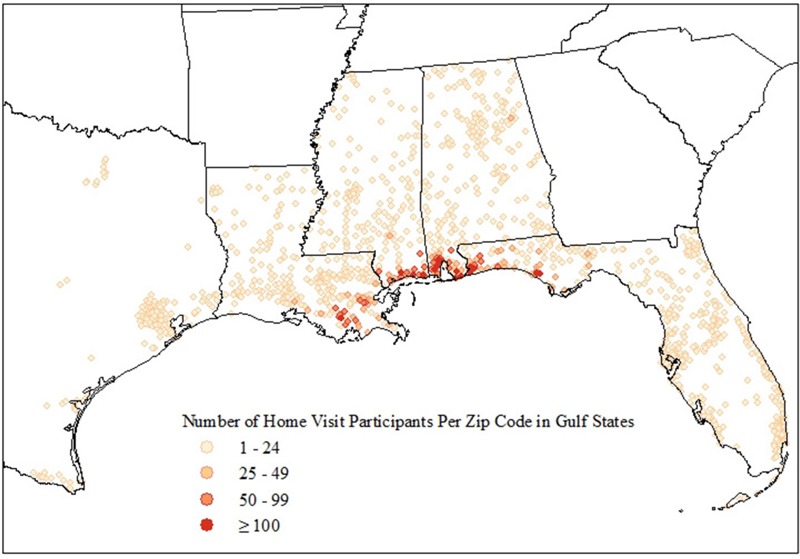
Participants were recruited by telephone from lists of individuals who worked on the oil spill response and clean-up or received safety training. Enrollment interviews between 2011 and 2013 collected information about spill-related activities, demographics, lifestyle, and health. Exposure measurements taken during the oil spill were used with questionnaire responses to characterize oil exposures of participants. Participants from Gulf states completed a home visit in which biological and environmental samples, anthropometric and clinical measurements, and additional health and lifestyle information were collected. Participants are being followed for changes in health status.
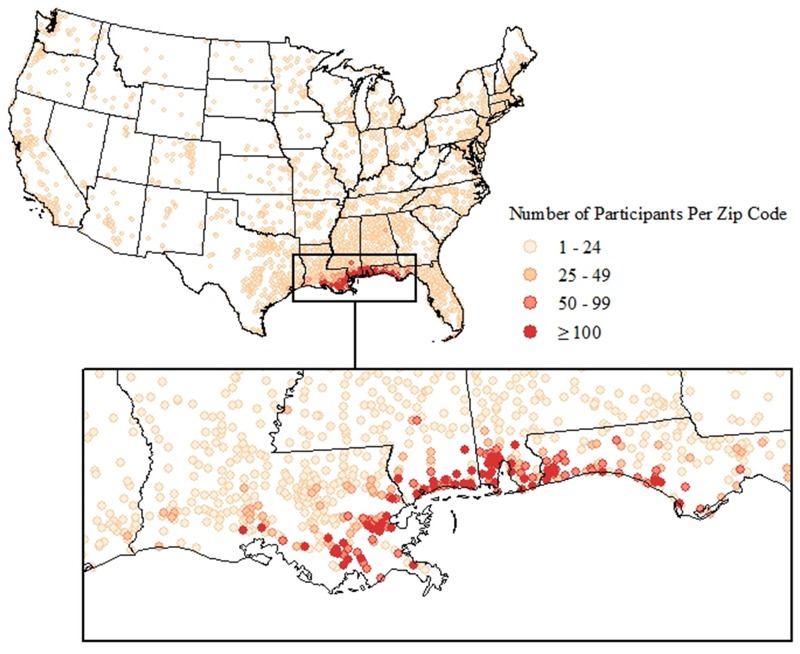
Thirty-two thousand six hundred eight individuals enrolled in the cohort, and 11,193 completed a home visit. Most were young (56.2% ≤ 45 years of age), male (80.8%), lived in a Gulf state (82.3%), and worked at least 1 day on the oil spill (76.5%). Workers were involved in response (18.0%), support operations (17.5%), clean-up on water (17.4%) or land (14.6%), decontamination (14.3%), and administrative support (18.3%). Using an ordinal job exposure matrix, 45% had maximum daily total hydrocarbon exposure levels ≥ 1.0 ppm.
The GuLF STUDY provides a unique opportunity to study potential adverse health effects from the oil spill.
2010年的灾难导致了有史以来最大规模的海洋石油泄漏。参与清理泄漏事故的人员接触到了可能导致不良影响的有毒物质和压力源。
海湾地区漏油事件健康影响研究(GuLF STUDY)旨在调查石油泄漏暴露与多种潜在身心健康影响之间的关系。
通过电话从参与石油泄漏应对和清理工作或接受过安全培训的人员名单中招募参与者。2011年至2013年的入组访谈收集了与泄漏相关活动、人口统计学、生活方式和健康方面的信息。将石油泄漏期间进行的暴露测量结果与问卷调查回复相结合,以描述参与者的石油暴露情况。来自海湾各州的参与者完成了一次家访,期间收集了生物和环境样本、人体测量和临床测量数据,以及其他健康和生活方式信息。目前正在对参与者的健康状况变化进行跟踪。
该队列共有32608人入组,11193人完成了家访。大多数人较为年轻(56.2%年龄≤45岁),男性居多(80.8%),居住在海湾州(82.3%),并且至少参与了1天的石油泄漏清理工作(76.5%)。工作人员参与了应对工作(18.0%)、支持行动(17.5%)、水上(17.4%)或陆上(14.6%)清理、去污(14.3%)以及行政支持工作(18.3%)。使用序数工作暴露矩阵,45%的人每日总烃最大暴露水平≥1.0 ppm。
海湾地区漏油事件健康影响研究提供了一个独特的机会,来研究石油泄漏可能对健康造成的不良影响。