Shaikh Shiraz, Baig Lubna A, Polkowski Maciej
Dr. Shiraz Shaikh. MBBS, FCPS. Assistant Professor, APPNA Institute of Public Health, Jinnah Sind Medical University, Karachi, Pakistan.
Prof. Lubna A Baig. MBBS, FCPS, PhD. Dean, APPNA Institute of Public Health, Jinnah Sind Medical University, Karachi, Pakistan.
Pak J Med Sci. 2017 Jan-Feb;33(1):221-226. doi: 10.12669/pjms.331.12176.
The findings of the Health Care in Danger project in Karachi suggests that there is presence of behavioral negligence among vehicle operators on roads in regards to giving way to ambulances. A mass media campaign was conducted to raise people's awareness on the importance of giving way to ambulances. The main objective of this study was to determine the effectiveness of the campaign on increasing the proportion of vehicles that give way to ambulances.
This was a quasi-experimental study that was based on before and after design. Three observation surveys were carried out in different areas of the city in Karachi, Pakistan before, during and after the campaign by trained observers who recorded their findings on a checklist. Each observation was carried out at three different times of the day for at least two days on each road. The relationship of the media campaign with regards to a vehicle giving space to an ambulance was calculated by means of odds ratios and 95% confidence intervals using multivariate logistic regression.
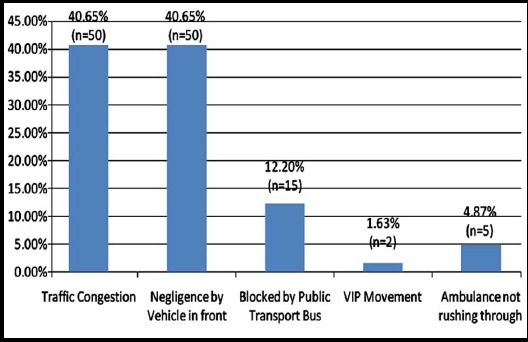
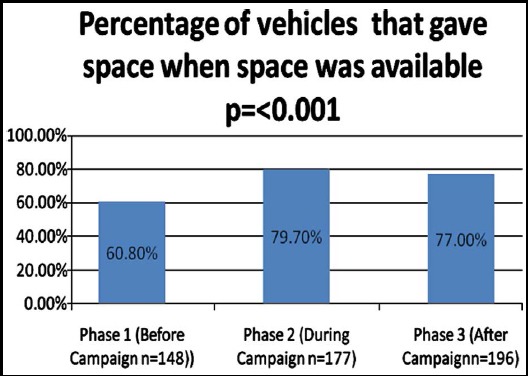
Overall, 245 observations were included in the analysis. Traffic congestion and negligence/resistance, by vehicles operators who were in front of the ambulance, were the two main reasons why ambulances were not given way. Other reasons include: sudden stops by minibuses and in the process causing obstruction, ambulances not rushing through to alert vehicle operators to give way and traffic interruption by VIP movement. After adjustment for site, time of day, type of ambulance and number of cars in front of the ambulance, vehicles during (OR=2.13, 95% CI=1.22-3.71, p=0.007) and after the campaign (OR=1.73, 95% CI=1.02-2.95, p=0.042) were significantly more likely give space to ambulances.
Mass media campaigns can play a significant role in changing the negligent behavior of people, especially when the campaign conveys a humanitarian message such as: giving way to ambulances can save lives.
卡拉奇“危险中的医疗保健”项目的研究结果表明,道路上的车辆驾驶员在给救护车让行方面存在行为疏忽。开展了一场大众媒体宣传活动,以提高人们对给救护车让行重要性的认识。本研究的主要目的是确定该活动在增加给救护车让行车辆比例方面的有效性。
这是一项基于前后设计的准实验研究。在巴基斯坦卡拉奇市的不同区域,由训练有素的观察员在活动前、活动期间和活动后进行了三次观察调查,他们将调查结果记录在一份清单上。每次观察在每条道路上一天中的三个不同时间进行,至少持续两天。通过多变量逻辑回归,利用优势比和95%置信区间计算媒体宣传活动与车辆给救护车让行之间的关系。
总体而言,分析纳入了245次观察。交通拥堵以及救护车前方的车辆驾驶员疏忽/抗拒是救护车未被让行的两个主要原因。其他原因包括:小型巴士突然停车并造成阻塞、救护车未疾驰以提醒车辆驾驶员让行以及贵宾出行导致交通中断。在对地点、一天中的时间、救护车类型以及救护车前方的汽车数量进行调整后,活动期间(优势比=2.13,95%置信区间=1.22 - 3.71,p = 0.007)和活动后(优势比=1.73,95%置信区间=1.02 - 2.95,p = 0.042)的车辆更有可能给救护车让行。
大众媒体宣传活动在改变人们的疏忽行为方面可以发挥重要作用,尤其是当该活动传达诸如“给救护车让行能挽救生命”这样的人道主义信息时。