Öz Erdoğan, Küçükkelepçe Osman, Kurt Osman, Çavuş Abuzer Cihat
Family Medicine, Adıyaman Provincial Health Directorate, Adıyaman, TUR.
Public Health, Adıyaman Provincial Health Directorate, Adıyaman, TUR.
Cureus. 2023 Jan 12;15(1):e33722. doi: 10.7759/cureus.33722. eCollection 2023 Jan.
Speed humps allow vehicles to slow down their speeds, but they also cause emergency vehicles to waste time on their way to their destinations. The study aims to determine the delay times alone and queue delay time of ambulances passing through speed humps.
Three types of ambulances (Van, Multiple Victim Assistance, Bariatric) and vehicles (Truck, Lorry, Van) are passed in a controlled manner through speed humps at different speeds in three streets of Adıyaman province of Turkey. Ambulances and vehicles are slowed down to 15 km/h while passing the speed hump for safe passage. Passing and lost times were calculated with the help of a stopwatch (Catiga CG-503; Catiga Electronics Company, Hong Kong) and a global positioning system (GPS) speedometer (Vjoycar smart speedometer; Vjoy Car Electronics Limited, China). Differences in passing times in the absence and the presence of speed humps, determined with the speed equation formula (t=x / V), were lost timings or delay timings for ambulances and vehicles.
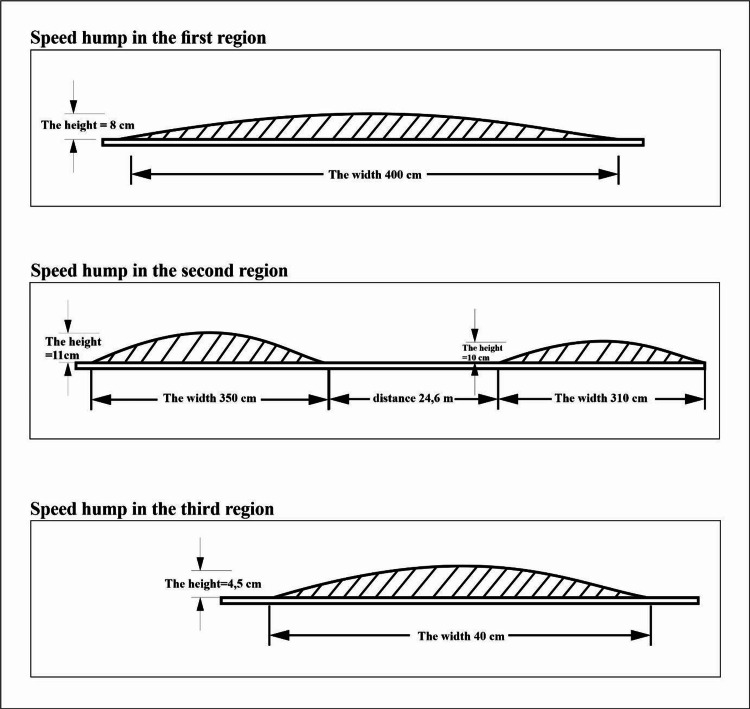
In the first region, the lost time for the van ambulance with a speed of 70 km/h was 8.41 seconds, 10.14 seconds for the multiple victim assistance ambulances, and 9.56 seconds for the bariatric ambulance. While there was a truck in front of the van ambulance with a speed of 50 km/h, the lost time was also the queue delay time for the ambulance and was 54.96 seconds, with a lorry 42.81 seconds, and 7.02 seconds with a van. In the second region with a double-speed hump, the lost time for the van ambulance with a speed of 60 km/h was 9.94 seconds, 16.32 seconds for the multiple victim assistance ambulances, and 14.49 seconds for the bariatric ambulance. Ambulances did not waste time in the third region, as ambulances and other vehicles do not have to slow down.
Ambulances waste time by themselves or due to the vehicles in front of them passing speed hump. As the speed of ambulances increased, the lost time also increased. So, more time is lost when the ambulance needs to go faster.
减速带能使车辆降低速度,但也会导致急救车辆在前往目的地的途中浪费时间。本研究旨在确定救护车通过减速带时的单独延误时间和排队延误时间。
在土耳其阿迪亚曼省的三条街道上,以可控方式让三种类型的救护车(厢式救护车、多伤员援助救护车、肥胖症专用救护车)和车辆(卡车、货车、厢式车)以不同速度通过减速带。为安全通过减速带,救护车和车辆在通过时减速至15公里/小时。借助秒表(Catiga CG - 503;香港Catiga电子公司)和全球定位系统(GPS)速度计(Vjoycar智能速度计;中国Vjoy汽车电子有限公司)计算通过时间和损失时间。根据速度方程公式(t = x / V)确定有无减速带时通过时间的差异,这些差异即为救护车和车辆的损失时间或延误时间。
在第一个区域,速度为70公里/小时的厢式救护车的损失时间为8.41秒,多伤员援助救护车为10.14秒,肥胖症专用救护车为9.56秒。当速度为50公里/小时的厢式救护车前方有一辆卡车时,损失时间也是救护车的排队延误时间,为54.96秒,前方有一辆货车时为42.81秒,前方有一辆厢式车时为7.02秒。在有双减速带的第二个区域,速度为60公里/小时的厢式救护车的损失时间为9.94秒,多伤员援助救护车为16.32秒,肥胖症专用救护车为14.49秒。在第三个区域,救护车没有浪费时间,因为救护车和其他车辆无需减速。
救护车自身或因其前方车辆通过减速带而浪费时间。随着救护车速度增加,损失时间也增加。所以,当救护车需要更快行驶时会损失更多时间。