• 文献检索
  • 文档翻译
  • 深度研究
  • 学术资讯
  • Suppr Zotero 插件Zotero 插件
  • 邀请有礼
  • 套餐&价格
  • 历史记录
应用&插件
Suppr Zotero 插件Zotero 插件浏览器插件Mac 客户端Windows 客户端微信小程序
定价
高级版会员购买积分包购买API积分包
服务
文献检索文档翻译深度研究API 文档MCP 服务
关于我们
关于 Suppr公司介绍联系我们用户协议隐私条款
关注我们

Suppr 超能文献

核心技术专利:CN118964589B侵权必究
粤ICP备2023148730 号-1Suppr @ 2026

文献检索

告别复杂PubMed语法,用中文像聊天一样搜索,搜遍4000万医学文献。AI智能推荐,让科研检索更轻松。

立即免费搜索

文件翻译

保留排版,准确专业,支持PDF/Word/PPT等文件格式,支持 12+语言互译。

免费翻译文档

深度研究

AI帮你快速写综述,25分钟生成高质量综述,智能提取关键信息,辅助科研写作。

立即免费体验

它的增长速度是呈指数级快速增长吗?——对于具有初始近指数增长动态的流行病,假设指数增长对其特征描述和预测的影响。

Is it growing exponentially fast? -- Impact of assuming exponential growth for characterizing and forecasting epidemics with initial near-exponential growth dynamics.

作者信息

Chowell Gerardo, Viboud Cécile

机构信息

School of Public Health, Georgia State University, Atlanta, GA, USA; Division of International Epidemiology and Population Studies, Fogarty International Center, National Institutes of Health, Bethesda, MD, USA.

Division of International Epidemiology and Population Studies, Fogarty International Center, National Institutes of Health, Bethesda, MD, USA.

出版信息

Infect Dis Model. 2016 Oct;1(1):71-78. doi: 10.1016/j.idm.2016.07.004. Epub 2016 Sep 3.

DOI:10.1016/j.idm.2016.07.004
PMID:28367536
原文链接:https://pmc.ncbi.nlm.nih.gov/articles/PMC5373088/
Abstract

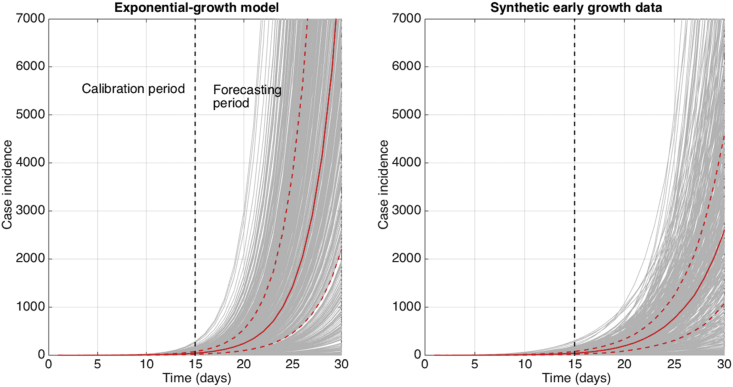
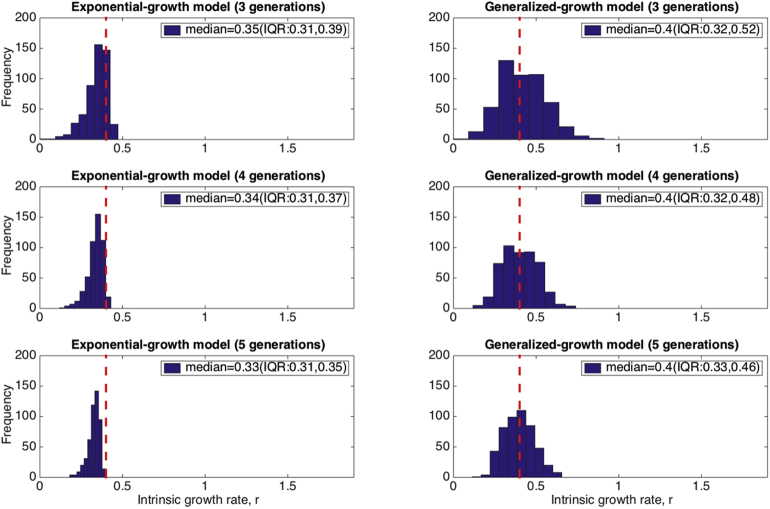
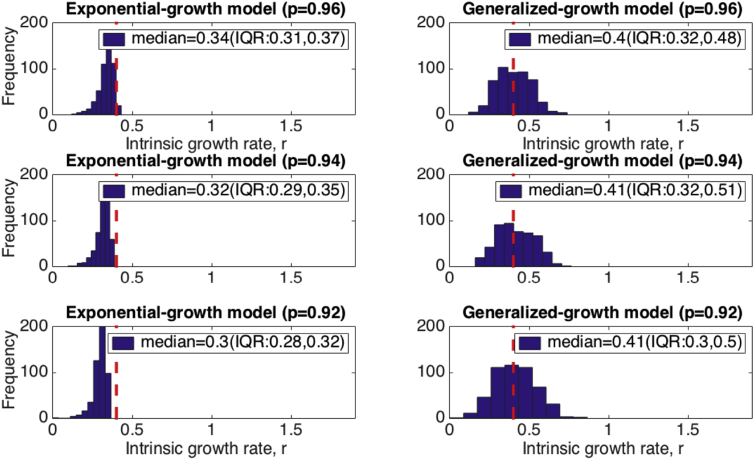
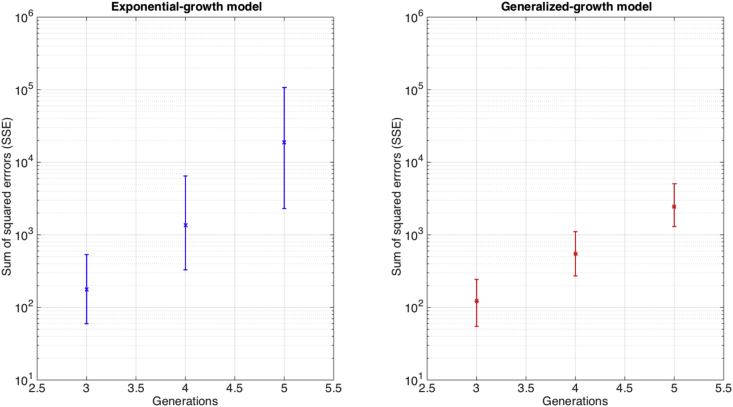
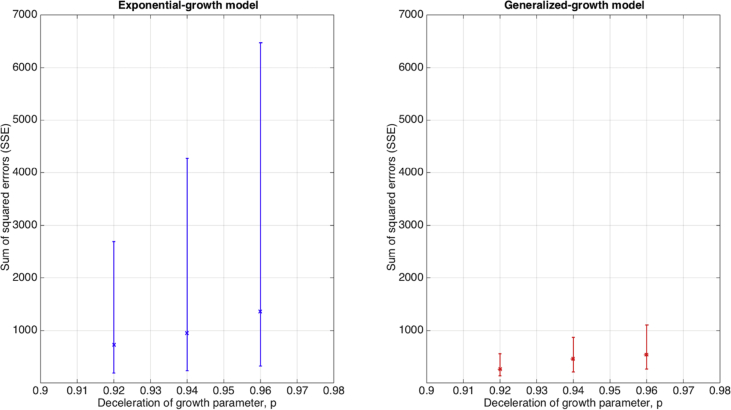
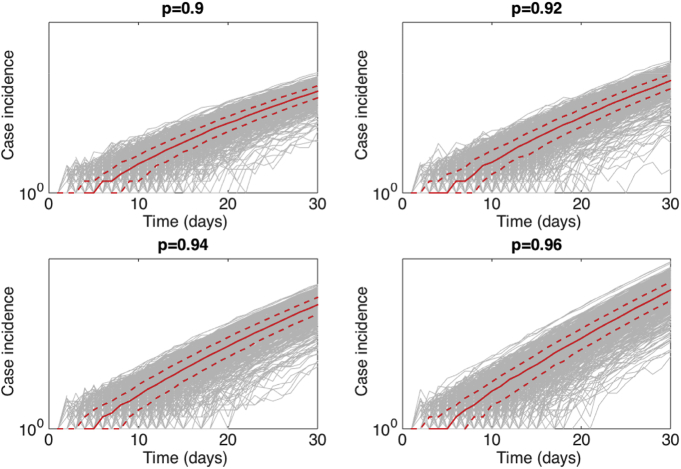
The increasing use of mathematical models for epidemic forecasting has highlighted the importance of designing models that capture the baseline transmission characteristics in order to generate reliable epidemic forecasts. Improved models for epidemic forecasting could be achieved by identifying signature features of epidemic growth, which could inform the design of models of disease spread and reveal important characteristics of the transmission process. In particular, it is often taken for granted that the early growth phase of different growth processes in nature follow early exponential growth dynamics. In the context of infectious disease spread, this assumption is often convenient to describe a transmission process with mass action kinetics using differential equations and generate analytic expressions and estimates of the reproduction number. In this article, we carry out a simulation study to illustrate the impact of incorrectly assuming an exponential-growth model to characterize the early phase (e.g., 3-5 disease generation intervals) of an infectious disease outbreak that follows near-exponential growth dynamics. Specifically, we assess the impact on: 1) goodness of fit, 2) bias on the growth parameter, and 3) the impact on short-term epidemic forecasts. Designing transmission models and statistical approaches that more flexibly capture the profile of epidemic growth could lead to enhanced model fit, improved estimates of key transmission parameters, and more realistic epidemic forecasts.

摘要

数学模型在疫情预测中的应用日益广泛,这凸显了设计能够捕捉基线传播特征的模型以生成可靠疫情预测的重要性。通过识别疫情增长的标志性特征,可以改进疫情预测模型,这些特征可为疾病传播模型的设计提供信息,并揭示传播过程的重要特征。特别是,人们常常理所当然地认为,自然界中不同增长过程的早期增长阶段遵循早期指数增长动态。在传染病传播的背景下,这个假设通常便于使用微分方程来描述具有质量作用动力学的传播过程,并生成繁殖数的解析表达式和估计值。在本文中,我们进行了一项模拟研究,以说明错误地假设指数增长模型来表征遵循近似指数增长动态的传染病爆发早期阶段(例如,3 - 5个疾病代间隔)的影响。具体而言,我们评估对以下方面的影响:1)拟合优度,2)增长参数的偏差,以及3)对短期疫情预测的影响。设计能够更灵活地捕捉疫情增长特征的传播模型和统计方法,可能会提高模型拟合度,改进关键传播参数的估计,并做出更现实的疫情预测。
https://cdn.ncbi.nlm.nih.gov/pmc/blobs/2a4a/5963312/58f761d9cfb1/gr6.jpg
https://cdn.ncbi.nlm.nih.gov/pmc/blobs/2a4a/5963312/a680f88fc8f3/gr1.jpg
https://cdn.ncbi.nlm.nih.gov/pmc/blobs/2a4a/5963312/e067f2b1d625/gr2.jpg
https://cdn.ncbi.nlm.nih.gov/pmc/blobs/2a4a/5963312/709b105a76bf/gr3.jpg
https://cdn.ncbi.nlm.nih.gov/pmc/blobs/2a4a/5963312/c7c30ac46bd1/gr4.jpg
https://cdn.ncbi.nlm.nih.gov/pmc/blobs/2a4a/5963312/999415b299e9/gr5.jpg
https://cdn.ncbi.nlm.nih.gov/pmc/blobs/2a4a/5963312/58f761d9cfb1/gr6.jpg
https://cdn.ncbi.nlm.nih.gov/pmc/blobs/2a4a/5963312/a680f88fc8f3/gr1.jpg
https://cdn.ncbi.nlm.nih.gov/pmc/blobs/2a4a/5963312/e067f2b1d625/gr2.jpg
https://cdn.ncbi.nlm.nih.gov/pmc/blobs/2a4a/5963312/709b105a76bf/gr3.jpg
https://cdn.ncbi.nlm.nih.gov/pmc/blobs/2a4a/5963312/c7c30ac46bd1/gr4.jpg
https://cdn.ncbi.nlm.nih.gov/pmc/blobs/2a4a/5963312/999415b299e9/gr5.jpg
https://cdn.ncbi.nlm.nih.gov/pmc/blobs/2a4a/5963312/58f761d9cfb1/gr6.jpg

相似文献

1
Is it growing exponentially fast? -- Impact of assuming exponential growth for characterizing and forecasting epidemics with initial near-exponential growth dynamics.它的增长速度是呈指数级快速增长吗?——对于具有初始近指数增长动态的流行病,假设指数增长对其特征描述和预测的影响。
Infect Dis Model. 2016 Oct;1(1):71-78. doi: 10.1016/j.idm.2016.07.004. Epub 2016 Sep 3.
2
Mathematical models to characterize early epidemic growth: A review.用于描述早期疫情增长的数学模型:综述
Phys Life Rev. 2016 Sep;18:66-97. doi: 10.1016/j.plrev.2016.07.005. Epub 2016 Jul 11.
3
Forecasting the 2001 Foot-and-Mouth Disease Epidemic in the UK.预测2001年英国口蹄疫疫情。
Ecohealth. 2018 Jun;15(2):338-347. doi: 10.1007/s10393-017-1293-2. Epub 2017 Dec 13.
4
Using phenomenological models for forecasting the 2015 Ebola challenge.运用现象学模型预测 2015 年埃博拉病毒挑战
Epidemics. 2018 Mar;22:62-70. doi: 10.1016/j.epidem.2016.11.002. Epub 2016 Nov 19.
5
Simple multi-scale modeling of the transmission dynamics of the 1905 plague epidemic in Bombay.孟买 1905 年鼠疫疫情传播动力学的简单多尺度建模。
Math Biosci. 2018 Jul;301:83-92. doi: 10.1016/j.mbs.2018.04.003. Epub 2018 Apr 16.
6
Modeling sub-exponential epidemic growth dynamics through unobserved individual heterogeneity: a frailty model approach.通过未观察到的个体异质性对亚指数流行增长动态进行建模:一种脆弱模型方法。
Math Biosci Eng. 2024 Oct 10;21(10):7278-7296. doi: 10.3934/mbe.2024321.
7
A generalized-growth model to characterize the early ascending phase of infectious disease outbreaks.一种用于描述传染病暴发早期上升阶段的广义增长模型。
Epidemics. 2016 Jun;15:27-37. doi: 10.1016/j.epidem.2016.01.002. Epub 2016 Feb 1.
8
Using Phenomenological Models to Characterize Transmissibility and Forecast Patterns and Final Burden of Zika Epidemics.使用现象学模型来表征寨卡疫情的传播性、预测模式及最终负担。
PLoS Curr. 2016 May 31;8:ecurrents.outbreaks.f14b2217c902f453d9320a43a35b9583. doi: 10.1371/currents.outbreaks.f14b2217c902f453d9320a43a35b9583.
9
An ensemble -sub-epidemic modeling framework for short-term forecasting epidemic trajectories: Application to the COVID-19 pandemic in the USA.一种用于短期预测疫情轨迹的集成子疫情建模框架:在美国新冠肺炎疫情中的应用。
medRxiv. 2022 Jun 21:2022.06.19.22276608. doi: 10.1101/2022.06.19.22276608.
10
Perspectives on model forecasts of the 2014-2015 Ebola epidemic in West Africa: lessons and the way forward.对2014 - 2015年西非埃博拉疫情模型预测的展望:经验教训与未来方向。
BMC Med. 2017 Mar 1;15(1):42. doi: 10.1186/s12916-017-0811-y.

引用本文的文献

1
A conceptual and computational framework for modeling the complex, adaptive dynamics of epidemics: The case of the SARS-CoV-2 pandemic in Mexico.用于模拟流行病复杂适应性动态的概念和计算框架:以墨西哥的SARS-CoV-2大流行为例。
PLoS One. 2025 May 8;20(5):e0323473. doi: 10.1371/journal.pone.0323473. eCollection 2025.
2
Exponential Growth Bias of Infectious Diseases: Protocol for a Systematic Review.传染病的指数增长偏差:系统评价方案
JMIR Res Protoc. 2022 Oct 24;11(10):e37441. doi: 10.2196/37441.
3
Transmission Potential of the Omicron Variant of Severe Acute Respiratory Syndrome Coronavirus 2 in South Korea, 25 November 2021-8 January 2022.

本文引用的文献

1
Characterizing the reproduction number of epidemics with early subexponential growth dynamics.刻画具有早期次指数增长动态的流行病的再生数。
J R Soc Interface. 2016 Oct;13(123). doi: 10.1098/rsif.2016.0659.
2
Mathematical models to characterize early epidemic growth: A review.用于描述早期疫情增长的数学模型:综述
Phys Life Rev. 2016 Sep;18:66-97. doi: 10.1016/j.plrev.2016.07.005. Epub 2016 Jul 11.
3
Using Phenomenological Models to Characterize Transmissibility and Forecast Patterns and Final Burden of Zika Epidemics.使用现象学模型来表征寨卡疫情的传播性、预测模式及最终负担。
2021年11月25日至2022年1月8日韩国严重急性呼吸综合征冠状病毒2奥密克戎变异株的传播潜力
Open Forum Infect Dis. 2022 May 13;9(7):ofac248. doi: 10.1093/ofid/ofac248. eCollection 2022 Jul.
4
The impact of 2020 French municipal elections on the spread of COVID-19.2020年法国市政选举对新冠疫情传播的影响。
J Popul Econ. 2022;35(3):963-988. doi: 10.1007/s00148-022-00887-0. Epub 2022 Mar 24.
5
Measuring differences between phenomenological growth models applied to epidemiology.测量应用于流行病学的现象学增长模型之间的差异。
Math Biosci. 2021 Apr;334:108558. doi: 10.1016/j.mbs.2021.108558. Epub 2021 Feb 8.
6
On the use of growth models to understand epidemic outbreaks with application to COVID-19 data.利用生长模型理解传染病暴发的应用——以 COVID-19 数据为例。
PLoS One. 2020 Oct 20;15(10):e0240578. doi: 10.1371/journal.pone.0240578. eCollection 2020.
7
Predicting the number of reported and unreported cases for the COVID-19 epidemics in China, South Korea, Italy, France, Germany and United Kingdom.预测中国、韩国、意大利、法国、德国和英国的 COVID-19 疫情报告病例和未报告病例数量。
J Theor Biol. 2021 Jan 21;509:110501. doi: 10.1016/j.jtbi.2020.110501. Epub 2020 Sep 25.
8
Inferring generation-interval distributions from contact-tracing data.从接触者追踪数据推断代间隔分布。
J R Soc Interface. 2020 Jun;17(167):20190719. doi: 10.1098/rsif.2019.0719. Epub 2020 Jun 24.
9
Reproduction numbers of infectious disease models.传染病模型的繁殖数。
Infect Dis Model. 2017 Jun 29;2(3):288-303. doi: 10.1016/j.idm.2017.06.002. eCollection 2017 Aug.
10
Fitting dynamic models to epidemic outbreaks with quantified uncertainty: A Primer for parameter uncertainty, identifiability, and forecasts.用量化不确定性将动态模型拟合到疫情爆发:参数不确定性、可识别性和预测入门
Infect Dis Model. 2017 Aug;2(3):379-398. doi: 10.1016/j.idm.2017.08.001. Epub 2017 Aug 12.
PLoS Curr. 2016 May 31;8:ecurrents.outbreaks.f14b2217c902f453d9320a43a35b9583. doi: 10.1371/currents.outbreaks.f14b2217c902f453d9320a43a35b9583.
4
A generalized-growth model to characterize the early ascending phase of infectious disease outbreaks.一种用于描述传染病暴发早期上升阶段的广义增长模型。
Epidemics. 2016 Jun;15:27-37. doi: 10.1016/j.epidem.2016.01.002. Epub 2016 Feb 1.
5
Modeling household and community transmission of Ebola virus disease: Epidemic growth, spatial dynamics and insights for epidemic control.埃博拉病毒病家庭和社区传播建模:流行增长、空间动态及疫情控制见解
Virulence. 2016;7(2):163-73. doi: 10.1080/21505594.2015.1076613. Epub 2015 Aug 20.
6
A three-scale network model for the early growth dynamics of 2014 west Africa ebola epidemic.2014年西非埃博拉疫情早期增长动态的三尺度网络模型
PLoS Curr. 2014 Nov 13;6:ecurrents.outbreaks.c6efe8274dc55274f05cbcb62bbe6070. doi: 10.1371/currents.outbreaks.c6efe8274dc55274f05cbcb62bbe6070.
7
Spatiotemporal spread of the 2014 outbreak of Ebola virus disease in Liberia and the effectiveness of non-pharmaceutical interventions: a computational modelling analysis.2014 年利比里亚埃博拉病毒病疫情的时空传播及非药物干预措施的效果:基于计算模型的分析。
Lancet Infect Dis. 2015 Feb;15(2):204-11. doi: 10.1016/S1473-3099(14)71074-6. Epub 2015 Jan 7.
8
An IDEA for short term outbreak projection: nearcasting using the basic reproduction number.短期疫情爆发预测的思路:利用基本再生数进行临近预测。
PLoS One. 2013 Dec 31;8(12):e83622. doi: 10.1371/journal.pone.0083622. eCollection 2013.
9
Richards model revisited: validation by and application to infection dynamics.重温 Richards 模型:通过感染动力学验证和应用。
J Theor Biol. 2012 Nov 21;313:12-9. doi: 10.1016/j.jtbi.2012.07.024. Epub 2012 Aug 7.
10
Pandemic influenza A (H1N1) during winter influenza season in the southern hemisphere.南半球冬季流感季的甲型 H1N1 流感大流行。
Influenza Other Respir Viruses. 2010 Jul;4(4):187-97. doi: 10.1111/j.1750-2659.2010.00147.x.