Tanaka Toshikazu, Hatakeyama Shingo, Yamamoto Hayato, Narita Takuma, Hamano Itsuto, Matsumoto Teppei, Soma Osamu, Tobisawa Yuki, Yoneyama Tohru, Yoneyama Takahiro, Hashimoto Yasuhiro, Koie Takuya, Takahashi Ippei, Nakaji Shigeyuki, Terayama Yuriko, Funyu Tomihisa, Ohyama Chikara
Department of Urology, Hirosaki University Graduate School of Medicine, 5 Zaifu-chou, Hirosaki, 036-8562, Japan.
Department of Advanced Transplant and Regenerative Medicine, Hirosaki University Graduate School of Medicine, Hirosaki, Japan.
BMC Urol. 2017 Apr 4;17(1):25. doi: 10.1186/s12894-017-0218-2.
The aim of the present study is to investigate the clinical relevance of aortic calcification in urolithiasis patients.
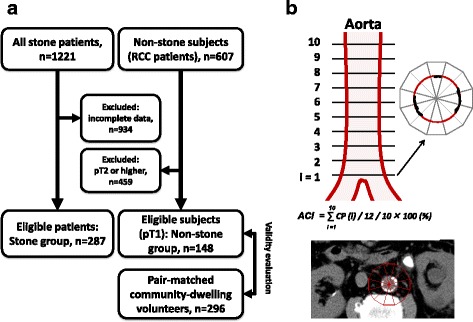
Between January 2010 and September 2014, 1221 patients with urolithiasis were treated in Oyokyo Kidney Research Institute and Hirosaki University Hospital. Among these, 287 patients (Stone group) on whom adequate data were available were included in this retrospective study. We also selected 148 subjects with early stage (pT1N0M0) renal cell carcinoma from 607 renal cell carcinoma patients who underwent radical nephrectomy at Hirosaki University Hospital (Non-stone group) as control subjects. Validity of the Non-stone group was evaluated by comparison with pair-matched 296 volunteers from 1166 subjects who participated in the Iwaki Health Promotion Project in 2014. Thereafter, age, body mass index, aortic calcification index (ACI), renal function, serum uric acid concentrations, and comorbidities (diabetes, hypertension, or cardiovascular disease) were compared between the Non-stone and Stone groups. Independent factors for higher ACI and impaired renal function were assessed using multivariate logistic regression analysis.
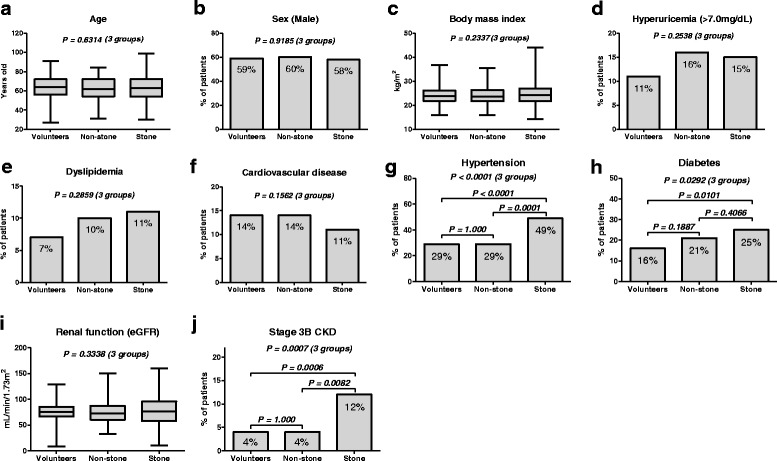
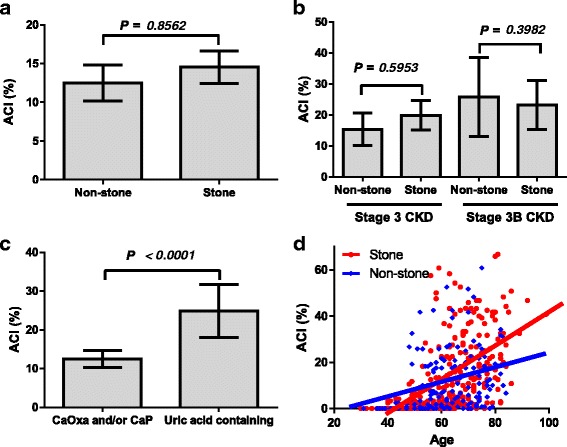
We confirmed relevance of Non-stone group patients as a control subject by comparing the pair-matched community-dwelling volunteers. Backgrounds of patients between the Non-stone and Stone groups were not significantly different except for the presence of hypertension in the Stone group. ACI was not significantly high in the Stone group compared with the Non-stone group. However, age-adjusted ACI was greater in the Stone group than the Non-stone group. Among urolithiasis patients, ACI was significantly higher in uric acid containing stone patients. The number of patients with stage 3B chronic kidney disease (CKD) was significantly higher in the Stone group than in the Non-stone group (12% vs. 4%, P = 0.008). Multivariate logistic regression analysis showed higher aortic calcification index (>13%), and being a stone former were independent factors for stage 3B CKD at the time of diagnosis.
Aortic calcification and being a stone former had harmful influence on renal function. This study was registered as a clinical trial: UMIN: UMIN000022962.
本研究旨在探讨尿路结石患者主动脉钙化的临床相关性。
2010年1月至2014年9月期间,1221例尿路结石患者在大东京肾脏研究所和弘前大学医院接受治疗。其中,287例(结石组)有足够可用数据的患者被纳入这项回顾性研究。我们还从弘前大学医院接受根治性肾切除术的607例肾细胞癌患者中选择了148例早期(pT1N0M0)肾细胞癌患者作为对照组(非结石组)。通过与2014年参加磐城健康促进项目的1166名受试者中配对匹配的296名志愿者进行比较,评估非结石组的有效性。此后,比较非结石组和结石组之间的年龄、体重指数、主动脉钙化指数(ACI)、肾功能、血清尿酸浓度和合并症(糖尿病、高血压或心血管疾病)。使用多因素逻辑回归分析评估ACI升高和肾功能受损的独立因素。
通过比较配对匹配的社区居住志愿者,我们证实了非结石组患者作为对照的相关性。除结石组存在高血压外,非结石组和结石组患者的背景无显著差异。与非结石组相比,结石组的ACI没有显著升高。然而,结石组的年龄调整后ACI高于非结石组。在尿路结石患者中,含尿酸结石患者的ACI显著更高。结石组3B期慢性肾脏病(CKD)患者的数量显著高于非结石组(12%对4%,P = 0.008)。多因素逻辑回归分析显示,较高的主动脉钙化指数(>13%)和结石形成者是诊断时3B期CKD的独立因素。
主动脉钙化和结石形成对肾功能有有害影响。本研究已注册为临床试验:UMIN:UMIN000022962。