Barel Monique, Charbit Alain
Sorbonne Paris Cité, Bâtiment Leriche, Université Paris DescartesParis, France; Institut National de la Santé et de la Recherche Médicale, Institut Necker-Enfants Malades, INSERM U1151 -Team 11, Pathogenesis of Systemic InfectionsParis, France; Centre National de la Recherche Scientifique, UMR8253Paris, France.
Front Cell Infect Microbiol. 2017 Mar 21;7:71. doi: 10.3389/fcimb.2017.00071. eCollection 2017.
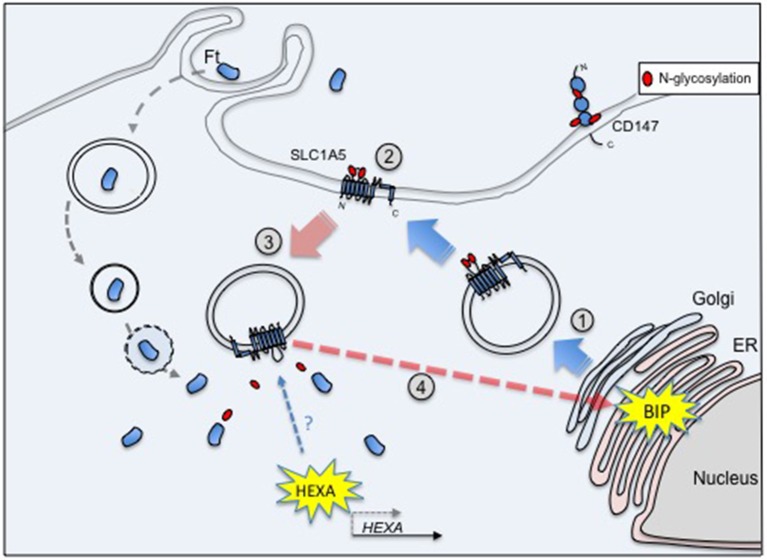
is able to invade, survive and replicate inside a variety of cell types. However, preferentially enters host macrophages where it rapidly escapes to the cytosol to avoid phagosomal stresses and to multiply to high numbers. We previously showed that human monocyte infection by LVS triggered deglycosylation of the glutamine transporter SLC1A5. However, this deglycosylation, specifically induced by infection, was not restricted to SLC1A5, suggesting that host protein deglycosylation processes in general might contribute to intracellular bacterial adaptation. Indeed, we later found that infection modulated the transcription of numerous glycosidase and glycosyltransferase genes in human macrophages and analysis of cell extracts revealed an important increase of N and O-protein glycosylation. In eukaryotic cells, glycosylation has significant effects on protein folding, conformation, distribution, stability, and activity and dysfunction of protein glycosylation may lead to development of diseases like cancer and pathogenesis of infectious diseases. Pathogenic bacteria have also evolved dedicated glycosylation machineries and have notably been shown to use these glycoconjugates as ligands to specifically interact with the host. In this review, we will focus on and summarize our current understanding of the importance of these post-translational modifications on its intracellular niche adaptation.
能够在多种细胞类型中侵袭、存活并复制。然而,它优先进入宿主巨噬细胞,在其中迅速逃到细胞质中以避免吞噬体应激并大量繁殖。我们之前表明,LVS感染人类单核细胞会引发谷氨酰胺转运蛋白SLC1A5的去糖基化。然而,这种由感染特异性诱导的去糖基化并不局限于SLC1A5,这表明一般而言宿主蛋白去糖基化过程可能有助于细胞内细菌的适应。事实上,我们后来发现感染会调节人类巨噬细胞中众多糖苷酶和糖基转移酶基因的转录,并且对细胞提取物的分析显示N和O蛋白糖基化有显著增加。在真核细胞中,糖基化对蛋白质折叠、构象、分布、稳定性和活性有显著影响,蛋白质糖基化功能障碍可能导致癌症等疾病的发展以及传染病的发病机制。致病细菌也进化出了专门的糖基化机制,并且特别显示出利用这些糖缀合物作为配体与宿主特异性相互作用。在这篇综述中,我们将重点关注并总结我们目前对这些翻译后修饰对其细胞内生态位适应重要性的理解。