Damorim Igor Rodrigues, Santos Tony Meireles, Barros Gustavo Willames Pimentel, Carvalho Paulo Roberto Cavalcanti
Programa de Pós-Graduação em Educação da Física da Universidade Federal de Pernambuco - UFPE, Recife, PE - Brazil.
Arq Bras Cardiol. 2017 Apr;108(4):323-330. doi: 10.5935/abc.20170029. Epub 2017 Mar 30.
Resistance and aerobic training are recommended as an adjunctive treatment for hypertension. However, the number of sessions required until the hypotensive effect of the exercise has stabilized has not been clearly established.
To establish the adaptive kinetics of the blood pressure (BP) responses as a function of time and type of training in hypertensive patients.
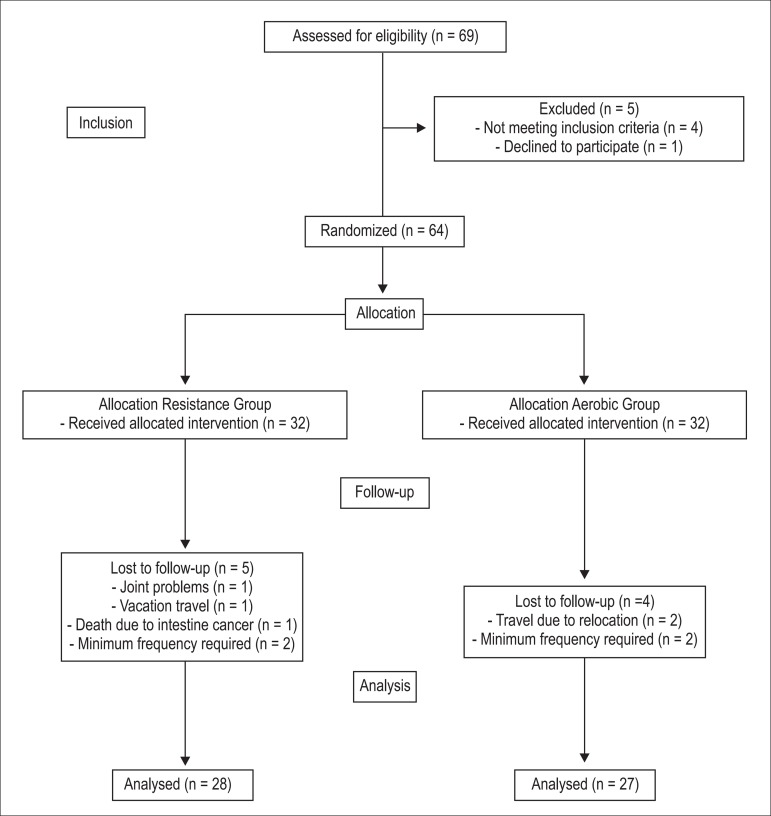
We recruited 69 patients with a mean age of 63.4 ± 2.1 years, randomized into one group of resistance training (n = 32) and another of aerobic training (n = 32). Anthropometric measurements were obtained, and one repetition maximum (1RM) testing was performed. BP was measured before each training session with a digital BP arm monitor. The 50 training sessions were categorized into quintiles. To compare the effect of BP reduction with both training methods, we used two-way analysis of covariance (ANCOVA) adjusted for the BP values obtained before the interventions. The differences between the moments were established by one-way analysis of variance (ANOVA).
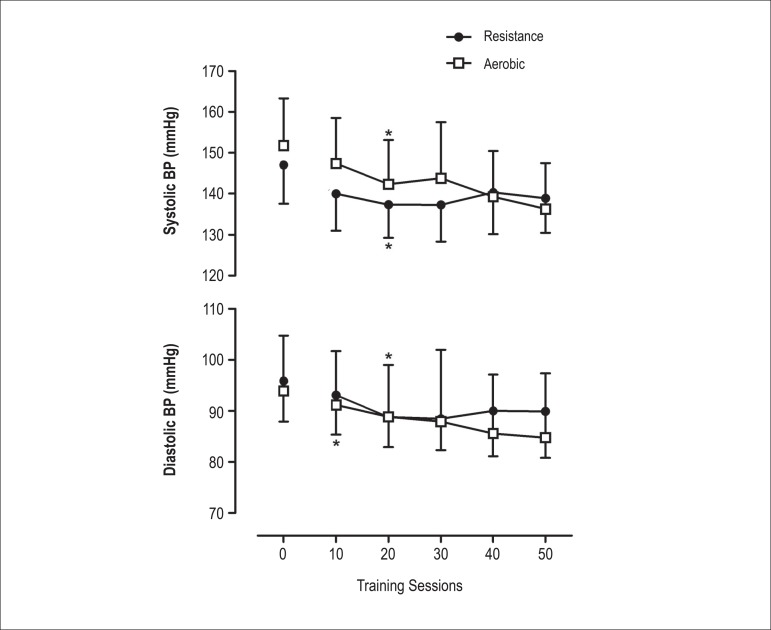
The reductions in systolic (SBP) and diastolic BP (DBP) were 6.9 mmHg and 5.3 mmHg, respectively, with resistance training and 16.5 mmHg and 11.6 mmHg, respectively, with aerobic training. The kinetics of the hypotensive response of the SBP showed significant reductions until the 20th session in both groups. Stabilization of the DBP occurred in the 20th session of resistance training and in the 10th session of aerobic training.
A total of 20 sessions of resistance or aerobic training are required to achieve the maximum benefits of BP reduction. The methods investigated yielded distinct adaptive kinetic patterns along the 50 sessions.
抗阻训练和有氧训练被推荐作为高血压的辅助治疗方法。然而,运动降压效果稳定之前所需的训练次数尚未明确确定。
确定高血压患者血压(BP)反应随时间和训练类型变化的适应性动力学。
我们招募了69名平均年龄为63.4±2.1岁的患者,随机分为抗阻训练组(n = 32)和有氧训练组(n = 32)。进行人体测量,并进行一次重复最大值(1RM)测试。每次训练前使用数字臂式血压监测仪测量血压。50次训练分为五个五分位数。为比较两种训练方法的降压效果,我们使用双向协方差分析(ANCOVA),并对干预前获得的血压值进行校正。通过单向方差分析(ANOVA)确定各时间点之间的差异。
抗阻训练使收缩压(SBP)和舒张压(DBP)分别降低6.9 mmHg和5.3 mmHg,有氧训练使收缩压和舒张压分别降低16.5 mmHg和11.6 mmHg。两组SBP的降压反应动力学均显示直到第20次训练时才有显著降低。抗阻训练组DBP在第20次训练时趋于稳定,有氧训练组在第10次训练时趋于稳定。
总共需要进行20次抗阻训练或有氧训练才能实现最大程度的血压降低。所研究的方法在50次训练中呈现出不同的适应性动力学模式。