Department of Chemistry and Chemical Biology, Cornell University , Ithaca, New York 14853, United States.
Department of Chemistry, Northwestern University , Evanston, Illinois 60208, United States.
J Am Chem Soc. 2017 Apr 26;139(16):5680-5683. doi: 10.1021/jacs.7b01712. Epub 2017 Apr 13.
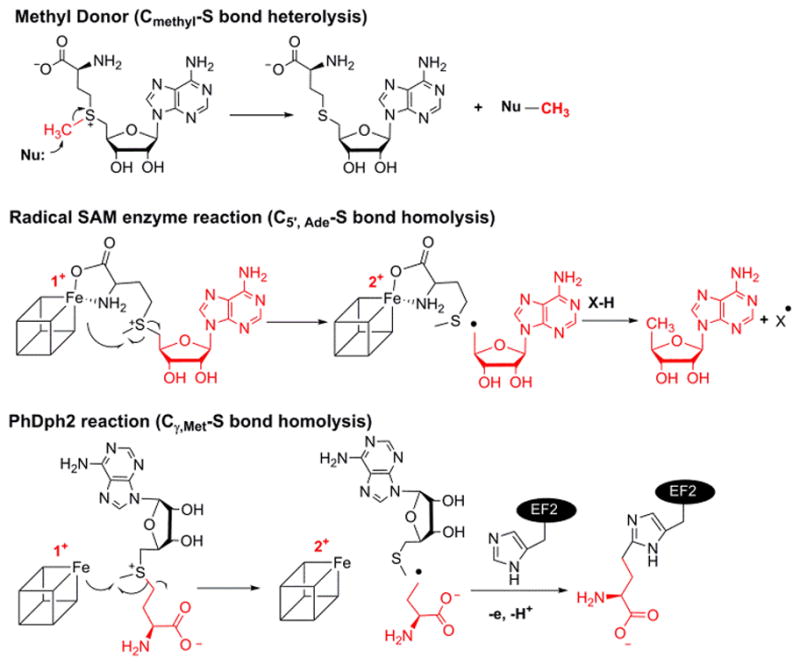
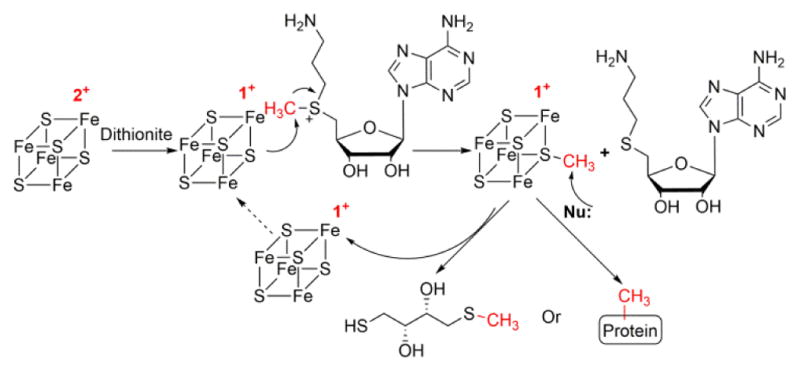
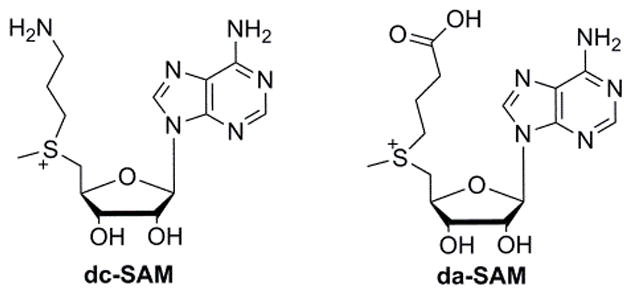
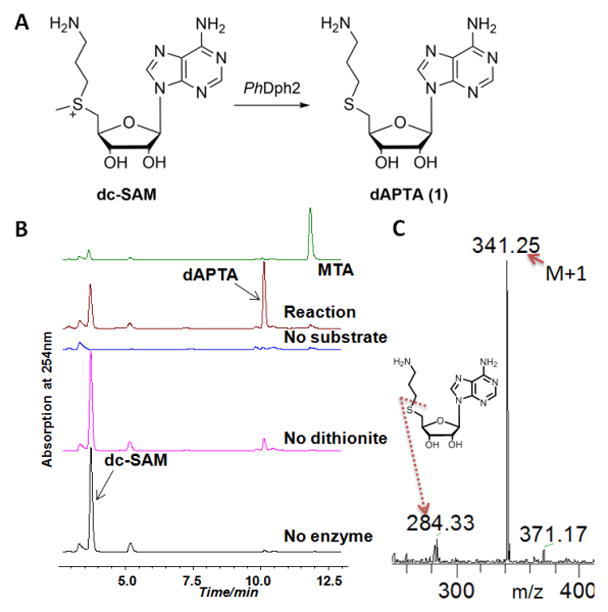
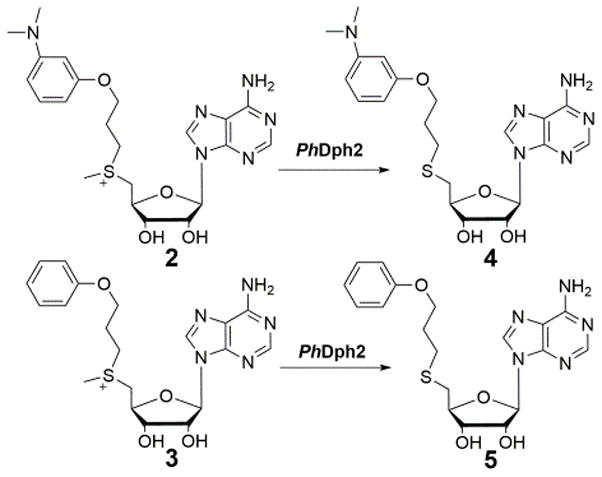
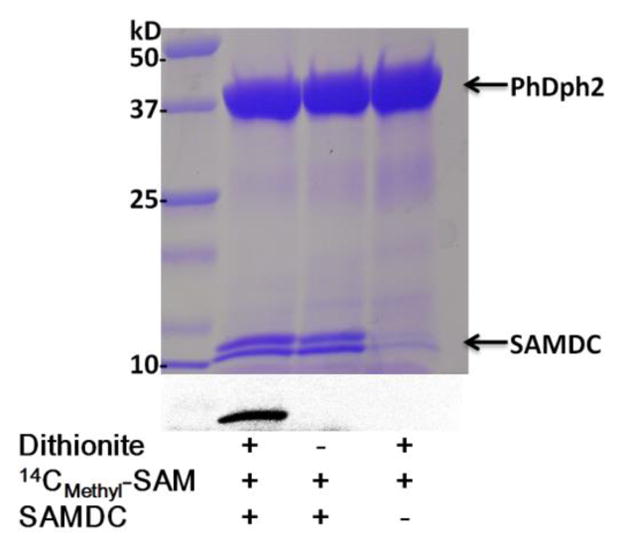
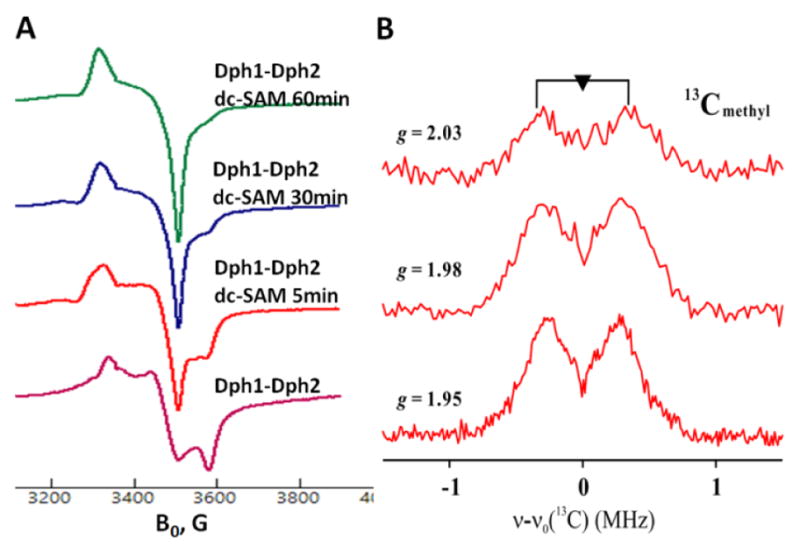
S-Adenosylmethionine (SAM) has a sulfonium ion with three distinct C-S bonds. Conventional radical SAM enzymes use a [4Fe-4S] cluster to cleave homolytically the C-S bond of SAM to generate a 5'-deoxyadenosyl radical, which catalyzes various downstream chemical reactions. Radical SAM enzymes involved in diphthamide biosynthesis, such as Pyrococcus horikoshii Dph2 (PhDph2) and yeast Dph1-Dph2 instead cleave the C-S bond of methionine to generate a 3-amino-3-carboxylpropyl radical. We here show radical SAM enzymes can be tuned to cleave the third C-S bond to the sulfonium sulfur by changing the structure of SAM. With a decarboxyl SAM analogue (dc-SAM), PhDph2 cleaves the C-S bond, forming 5'-deoxy-5'-(3-aminopropylthio) adenosine (dAPTA, 1). The methyl cleavage activity, like the cleavage of the other two C-S bonds, is dependent on the presence of a [4Fe-4S] cluster. Electron-nuclear double resonance and mass spectroscopy data suggests that mechanistically one of the S atoms in the [4Fe-4S] cluster captures the methyl group from dc-SAM, forming a distinct EPR-active intermediate, which can transfer the methyl group to nucleophiles such as dithiothreitol. This reveals the [4Fe-4S] cluster in a radical SAM enzyme can be tuned to cleave any one of the three bonds to the sulfonium sulfur of SAM or analogues, and is the first demonstration a radical SAM enzyme could switch from an Fe-based one electron transfer reaction to a S-based two electron transfer reaction in a substrate-dependent manner. This study provides an illustration of the versatile reactivity of Fe-S clusters.
S-腺苷甲硫氨酸(SAM)具有带有三个独特 C-S 键的锍离子。传统的自由基 SAM 酶使用 [4Fe-4S] 簇来均裂裂解 SAM 的 C-S 键,生成 5'-脱氧腺苷自由基,该自由基催化各种下游化学反应。涉及二氢喋呤生物合成的自由基 SAM 酶,如 Pyrococcus horikoshii Dph2(PhDph2)和酵母 Dph1-Dph2,而是裂解甲硫氨酸的 C-S 键,生成 3-氨基-3-羧基丙基自由基。我们在这里表明,通过改变 SAM 的结构,自由基 SAM 酶可以被调整为裂解与锍硫的第三个 C-S 键。使用脱羧基 SAM 类似物(dc-SAM),PhDph2 裂解 C-S 键,形成 5'-脱氧-5'-(3-氨基丙基硫代)腺苷(dAPTA,1)。与裂解其他两个 C-S 键一样,甲基裂解活性依赖于 [4Fe-4S] 簇的存在。电子-核双共振和质谱数据表明,从机制上讲,[4Fe-4S] 簇中的一个 S 原子捕获来自 dc-SAM 的甲基,形成一种独特的 EPR 活性中间体,该中间体可以将甲基转移给亲核试剂,如二硫苏糖醇。这表明自由基 SAM 酶中的 [4Fe-4S] 簇可以被调整为裂解 SAM 或类似物中与锍硫的三个键中的任何一个,这是第一个证明自由基 SAM 酶可以在底物依赖性的方式下从基于 Fe 的单电子转移反应转换为基于 S 的双电子转移反应的例子。该研究提供了一个例证,说明了 Fe-S 簇的多功能反应性。