Ajabnoor Ghada M A, Bahijri Suhad, Shaik Noor Ahmad, Borai Anwar, Alamoudi Aliaa A, Al-Aama Jumana Y, Chrousos George P
Department of Clinical Biochemistry, Faculty of Medicine, King Abdulaziz University, Jeddah, Saudi Arabia.
Saudi Diabetes Study Research Group, King Fahd Medical Research Center, King Abdulaziz University, Jeddah, Saudi Arabia.
PLoS One. 2017 Apr 6;12(4):e0174342. doi: 10.1371/journal.pone.0174342. eCollection 2017.
During the fasting month of Ramadan, practicing Saudis develop severe disturbances in sleeping and feeding patterns. Concomitantly, cortisol circadian rhythm is abolished, diurnal cortisol levels are elevated and circulating levels of several adipokines are altered favouring insulin resistance.
To examine changes in the expression of CLOCK and glucocorticoid-controlled genes, such as DUSP1 and IL-1α in Saudi adults before and during Ramadan, and to investigate possible associations with selected cardiometabolic risk factors.
Healthy young volunteers (5 females, 18 males; mean age +SEM = 23.2 +1.2 years) were evaluated before Ramadan and two weeks into it. Blood samples were collected at 9 am (±1 hour) and twelve hours later for determination of serum lipid profile, high sensitivity CRP (hsCRP), and adiponectin. The expression of CLOCK, DUSP1 and IL-1α was evaluated in circulating leukocytes.
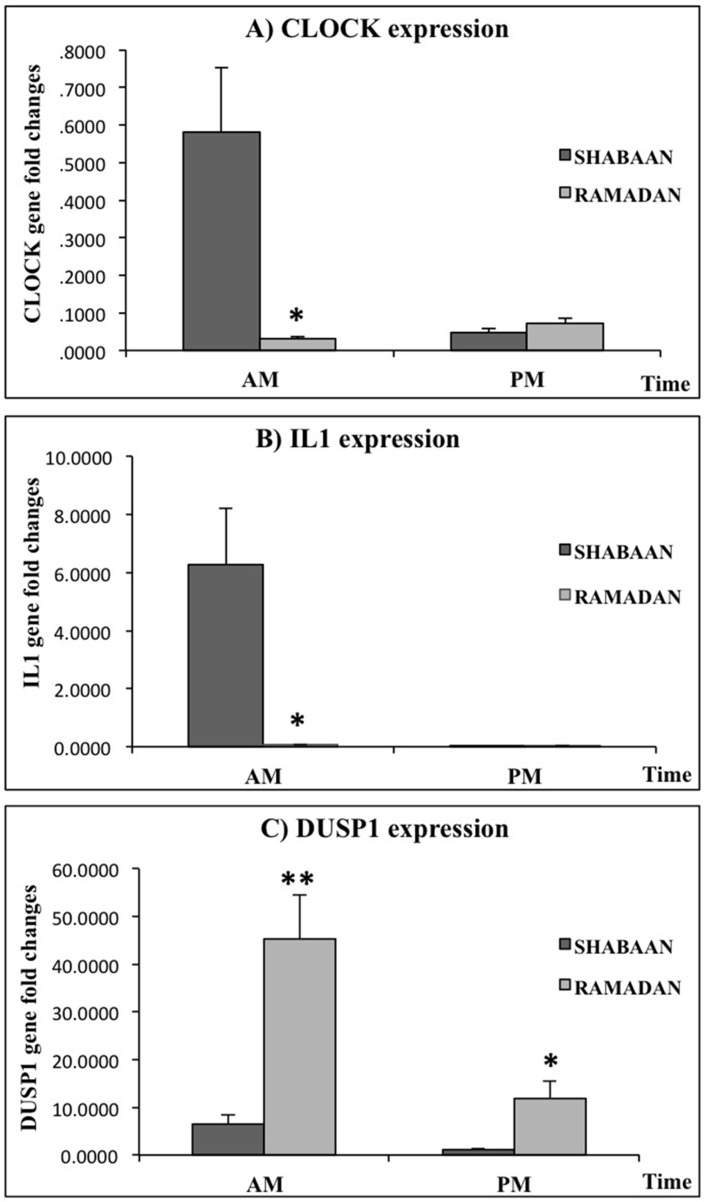
Mean levels of GGT and morning adiponectin decreased, while those of LDL-c/ HDL-c and atherogenic index (AI) increased significantly in Ramadan compared to Shabaan. There was no significant difference between morning and evening adiponectin during Ramadan, while the diurnal rhythm of hsCRP was lost. CLOCK gene expression mean was significantly higher in morning than in evening during Shabaan. Mean morning and evening DUSP1 mRNA levels showed significant increase during Ramadan compared to Shabaan, however, its diurnal rhythm was maintained. Morning IL-1α mRNA expression remained significantly higher than in the evening during Ramadan, but was markedly decreased compared to Shabaan.
Ramadan fasting in Saudi Arabia is associated with improvements in some cardiometabolic risk factors, such as circulating GGT and hsCRP and leukocyte expression of IL-1α mRNA, suggesting that intermittent fasting might have a beneficial component. These benefits may be offset by the previously reported dysregulation in the circadian rhythm, excess glucocorticoid levels and action, and insulin resistance, explaining increased prevalence of cardiometabolic disorders and type 2 diabetes mellitus.
在斋月禁食期间,沙特阿拉伯的穆斯林在睡眠和饮食模式上会出现严重紊乱。与此同时,皮质醇昼夜节律被打乱,日间皮质醇水平升高,多种脂肪因子的循环水平发生改变,从而导致胰岛素抵抗。
研究斋月前后沙特成年人中生物钟基因(CLOCK)以及糖皮质激素调控基因(如双特异性磷酸酶1基因(DUSP1)和白细胞介素-1α基因(IL-1α))表达的变化,并探讨其与选定的心脏代谢危险因素之间的可能关联。
选取健康年轻志愿者(5名女性,18名男性;平均年龄±标准误=23.2±1.2岁),在斋月前及斋月开始两周后进行评估。于上午9点(±1小时)及12小时后采集血样,测定血清脂质谱、高敏C反应蛋白(hsCRP)和脂联素水平。评估循环白细胞中CLOCK、DUSP1和IL-1α的表达。
与沙班月相比,斋月期间γ-谷氨酰转移酶(GGT)的平均水平和早晨脂联素水平下降,而低密度脂蛋白胆固醇/高密度脂蛋白胆固醇(LDL-c/HDL-c)和动脉粥样硬化指数(AI)显著升高。斋月期间早晨和晚上的脂联素水平无显著差异,而hsCRP的昼夜节律消失。在沙班月期间,CLOCK基因表达的平均值早晨显著高于晚上。与沙班月相比,斋月期间DUSP1 mRNA的平均早晨和晚上水平均显著升高,但其昼夜节律得以维持。斋月期间早晨IL-1α mRNA表达仍显著高于晚上,但与沙班月相比明显下降。
沙特阿拉伯的斋月禁食与一些心脏代谢危险因素的改善有关,如循环GGT和hsCRP以及白细胞中IL-1α mRNA的表达,这表明间歇性禁食可能具有有益作用。这些益处可能会被先前报道的昼夜节律失调、糖皮质激素水平过高及其作用以及胰岛素抵抗所抵消,这也解释了心脏代谢紊乱和2型糖尿病患病率增加的原因。